
[magazine kave=Lee Tae-rim Reporter]
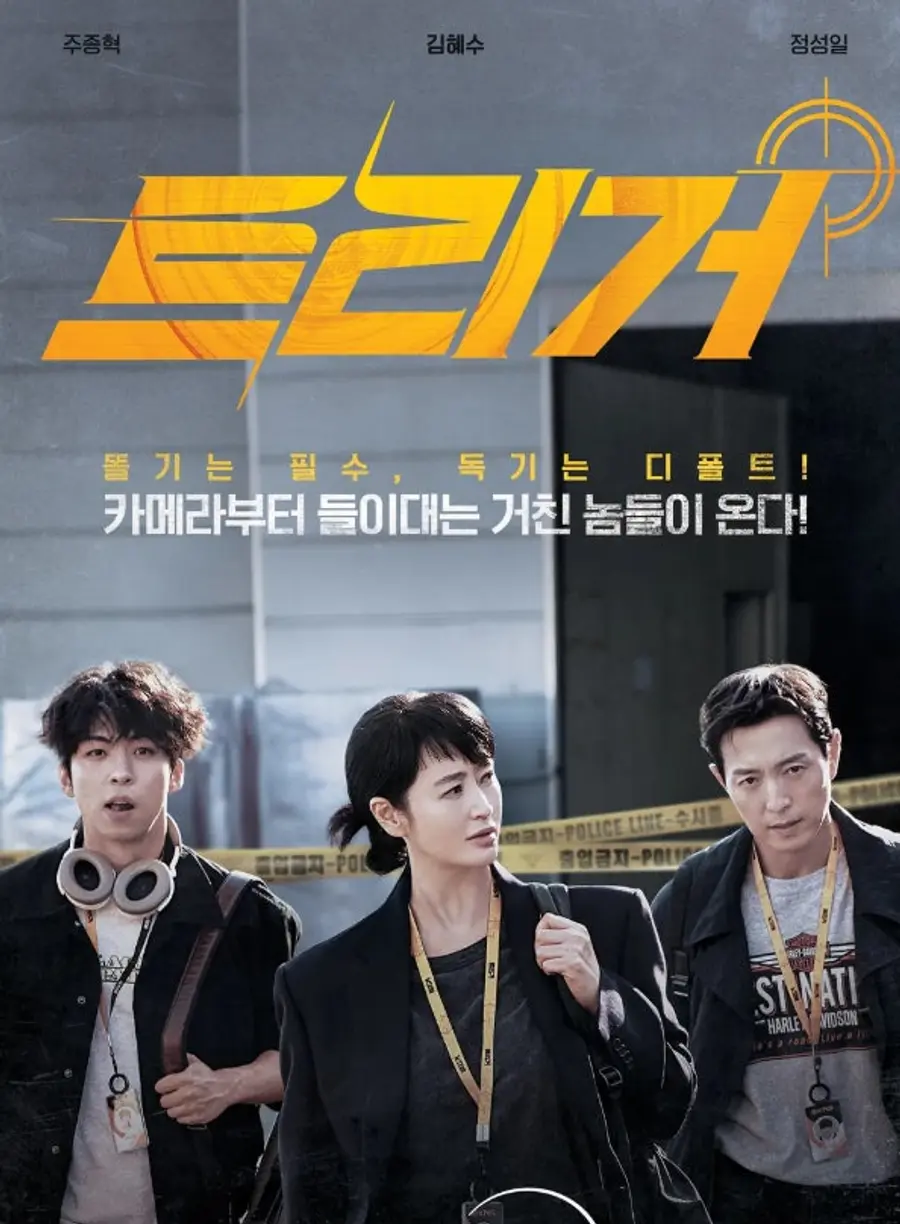
In the heart of Korea, which has long been believed to be the country farthest from guns, gunshots suddenly begin to ring out one day. The drama 'Trigger' is a work that boldly pushes this seemingly impossible imagination to the forefront. Just as a butcher shop suddenly appears in a paradise for vegetarians, unidentified illegal firearms flood into a society where gun possession is legally prohibited, and ordinary citizens find themselves standing in front of the trigger for their own reasons, setting the story in motion. At the center are two men. Detective Lee Do (Kim Nam-gil), who exclusively pursues illegal gun cases, and arms broker Moon Baek (Kim Young-kwang), who supplies firearms in the dark underground market and moves the game. One is trying to stop the guns, while the other is the one letting them flow, and the drama does not simply divide these two into good and evil but carries them together until the end. It’s an experiment that implants the relationship of Batman and Joker into Korean society.
The early episodes focus on vividly showing how this world is collapsing. A trivial dispute that ended in a street fight suddenly escalates into a shooting, and a worker protesting unfair dismissal at a quiet local factory disappears with a gun in hand. In classrooms, rumors circulate that a bullied student has obtained an unidentified firearm from the internet, and news of guns being found in delivery boxes breaks one after another. It’s as if we’ve entered an era where one can receive a gun just like ordering an appliance from Amazon. The screen lingers not on grand explosions or flashy shootouts, but on the frozen faces of people after the gunfire. It feels like watching the moment someone realizes, 'This country is no longer the place I knew.' Those faces are closer to confusion than fear. The bewilderment of a world where what was impossible yesterday has become reality today.
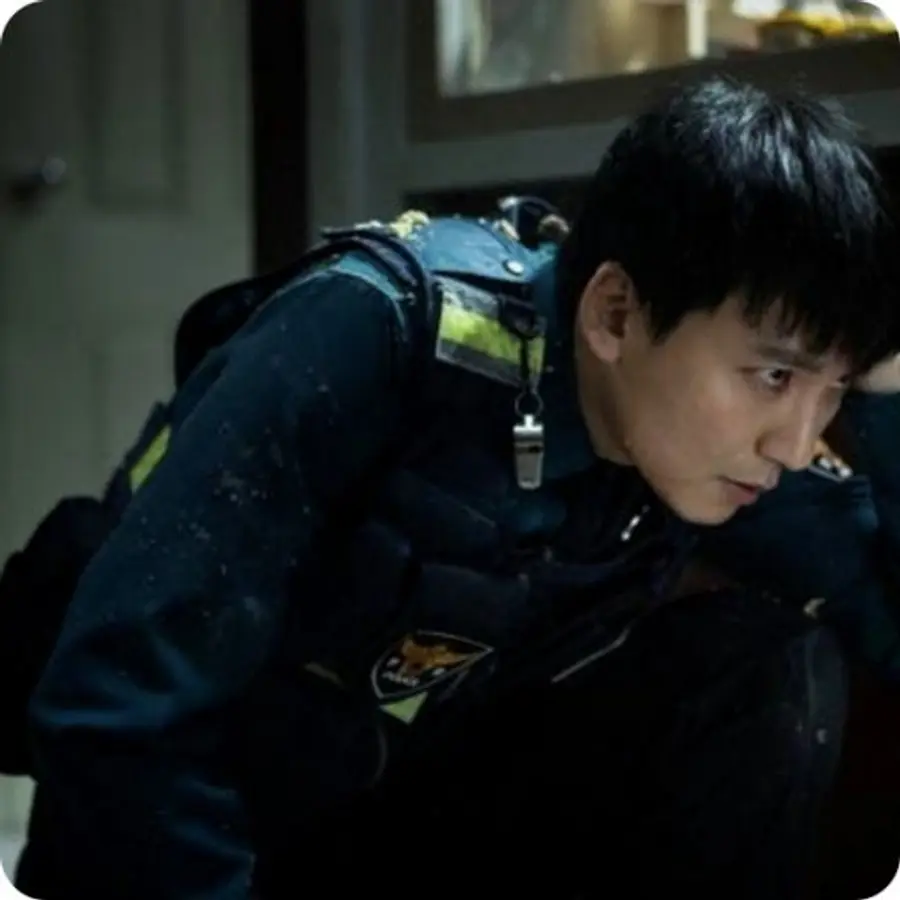
Lee Do is a character with a past of carrying out sniper missions in the military. He claims to be a 'soldier who performed a legitimate duty,' but he cannot easily shake off the memory that every time he pulls the trigger, someone’s life is completely erased. Even after becoming a detective, he tries to keep guns as far away as possible, but paradoxically, his desk is always covered with files of gun incidents. It’s a cruel irony, like an alcoholic living next to a bar. Whenever an incident occurs, Lee Do looks at people first, not the guns. He tries to read the victim's last movements, the gazes of those around, and any left behind notes or messages, obsessively focusing on why they chose guns. For him, a gun is not just a weapon; it is a manifestation of someone’s despair.
Moon Baek is a person who has lived with guns in a completely different way. He is cheerful and articulate, appearing to be someone who could fit in anywhere. It’s like seeing someone who would score full marks on a psychopath test, dressed in a suit and smiling. But whenever his hand moves, a gun is released somewhere in the city. He balances between criminal organizations and sends 'last resorts' to disgruntled individuals. For him, a gun is merely a trigger that unleashes the pent-up anger and injustice somewhere, a switch in the truest sense. From Moon Baek's perspective, the world is already sufficiently violent and absurd. He seems to adopt an attitude that he is merely adding another operating principle to it. Like Mephistopheles presenting a contract to Faust, he hands over metal chunks to the desperate.
How the Ecosystem of Anger Harms Society
The drama brings various facets of Korean society into each episode and combines them with the device of guns. A student exhausted by school violence holding a gun, parents who lost their son to an industrial accident facing a reality where no one is held accountable, and those worn down by domestic violence, dating violence, and hate crimes looking at guns as their last choice—all these familiar keywords are connected to guns and gain new meanings. It’s like a social experiment that takes today’s news headlines and inserts the variable of guns. Some hold guns to protect themselves, some for revenge, and others to prove their anger towards the world. Lee Do discovers a commonality in his investigations. Someone has meticulously created an environment for their anger to flow naturally into guns. Like a documentary observing wildlife by scattering food in the jungle, Moon Baek scatters guns in society and observes human nature.
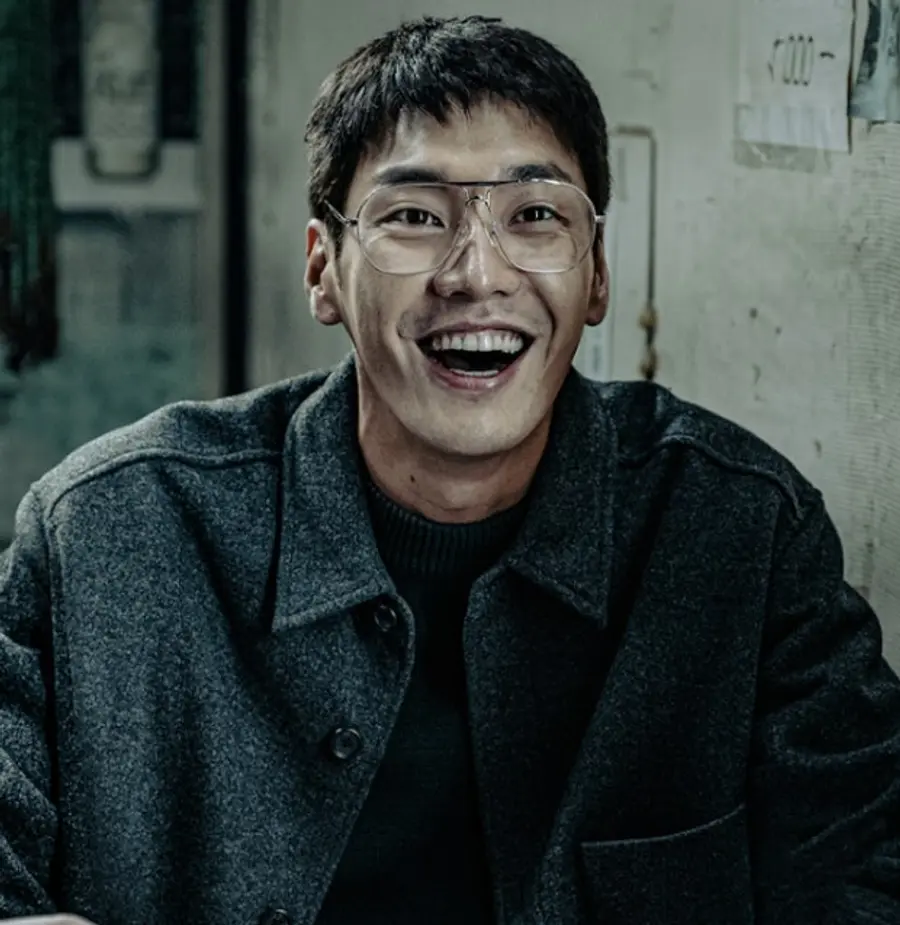
In this process, characters like fellow detective Jo Hyun-sik (Kim Won-hae), Oh Kyung-sook (Gil Hae-yeon) who fights on the streets after losing her son, youth Yoo Jeong-tae (Woo Ji-hyun) suffocating between employment and survival, and Park Gyu-jin (Park Yoon-ho) and Seo Yong-dong (Son Bo-seung) who are bullied at school take center stage in significant episodes. They are all characters that are difficult to call 'monsters,' yet it’s also ambiguous to say they are completely innocent victims. The process that leads them to hold guns is always intertwined with the contradictions of reality. Lee Do is placed in a position where he must view them as both criminals and victims, while Moon Baek skillfully exploits their anger to push forward his plans. Like a chess master moving pawns and knights, Moon Baek uses people’s despair as his pieces.
As the drama approaches its latter half, it reveals an increasingly larger picture. Why at this point, and why in this society, are so many guns coming in? Is it merely a turf war among smuggling organizations, or is it an experiment by someone trying to overturn the social structure? As Lee Do's military past and Moon Baek's personal history are gradually revealed, the conspiracy surrounding firearms takes on a more concrete face. However, the drama does not kindly explain everything until the end. At a certain point where the puzzle is somewhat assembled, it merely shows scenes of Lee Do and Moon Baek preparing for their final choices in their own ways. The remaining conclusion is left for each viewer to imagine in their minds. Like the spinning top in Inception, the final scene keeps spinning.
The Power of Forging Material into Narrative
'Trigger' is significant in that it does not treat its setting merely as a simple material but pushes it to the end. In most Korean genre works, guns often appear as the domain of foreign gangsters, special agents, or unrealistic villains. They are treated like props detached from reality, akin to a magic wand in a fantasy novel. However, this drama makes 'people who seem unlikely to hold guns' hold them and shows how much a person can waver in front of them. In the moment standing in front of the trigger, people tell themselves all sorts of things. Rationalizations and anger mix, such as, "I have something to say too," "The world should experience this at least once," and "This is self-defense." The drama gazes at that time for quite a long time, uncomfortably long. It dissects the moment when humans cross the line, frame by frame, like a traffic accident video played in slow motion.
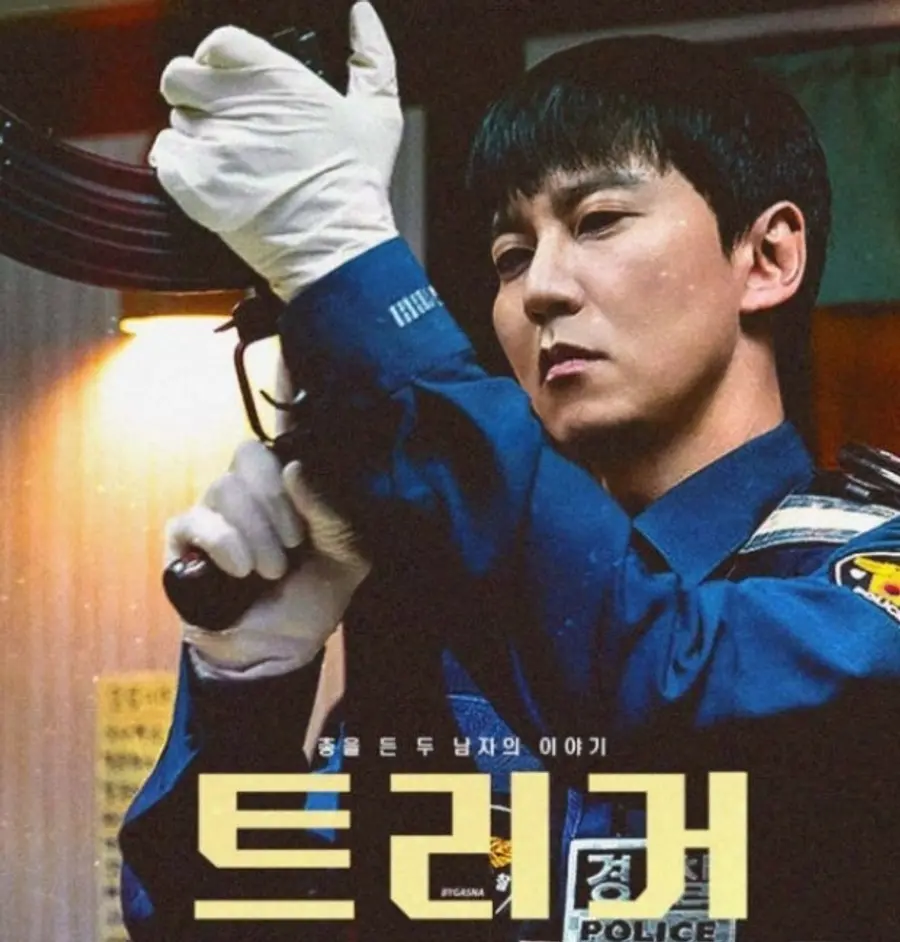
The contrast between Lee Do and Moon Baek is also intriguing. Lee Do is someone who wants to leave guns as evidence only, while Moon Baek is someone who wants to use guns as a message. Lee Do tries to resolve everything within the law and system, but as he continues his investigation, he confronts how many people the law and system have neglected. Conversely, Moon Baek is a character who has already pushed his distrust of the system to the limit. His logic is simple: "It’s just individuals returning the violence the world has inflicted." The conflict between the two ultimately leads to the question of 'who can be responsible for violence and to what extent.' If Thomas Hobbes and Jean-Jacques Rousseau were to brawl in a bar, it might look like this. One side believes in the power of the state, while the other declares that the state has already broken the contract.
The Aesthetics of Light and Shadow
The direction visually separates these two characters clearly. Lee Do's space is filled with police stations illuminated by fluorescent lights, buttons of uniforms, and the cold lighting of crime scenes. It’s a world where everything is recorded, classified, and reported. Moon Baek's world consists of spaces filled with shadows and darkness, like neon signs, underground clubs, warehouses, and ports. A world made up of CCTV blind spots, cash transactions, and anonymous contacts. Instead of the screen shaking loudly every time a gunshot rings out, it impressively lingers on the smoke left in the air and the faces of people after the sound has died down. As a result, viewers find themselves taking a breath rather than feeling catharsis during the shooting scenes. Instead of romanticizing gunfire like John Woo's Hong Kong noir, it gazes at the consequences of violence with Stanley Kubrick's cold eye.
The episode structure is also solid. Each episode chooses different backgrounds such as schools, labor sites, homes, and online communities to unfold the incidents while showing the common structure of anger within them. While adequately placing puzzle-solving and chases for the fun of being a genre piece, it always returns to the faces of people in the end. After the case is resolved, the bereaved family returns to an empty house and opens the refrigerator door blankly, or the air felt when a student walks down the school hallway again lingers heavily. Instead of neatly wrapping up the cases like in the CSI series, it leaves the lingering sadness of unresolved grief.
The Gunshot of a Society Without Guns
The social questions posed by 'Trigger' are not simple. Several episodes repeatedly remind us that this society was already sufficiently violent even before guns appeared. Group bullying occurring casually in school hallways, companies viewing people as mere numbers in labor sites, systems that do not function properly even when reports are made, and the amplification of hate and mockery online. The process of these violences piling up and eventually exploding through the medium of guns is convincingly depicted. Incidents that would have passed as just another article or another newspaper headline become catastrophic when they meet guns, no longer able to be covered up. Watching that connection leads to much deeper thoughts than the simple question of whether gun control is the answer. Like a drama dealing with the Chernobyl nuclear disaster, this work dissects the structural flaws that had already accumulated 'before the trigger was pulled.'
However, this work does not maintain perfect balance. As the story progresses, the scale of the worldview expands, and the focus on unraveling the past and conspiracies increases, causing the detailed psychological portrayals from the beginning to slightly diminish. Some subplots are resolved without leaving enough lingering impact, and some characters feel like their emotional arcs are abruptly cut off. It’s like a chess game entering the endgame stage, where pieces are quickly organized. In terms of realism, there are indeed setups that raise the question, 'Could guns really be distributed this way?' While trying to hold both genre pleasure and the message it wants to convey, there are moments where the weight shifts slightly. However, this is also a natural cost of ambitious attempts. To travel safely, one can just stick to paved roads, but to forge new paths, one must endure the bumps of unpaved roads.
Who Should Pull This Trigger?
I think of viewers looking for genre works that leave lingering questions rather than just stimulating action. There is certainly tension in the shooting scenes and the investigation, but the real enjoyment of this drama lies in the process of listening to why people picked up guns and what they lost afterward. After watching an episode, it’s easy to hit play on the next one, but it’s also a drama that requires pauses to catch one’s breath. Like drinking water while eating spicy food, it needs moments to stop and think in between.
For those interested in social issues in reality, this work will lead them to view various incidents from different angles. Watching familiar words seen in articles or reports rearranged with the device of guns makes the news that one usually glosses over come to mind differently. School violence, labor, gender conflict and hate, online culture, and stories happening right around us make one imagine what kind of catastrophe might ensue if 'violence could be more easily grasped.' While Black Mirror depicts the future as a dystopia through technology, Trigger views the present as a dystopia through the object of guns.
Also, for viewers who value the enjoyment of good acting, the tension created by Kim Nam-gil and Kim Young-kwang alone is enough to satisfy. On one side is a person clinging to a crumbling sense of justice, while on the other is someone declaring that the world is already broken and trying to shake it even harder. Following the moments when their gazes collide feels less like a simple fight between police and villains, but rather an endless debate over how to define and prevent violence. Like the scene where Al Pacino and Robert De Niro face each other in a café in Heat, the game has already begun before the gun is fired.
Conversely, if the subject of guns and violence is emotionally too burdensome, this drama could be quite a consuming experience. Every episode places someone’s life at the crossroads of extreme choices. However, if one has a desire to deeply question what people believe in and what they grasp when the world is on the brink, 'Trigger' is a work that keeps that contemplation alive for a long time. After watching, the sounds of incidents heard in the news may resonate differently. And in that moment, we realize that countless triggers had already been activated before the trigger was pulled. This drama is precisely the work that visualizes those invisible triggers. And that is the most powerful message this work leaves behind.