

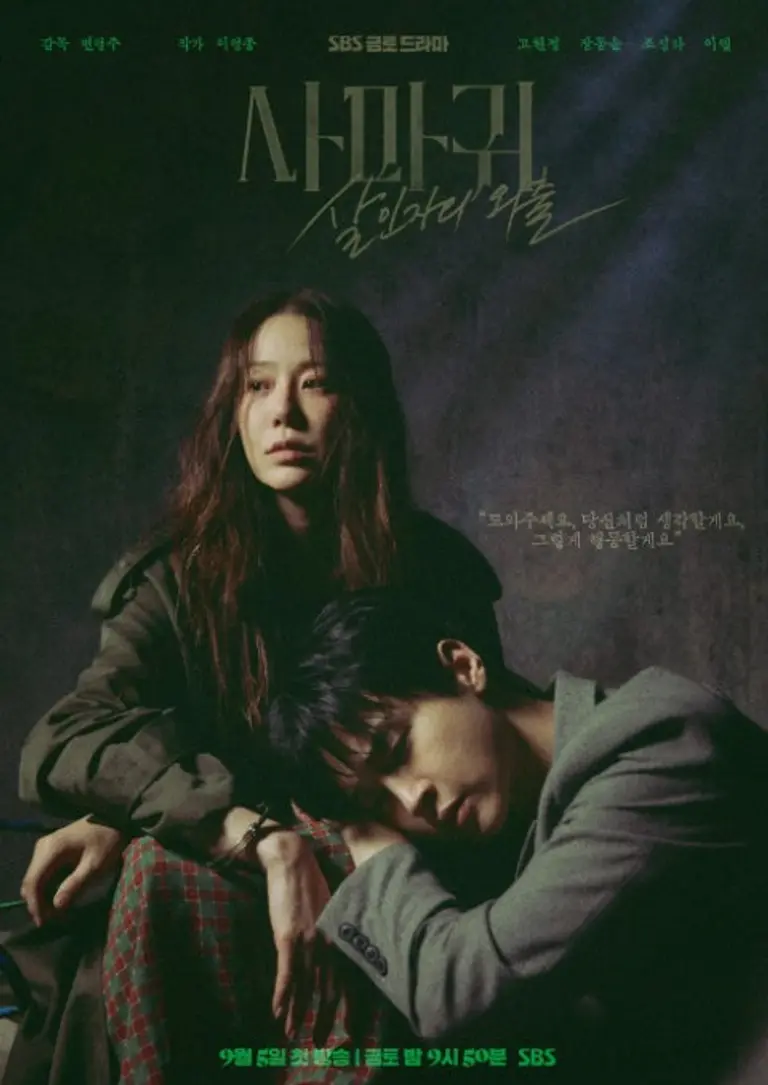
If Korean crime thrillers have begun to touch on points previously unimagined, the work at the center of it all is the drama 'Mantis: The Killer's Outing'. Like an old photo accidentally discovered in a family album that turns the whole house upside down, the story begins with the name of a female serial killer, Jung Yi-shin (Go Hyun-jung), who once made headlines around the world. Time has passed, and she has long been imprisoned, with the case treated as an old story that remains only in documentaries and online urban legends. While people remember the name Mantis, they are forgetting the meaning of the murders and the lives of the victims. This is a typical aspect of the era of 'true crime' consumption, where only the content remains and the pain evaporates.
However, one day, murders resembling Jung Yi-shin's methods from the past begin again. As bizarrely overlapping incidents occur, including the victim's profile, the murder weapon, and the way the bodies are staged, the forgotten nightmare is summoned back to the present. It is as if a ghost from a horror movie has resurrected through the SNS algorithm, and the past begins to engulf the present.
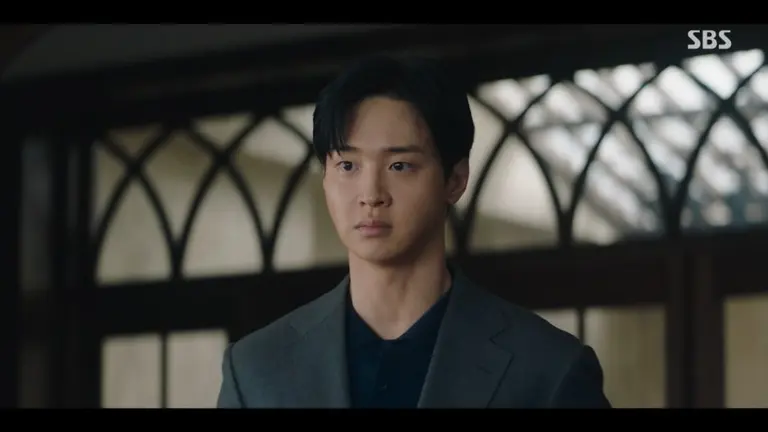
The person assigned to this case is Detective Cha Soo-yeol (Jang Dong-yoon), who is known as a problematic figure within the police department. Soo-yeol is a capable investigator, but he is always a problem due to excessive force and anger. Like a flamethrower that is not properly aimed, he reacts more violently to crime than anyone else and wants to stand by the victims, but he has crossed the line several times due to his inability to control his emotions. His superior, Superintendent Choi Joong-ho (Jo Sung-ha), throws Soo-yeol a kind of last chance due to this imitation murder case. Initially, Soo-yeol coldly tracks the evidence as usual, but soon faces the fact that the Mantis case is horrifically intertwined with him. The Mantis Jung Yi-shin is, in fact, his mother. This ironic twist of fate, which could be seen in a Greek tragedy, is as brutal as if Oedipus had reappeared in modern Korean detective attire.
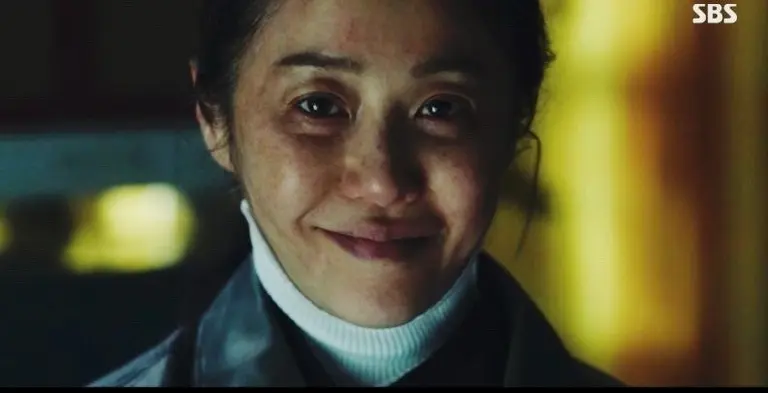
The drama does not rush to consume this shocking setup but slowly raises Soo-yeol's emotional arc. Soo-yeol is a character who has grown up in violence and fear since childhood. The violence that occurred within the family, the truths covered by religion and face-saving, and the fact that his mother was revealed to be a serial killer shook his life to its core. Soo-yeol has defined his mother as a 'monster' and has lived severing all ties, but he can never escape the fact that he has also become someone close to violence. Somewhere between genetics and environment, he asks himself every morning while looking in the mirror, "Do I resemble my mother, or have I just been ruined because of her?"
Dancing with the Devil: The Twisted Mother-Son Duo
The investigation into the imitation murders does not progress easily. The perpetrator leaves traces as if they know the police's movements, and each crime intricately recreates specific scenes from the Mantis case. In this process, the investigation team makes a dangerous choice. They decide to involve the real Mantis Jung Yi-shin in the investigation. Like the FBI seeking advice from Hannibal Lecter, they acknowledge that they need the devil's knowledge. Jung Yi-shin presents her conditions with a cold, expressionless face. If she is to help, her son Cha Soo-yeol must be deeply involved in the investigation. This is the moment when the most bizarre variation of maternal love begins.
From this point on, the drama begins to depict the twisted mother-son duo in earnest. Jung Yi-shin, having been released from prison, looks at crime scene photos while bound in shackles and points out details that other detectives have missed. She reads the psychology and patterns of the perpetrator from the victim's minor gestures, the clutter in the house, and the graffiti left on the wall. Like Sherlock Holmes reincarnated as Professor Moriarty, her insights are precise and chilling. Soo-yeol cannot help but acknowledge his mother's abilities, yet at the same time, every moment is repulsive to him. Jung Yi-shin repeatedly hints to Soo-yeol that "you and I are not different," and the more Soo-yeol tries to deny this, the more he confronts the violence hidden within himself. This is the moment when Nietzsche's warning that "those who fight monsters must be careful not to become a monster themselves" becomes a reality.
The characters surrounding Jung Yi-shin also begin to reveal their outlines one by one. Her father, Jung Hyun-nam, who is also a pastor, her daughter-in-law Lee Jung-yeon, who struggles to keep the family together, those who chose silence while knowing the truth of the past case, and the victims and their families from the Mantis case, each character's narrative gradually intertwines with the current imitation murders, slowly revealing the bigger picture. The drama alternates between the past and present, showing how Jung Yi-shin became a monster and why imitation murders are occurring at this moment. Like an archaeologist digging through layers, the work peels back the geology of violence layer by layer.
As the latter half progresses, the tension of the investigation and emotions rises simultaneously. Soo-yeol must acknowledge that he cannot stop the case without using his mother, and Jung Yi-shin rises to an increasingly important position as she reads the psychology of the imitator. There is no reconciliation between the two, nor is there a grand embrace. Instead, a strange air settles in that they know each other better than anyone else. It is better to experience who the imitator is, why they want to resurrect the name Mantis, and what choice is made in the end by watching it directly. The tension of this work lies not only in the twist of the ending but also in the emotional buildup leading to that choice.
Relationship-Centric Crime Thriller
Looking at the artistic quality of Mantis, the first thing that stands out is that it is a 'relationship-centric crime thriller'. 'Mantis: The Killer's Outing' has the provocative subject of serial murder, but it keeps the focus on the cracks in human relationships until the end. It slowly focuses on the process of someone becoming a serial killer, who turned a blind eye around them, and how easily the boundaries between victim and perpetrator blur. It translates Michel Foucault's concept of 'the microphysics of power' into the Korean context of domestic violence, religious hypocrisy, and social bystanderism.
The character of Jung Yi-shin breaks away from the typical villain archetype seen in Korean dramas. Instead of exaggerated crazy eyes or explosive madness, her quiet and expressionless face is more chilling. What if Anthony Hopkins' Hannibal Lecter had grown up in a patriarchal Korean family? She reads the wounds of others astutely, throws in words that hit those wounds, and then quietly closes her mouth. As the reasons and processes behind her murders are revealed one by one through the drama, viewers find it difficult to dismiss this character as a mere monster. Clearly a horrific criminal, she also begins to appear as a victim of violence. This duality is the greatest strength of this character. The truth that there are always countless accomplices in the birth of a monster is coldly exposed by this drama.
Cha Soo-yeol is also an interesting axis. He is not the typical overly righteous detective. He is more like an adult child oscillating between anger and guilt, ready to explode at any moment. Like Bruce Banner living every day suppressing his transformation into the Hulk. The process of hating his mother while facing the fact that he has become like her is portrayed convincingly. The drama repeatedly shows Soo-yeol suppressing his violent impulses while engaging in the investigation. This prompts viewers to ask questions. How different is violence committed with good intentions from violence born of evil? Where does self-defense end and crime begin? This character, who tightropes the boundaries of law and ethics, embodies the complexities of enforcing justice in modern society.
What is Not Shown is More Terrifying
The directing style avoids excessive spectacle while maintaining psychological tension until the end. Instead of showcasing brutality with close-ups of crime scenes, it focuses on how ordinary spaces suddenly transform into hell. When everyday places like apartments, churches, workshops, and parks become crime scenes, the lighting and angles subtly twist. The camera sometimes lowers to the victim's eye level and closely follows the detectives' breaths. The stillness after the blood has stopped flowing lingers much longer than the scenes of bloodshed. This is a perfect execution of Hitchcock's principle that "fear is not the explosion but the time waiting for the explosion."
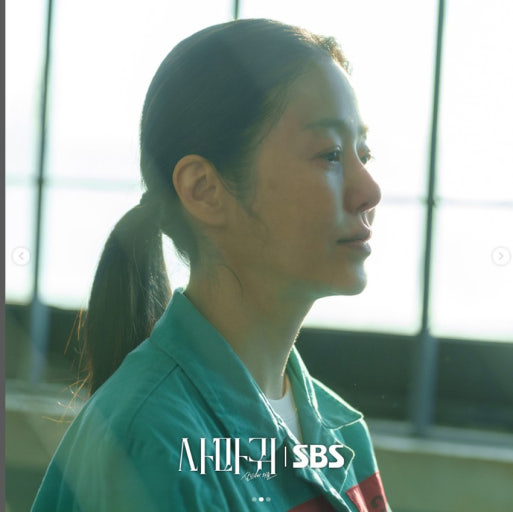
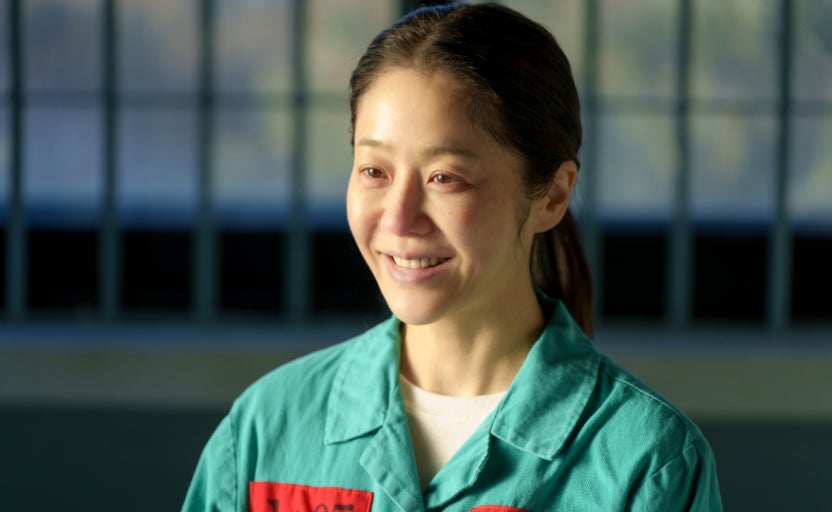
In particular, close-ups that linger on the characters' faces are frequently used. Moments like Jung Yi-shin subtly shaking her expression as she recalls her past, Soo-yeol swallowing his anger while avoiding eye contact, and the victim's family trembling as they look down at a photo on the police station table define the emotion of this drama. While maintaining the speed of a genre piece, there is an attitude of not wanting to miss a single expression or breath. It feels as if Yasujirō Ozu were making a thriller. An emotional volcano erupting in stillness.
A Rare Portrait of a Female Serial Killer
Another element that makes this work stand out is the position of the 'female serial killer'. While many works have featured female psychopaths or villainous characters, it is rare for the narrative weight to concentrate on one character and to trace that character's past and trauma to the end. Jung Yi-shin is not simply a female version of a male serial killer but is depicted as a unique product of Korean society intertwined with family, religion, gender, and violence. Following how she was raised in violence, at what moment she crossed the line, who supported and who stood by during that process naturally brings to light the structural contradictions of Korean society. It evokes memories of Aileen Wuornos or the film 'Monster' based on her true story, while adding the unique backdrop of Korean patriarchy and religious power.
The direction of the adaptation is also interesting. While retaining the basic structure of the original work, it feels strongly restructured to fit Korean sentiments and realities. The social environment presented as the backdrop for the Mantis case operates complexly with the fence of family, the authority of religion, the culture of face-saving and concealment, and the sensationalism of internet public opinion and media. The motives of the imitator are also explained not simply as 'another monster who enjoys killing' but through a distorted sense of justice and victim mentality. As a result, viewers feel both fear of the perpetrator and a strange sympathy. This work, which dissects the social mechanisms of creating perpetrators, transcends the realm of crime thrillers and enters the domain of sociological observation.
Imperfect Ambition, Yet a Precious Attempt
Of course, it is not without its flaws. In trying to encompass the past and present, family history and investigative drama, the identity of the imitator, and social criticism within the limited scope of eight episodes, some narratives pass by too quickly, leaving a sense of regret. It feels like eating a full-course meal at buffet speed; there is flavor, but not enough time to savor it. In particular, the stories of interesting supporting characters, such as the victims' families or Soo-yeol's fellow detectives, could have been much deeper if given a little more time. As the latter half leans more towards the pace of the investigation and plot twists, the chilling psychological drama flavor shown in the early episodes is partially diluted. Nevertheless, in the larger narrative, it relatively well maintains the balance of emotion and genre. It is an imperfect ambition, but it is precisely that ambition that makes it a memorable work.
The music and sound also solidify the atmosphere of this drama. Sometimes, the almost non-existent music replaces tension, and sharp, dissonant sounds subtly underlie crime scenes or mother-son confrontation scenes. The effect of making the ears more sensitive when the sound disappears is well utilized. If John Cage's 4'33" is music in silence, the sound of this drama is fear in stillness.
If You're Tired of Fragmented Thriller Works
The first people I would recommend this drama to are viewers who enjoy dissecting characters' psyches over the fun of guessing the perpetrator. While there are certainly twists in the case, the real weight lies in the process of following 'why did this person make such a choice?'. As you alternate between the perspectives of Cha Soo-yeol and Jung Yi-shin, you will find yourself confused about whose side you are on in this story at some point. If you enjoy that confusion, 'Mantis: The Killer's Outing' will likely leave a lasting impression. This journey, oscillating between good and evil like a Möbius strip, offers an intellectual experience beyond mere entertainment.
For those interested in the dark sides of Korean society, especially how family, religion, and institutional bystanderism can push individuals into corners, this work is also a good choice. As the episodes progress, it overlaps with various real events occurring in our society, transcending a simple crime thriller. It may serve as an uncomfortable mirror for some, but it is precisely that discomfort that makes for a more meaningful viewing experience. As Oscar Wilde said, "It is ridiculous to be angry at a mirror for being ugly." This drama is a mirror reflecting the ugly face of our society.
Finally, for viewers who prioritize the joy of watching heavy performances, the tension created by Go Hyun-jung and Jang Dong-yoon alone provides ample reason to watch this drama. One is a monster trapped in prison, bearing the responsibility for the violence already committed, while the other is a detective who has not yet crossed the line but could step on it at any moment. In scenes where the two sit facing each other, exchanging only glances, the highest density and chill that the thriller genre can offer is condensed. It is like the Korean version of the scene in 'Heat' where Al Pacino and Robert De Niro sit across from each other in a café. A confrontation more tense than a shootout without guns.
By the end, the question "Is there a separate devil, or is there a little bit of one in all of us?" will linger in your ears. And a more terrifying question follows. "Is it the monster that created the monster, or is it all of us who turned a blind eye to the monster?" 'Mantis: The Killer's Outing' places us in front of this uncomfortable question. We can run away or face it. The choice is up to the viewer. However, one thing is certain. After watching this drama, it becomes difficult to dismiss the monster as simply 'abnormal'. And that is the most precious legacy this work leaves behind.