


[magazine kave=Lee Tae-rim Reporter]
Such titles are rarely seen in the Korean genre drama scene. The phrase 'You killed me' seems like a finger pointed directly at someone. It resembles Arthur Miller's 'All My Sons', a charge questioning collective responsibility, and it declares a world where everyone is a suspect, much like Agatha Christie's 'Murder on the Orient Express'. The Netflix limited series 'You Killed Me' brings that very sentence to life, aiming not just at one person but at countless individuals throughout its eight episodes. Perpetrators and victims, family and neighbors, colleagues and authorities, no one is exempt from being confronted with that question. There are no bystanders. Everyone is an accomplice.
The starting point of the story is Jo Eun-soo (Jeon So-ni). Eun-soo is an ordinary saleswoman working in a large store. She deals with difficult customers day by day, tries to read her team leader's mood, and dreams of a better life someday, but she cannot envision a concrete future. Like Sisyphus in Camus' work, she pushes a boulder up every day, only for it to roll back down in the evening. One day, a high-end watch mysteriously disappears during the return process, causing a problem. Around that incident, the behavior of a customer, Jin So-baek (Lee Mu-saeng), who exudes a strange aura, keeps bothering her, and Eun-soo sets out to track him down using CCTV and her memories.
In the meantime, Eun-soo's private life gradually comes to light. Her mother, who has endured her husband's violence for a long time, the atmosphere of the family that carries the traces of that violence, and the fear and resignation that permeate the home overlap with Eun-soo's expression. Although she appears to be a cheerful sales employee on the outside, the trauma that makes her body flinch emerges in various aspects of her daily life. For Eun-soo, violence is not a crime in the news but something as familiar as the air she has breathed for a long time. This is what Bessel van der Kolk referred to as 'the trauma that the body remembers'. Even if she forgets it in her mind, her body vividly remembers the fear of that day.
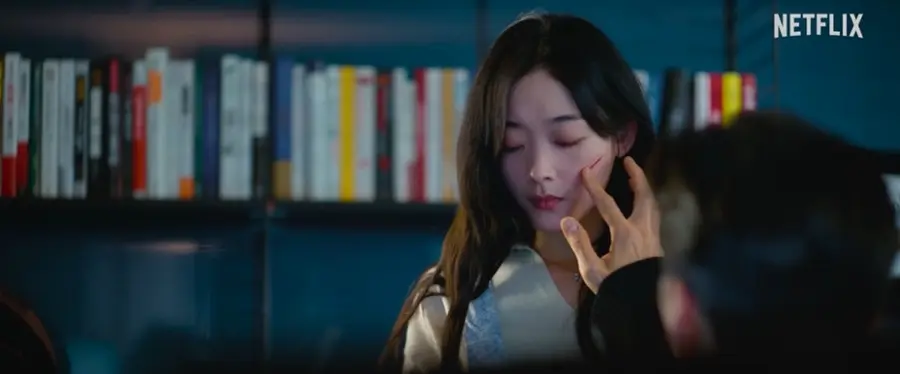
One day, Eun-soo visits her once closest friend, Jo Hee-soo (Lee Yu-mi), after a long time. From the photos on social media, she seems to be a 'successful friend'. She is married to a wealthy husband, lives in a beautiful house, and has made a name for herself as a children's book author. In the filtered world of Instagram, she appears to be the perfect proof of a successful life. However, the moment she steps through the front door, the reality Eun-soo faces is the complete opposite. The well-dressed home is filled with broken dishes and scattered items on the floor, and Hee-soo's face is covered in bruises and wounds. It is a scene where the violence that has been barely concealed by neat clothes and makeup is suddenly exposed. Like opening the attic door where Dorian Gray's portrait is hidden, the gap between appearance and reality is starkly revealed.
The Monster Goes to Work in a Suit
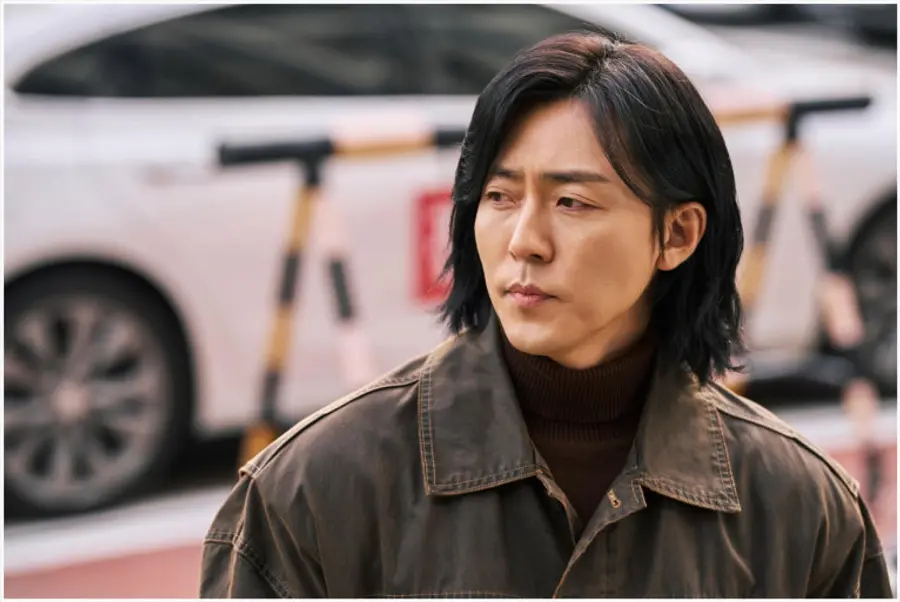
Hee-soo's husband, Noh Jin-pyo (Jang Seung-jo), initially appears as a kind husband. He speaks well, has a high social status, and is known as a polite and capable man outside. Like Patrick Bateman discussing business card designs in 'American Psycho', he wears a social mask perfectly. But at home, he is a complete monster. When drunk, he resorts to violence over trivial remarks, and after an assault, he apologizes with expensive bags and necklaces while blocking Hee-soo's ears. The 'turning a blind eye' of in-laws and those around them is actively mobilized to cover up the traces of this violence. The 'banality of evil' that Hannah Arendt spoke of evolves here into 'the sociality of evil'. Monsters are not created alone. They are nurtured by numerous accomplices.
Eun-soo is shocked to see this reality. However, that shock is not just simple surprise; it is more like déjà vu overlapping with scenes from her childhood when her mother was beaten. The sounds of shouting and objects crashing from Hee-soo's house sound exactly like the sounds she heard in her own home in the past. Like Proust's madeleine, the sounds transcend time and summon trauma. At first, Eun-soo suggests calling the police, escaping together, and informing others. But Hee-soo always pulls back at the last moment. She fears her husband will get angrier, is worried about the children, and her body freezes due to the repeated experiences of failed escapes. This is the moment when the psychological concept of learned helplessness is realized in dramatic reality.
Is It an Escape Route or a Suicide Goal: The Choice of Murder
Eventually, one day, Hee-soo tries to give up on life with a face drained of all strength. At that moment, the words that come out of Eun-soo's mouth become the starting point of this drama. "Let's kill him, your husband." That statement is not an impulse. It is an extreme choice that arises after recalling Eun-soo, a victim of violence since childhood, Hee-soo, another victim at this moment, and the countless nameless victims lined up behind them. They do not act out of a desire for revenge to punish a bad person. The despair of 'nothing will change if we don't do this' turns murder into a realistic escape route. Just as Raskolnikov pondered when killing the pawnbroker, they too ask, "Is removing the other an act of justice or a crime?"
The two begin to plan the perfect crime. They analyze Jin-pyo's daily routines and habits, devise situations that could appear as accidents, and meticulously calculate alibis for after the crime. Like Hitchcock's 'Rope' or 'Perfect Strangers', a suspense unfolds where ordinary people attempt a perfect crime. In this process, Eun-soo recalls the man Jin So-baek, who was at the center of the watch incident. He appears to be a sly and light-hearted boss, but he has exceptional judgment and insight into people. Eun-soo and Hee-soo involve an employee working at So-baek's store in their plan, gradually digging into Jin-pyo's schedule, vehicle, and surrounding CCTV.
However, no matter how perfect the preparations seem, reality always flows differently from the plan. Jin-pyo's violence becomes increasingly blatant, and the police and those around them still dismiss it as just a 'domestic dispute'. One night, Eun-soo and Hee-soo cross an irreversible line, and from that moment on, their lives enter a new hell. They must erase traces of the crime, move while avoiding suspicious gazes, and unexpected figures begin to appear one by one, shaking the puzzle. Jin-pyo's sister Noh Jin-young, the police, and the identity of Jin So-baek become more complex as the episodes progress. The drama persistently questions not the morality of murder but the path leading to that choice and the responsibilities that follow. It is better to experience the emotions of the conclusion firsthand, as this work places more weight on the process than on the twist.
The Monster Created by Structure, the Escape Blocked by Structure
Now, let’s examine what power this work possesses and why it is uncomfortable yet hard to look away from. The most daring aspect of 'You Killed Me' is that it treats domestic violence not as a simple incident but as a result nurtured by structure and environment. Violence is often easily reduced to an individual's madness or anger management issues. It is treated as a personal deviation, like saying an apple has rotted. However, this drama delves into how Jin-pyo's violence was possible, who remained silent or complicit in that violence, and why those who knew about the violence acted as if they did not. It inspects not just a single rotten apple but the entire tree, the orchard, and the entire distribution system.
Thus, the title 'You Killed Me' can be read on multiple levels. It is directed at perpetrators like Jin-pyo, who directly wielded their fists, but it also seems to address the family members who cover for him, dismissing it as 'family matters'. Furthermore, it feels like a statement directed at neighbors who turned a blind eye to the scenes of violence, authorities who neutralized reports, and those around who repeatedly blame victims with the question, "Why didn’t you just run away?" The English title 'As You Stood By' naturally overlaps with the expression that questions the responsibility of those who merely stood by and watched. Edmund Burke's saying, "The only condition for evil to triumph is for good people to do nothing" is realized in dramatic reality.
The direction allows this message to seep in through detailed scenes rather than exaggerated sermons. The camera does not brutally consume the moments of violence. Instead, it lingers on the silence after the violence, the broken dishes scattered across the shattered table, the hair on the bathroom floor, and the close-up of Hee-soo's trembling hands. It chooses to show the fear, shame, and helplessness that remain afterward rather than the spectacle of violence itself. Like Bernard Werber said, "The scariest thing is not the monster but the gaze of the person who has seen the monster", this drama gazes at the aftermath of violence rather than the violence itself. As a result, the viewer becomes a witness peeking into someone else's hell rather than a consumer of sensational scenes. And a witness can never be a bystander. The moment we see it, we are already accomplices.
The performances of the actors account for more than half of this drama. Jo Eun-soo is a character standing on the boundary between victim and perpetrator. She is a victim who has grown up witnessing violence, but now she becomes an active agent planning murder for her friend. Jeon So-ni remarkably embodies that complex position with incredible delicacy. She pretends to be indifferent while throwing jokes, but her body flinches at certain sounds, she cannot contain her anger and punches the wall, and in crucial moments, she naturally shifts between cold calculation and emotional turmoil. Like Daniel Day-Lewis immersing himself in a role, she becomes the very essence of Jo Eun-soo. Thanks to this, viewers find it difficult to easily judge Eun-soo's choices and continue to follow her emotions.
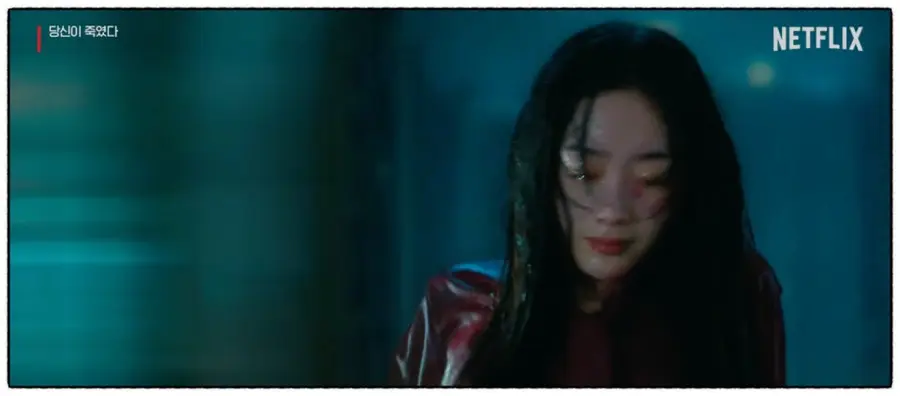
The character Jo Hee-soo reveals the psychology of abuse victims most starkly. Lee Yu-mi utilizes her naturally gentle face and gaze to simultaneously portray an image as fragile as glass and a tenacity to cling to life until the end. Hee-soo is undoubtedly a 'victim who could not escape', but this drama does not consume her as a frustrating character. Instead, it unfolds the reasons why she could not escape, what she would lose in the process, and the realistic barriers one by one, helping the audience understand the structure of that helplessness. The moment the home becomes a prison, escaping is not merely opening a door but a decision to abandon one's entire life.
Noh Jin-pyo, the antagonist, is not a one-dimensional monster either. Jang Seung-jo maintains a sophisticated and gentle smile on the surface while creating fear with just a glance. After committing violence, he often hands over gifts or whispers, "You are still the only one for me." This portrayal seems to perfectly replicate the archetype of domestic violence perpetrators seen and heard countless times in reality. Occasionally, the guilt and kindness that seem sincere pass by, causing the audience to feel confusion momentarily. This confusion is precisely the mechanism that leads victims back into the arms of their perpetrators, which the drama keenly identifies. It is a terrifying achievement that embodies the mechanism of gaslighting through performance.
Jin So-baek serves as an interesting buffer. He appears to be a boastful and shrewd businessman, but at some point, he begins to sense Eun-soo and Hee-soo's secret and enters the heart of this tragedy. He is neither completely good nor completely evil. He is a character who balances between profit and conscience, making him all the more realistic. Like Winston Wolf from 'Pulp Fiction', he is a problem solver who lives in a moral gray area. Through So-baek, the drama poses a question: When we learn all the truths, how far must we take responsibility? How much should we intervene, and how far can we turn a blind eye?
Traces of Imperfect Ambition
Of course, there are shortcomings. Within the framework of eight episodes, as it tries to capture the past and present, crime thriller and social critique, and character drama all at once, some narratives pass by quickly. In particular, Hee-soo's writing career, Eun-soo's position in the workplace, and Jin-pyo's family's political background could have made for a much more three-dimensional drama if explored further. In the latter half, the focus shifts to investigation and twists, causing the extreme realism built up in the early episodes to be slightly overshadowed by genre convenience. Nevertheless, overall, the attempt to balance message and immersion is relatively successful. It is not a perfect work, but its imperfections make it more human.
The color palette and mise-en-scène may be a matter of taste. The home feels excessively tidy, and the lighting seems to be good at hiding wounds and bruises. In some scenes, Netflix's characteristic vivid colors appear to clash with the tone of violence and fear. However, the minor mismatches ultimately get buried in the actors' gazes and breaths. The audience responds first to the fear and determination contained in the gazes exchanged rather than the colors on the screen.
For viewers who feel that human faces and emotions are more important in genre works, there is a high possibility of becoming deeply immersed in 'You Killed Me'. The true climax of this drama lies not in the murder scene but in the expressions and breaths of the characters just before and after it. Instead of judging who is right or wrong, it is a suitable work for those who want to follow the psychology of the characters and ponder together. It is like wandering alongside Raskolnikov while reading Dostoevsky's 'Crime and Punishment', following the journey of Eun-soo and Hee-soo.
I would also recommend it to those who enjoy dramas dealing with social issues. You may already feel fatigued by terms like domestic violence, bystander effect, and secondary victimization, but 'You Killed Me' brings these concepts into the concrete lives and choices of characters rather than abstract discourse. Thus, it is more painful and simultaneously more persuasive. While a single drama cannot resolve the numerous structural barriers surrounding violence, it at least possesses the power to make one hesitate to say, "Why didn’t they just leave?" when seeing similar incidents in the news in the future. It is a drama that builds empathy muscles.