

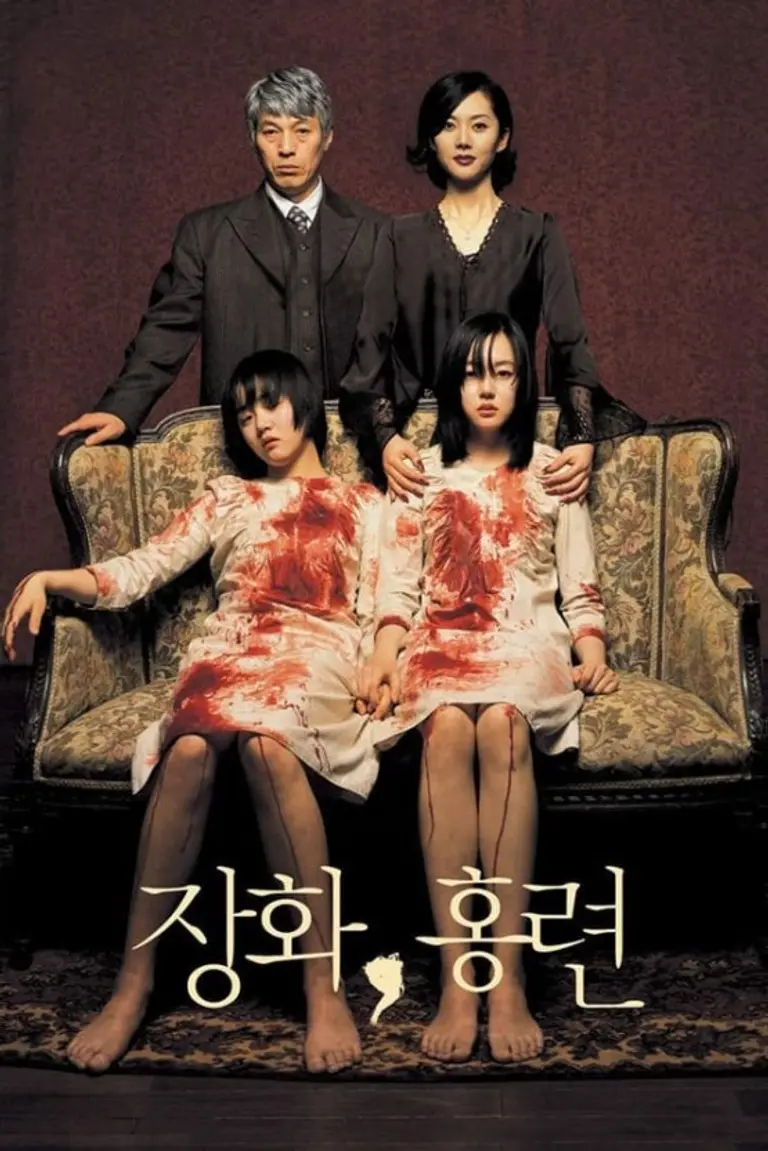
A narrow road leading to a secluded countryside house, with forests extending infinitely outside the car window. Sisters Sumi (Im Soo-jung) and Su-yeon (Moon Geun-young), after a long hospital stay, get into their father's car and return home. However, instead of joy, there is a subtle alarm-like feeling in the air. The moment the door opens, they are greeted by their taciturn father and overly kind stepmother Eun-joo (Yeom Jeong-ah). And a strange house that is both spacious and induces claustrophobia. This space, seemingly remodeled from an old hanok, has corridors and doors connected like a maze, with wardrobes, curtains, and darkness under the bed gaping like black holes everywhere. The movie 'Janghwa Hongryeon' slowly unfolds the tragedy of a family within this enclosed universe of a house, layering horror, melodrama, and psychological drama like a thick slice of pork belly.
From the first day back, Sumi radiates signals to Eun-joo that 'you do not belong in this house.' Eun-joo, too, hides a razor blade beneath her honeyed tone. The conversation at the dining table is superficially polite, but it feels like a fencing match, with each moment aimed at one another. Su-yeon shrinks back like a mouse, only observing. It feels as if a war has been ongoing in the house for a long time, and no one can breathe comfortably. An invisible presence also intervenes. Breathing and footsteps heard in the middle of the night, hair seeping through the cracks of the closet door, and the feeling of being watched from the darkness under the bed. The audience constantly questions what is in this house, or rather, who is in it.
The story soon penetrates into the family's past. The incident that forced Sumi and Su-yeon to go to the hospital, the absence of their biological mother, and their father's silence overlap, gradually revealing the outlines of the wounds left unattended in the house. Eun-joo believes she is the rightful mistress of this house and imposes order, but to the sisters, she is an intruder and an aggressor. A minor mistake at the dining table amplifies into humiliation and verbal abuse, and the pill packets and medicine bottles repeatedly appear like a Pandora's box sealing family trauma. Director Kim Ji-woon subtly hints at the house's past through objects and spaces instead of lengthy explanations. A family photo hanging on the wall, an empty room, and a locked drawer whisper the truth before any dialogue.
The tension in the early part mainly comes from invisible anxiety rather than visible violence. Eun-joo's gaze peeking at the sisters through the door crack, the father's silence pretending not to see anything, and Sumi's recurring nightmares are subtly connected. Then one night, an inexplicable event occurs in Su-yeon's room, upgrading the horror to another level. The sound of the door opening and closing, the bed sheet crumpling as if pulled by an invisible hand, and a black figure crawling up from the bottom of the screen. The audience senses that the horror of this house has far surpassed simple family conflict. At the same time, they feel that this horror is intricately connected to the family's history like an umbilical cord.
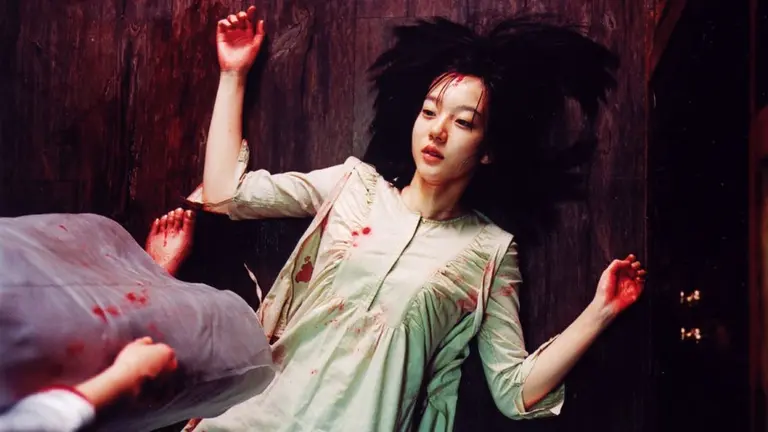
As the movie progresses into the middle, it intentionally blurs the boundaries between reality and nightmares, the present and memories. Scenes seen through Sumi's perspective become increasingly opaque, and Eun-joo's actions take on an exaggerated quality that seems to transcend human malice. Everyday objects like the meat plate on the dining table, the blood-stained towel, and the trash piled up under the stairs suddenly act as triggers of horror. The audience begins to confuse whether all of this is actually happening or if it is a hallucination created by someone's guilt. This unstable perception leads to a decisive blow that flips the entire screen at some point, but it is wise to confirm the identity of that twist directly.
However, what is clear is that 'Janghwa Hongryeon' is neither a simple ghost story nor a melodrama of stepmother vs. daughters. Director Kim Ji-woon takes the Joseon Dynasty folktale 'Janghwa Hongryeonjeon' as a motif, but instead of merely copying the stepmother's evil deeds and the daughters' grudges, he completely remakes it with the psychology and wounds of a modern family. If the ghost in the original was a manifestation of revenge, the horror in this film is closer to the shadows created by guilt, repression, and distorted memories. What is scarier than ghosts are humans who endlessly repeat their wounds without even understanding them, as if they cannot stop ctrl+C, ctrl+V.
‘Mise-en-scène’ Symbolizing the Renaissance of Korean Cinema
When discussing the artistic value of Janghwa Hongryeon, the first thing that comes to the table is space and mise-en-scène. The house in 'Janghwa Hongryeon' does not merely serve as a background but operates as a gigantic character. The wide-open living room, the endlessly extending corridor, and the rooms with different colors and lighting serve as a 3D map visualizing the characters' psyches. In particular, scenes where red, green, and blue lights alternately dominate the screen accurately visualize the temperature and density of emotions. The red side dishes and plates on the dining table, the flower-patterned wallpaper stained like blood, and the green forest shining in the darkness all appear as fragments of emotions seeping out from the characters. It is as if the colors have become the language of emotions, pushed to the extreme like an Instagram filter.
The choice of shooting and angles is also exquisite. The camera often captures characters from a low position looking up or voyeuristically observes them through gaps between doors and furniture. This uncomfortable perspective makes the audience feel like 'a third presence hiding somewhere in this house.' Even when moving down the corridor following someone, the camera insists on lagging slightly behind instead of rushing ahead. Thanks to this subtle distance, the audience feels a tension that something might jump out from off-screen at any moment, like being on guard against an enemy aiming for the back of the head in a first-person shooter game. At the same time, this camera position overlaps with the psychology of characters who are circling around without fully reaching the truth.
The sound design is delicate and calculated, as befits a horror film. Quiet breathing and soft footsteps come across as more chilling than loud screams or sudden sound effects. The creaking sounds of the house, the slight clinking of dishes, and the wind blowing from the forest all function like actors on stage. The music also refrains from exaggerated horror BGM and only intervenes clearly when necessary. At one moment, a nearly inaudible piano melody, and at another moment, it mixes with metallic percussion to sandpaper the audience's nerves. As a result, the horror of the film is not jump scares but a slowly penetrating anxiety, akin to the feeling of a dental waiting room.
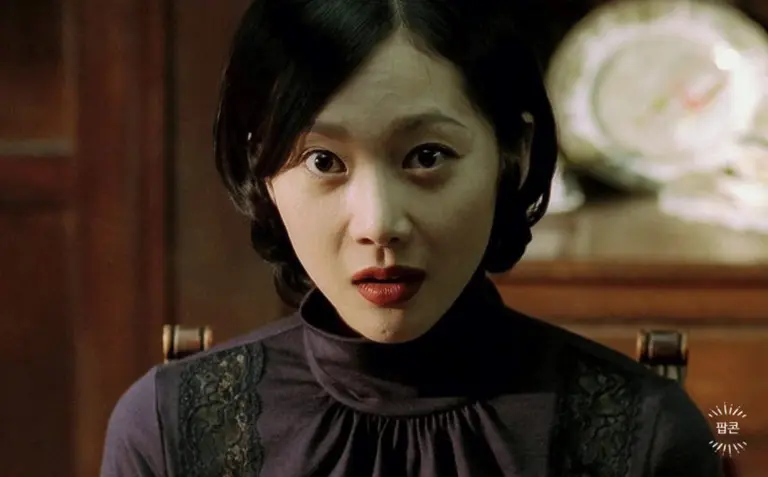
In terms of acting, this work is still astonishing upon rewatch. Im Soo-jung's Sumi is a complex character that embodies the protector, victim, and sometimes the aggressor all at once. Her firm gaze in trying to protect her sister and her anxious expression when waking from a nightmare coexist within her. Moon Geun-young's Su-yeon is the timid and delicate youngest, but occasionally shows an expression as if she knows all the secrets, like an audience member who knows the spoilers. Yeom Jeong-ah's Eun-joo is another engine of this film. On the surface, she appears to be a sophisticated and capable mistress, but at moments her expression distorts, revealing her hidden inferiority complex and anger. When the performances of these three actors collide, complex layers of emotion emerge that go beyond a simple good vs. evil dynamic.
Kim Gap-soo's portrayal of the father is the most repressed character in the film. He holds back words in almost every scene, avoids eye contact, and mumbles through situations. He appears to be a powerless head of the family, but the film shows that his silence is indeed one of the pillars of tragedy. This character painfully proves that doing nothing is also a choice. The film speaks through situations and outcomes rather than direct condemnation, illustrating how the attitude of being a bystander without protecting the family or facing wounds can have devastating power. It is as if the 'spiral of silence theory' has been embodied in a family drama.
‘Fundamental Fear’ Rather Than Surprises
The reason the horror of this film lingers particularly long is that its source is closer to psychology than the supernatural. Whether ghosts actually exist or not is not important. The core is who is trying to hide what and which memories they cannot ultimately acknowledge. Each character chooses a distorted way to push away or endure unbearable truths. That distortion accumulates and ferments, transforming every object and shadow in the house into twisted symbols at some point. The audience constantly deduces what is real and what is illusion, and whose memory is genuine. This very process serves as a device that multiplies the film's horror.
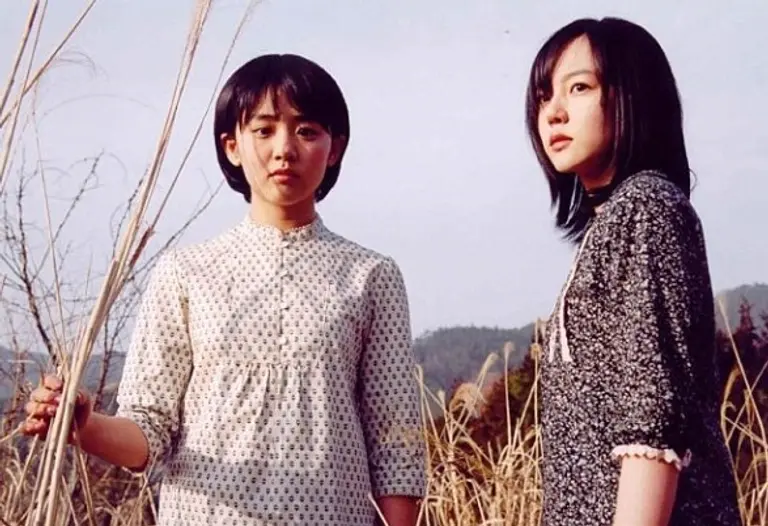
In terms of narrative structure, 'Janghwa Hongryeon' is also a very clever puzzle film. On the first viewing, one becomes immersed in simply chilling scenes and tension, but on the second and third viewings, hidden foreshadowing and hints become apparent. Details like the positions where characters' gazes intersect, who was where, and how the dining table is arranged in specific scenes function as pieces that hint at the truth. Like 'The Usual Suspects' or 'The Sixth Sense', it is a film that requires rewatching. Thus, this work continues to be reevaluated over time and remains prominent in horror film rankings. It is also a rare example of successfully mixing Korean sentiment with Western psychological thriller grammar, like adding cheese to kimchi stew and finding it surprisingly delicious.
However, it is not without its criticisms. For first-time viewers, the developments after the midpoint may feel somewhat perplexing. As the tones of horror, psychological drama, and family melodrama intertwine, there are moments of confusion about what to focus on. By the latter half, several scenes are recalled simultaneously, leading to a sort of explanatory part, which can divide opinions. For some viewers, that explanation may feel kind and shocking, while for others, it may seem to overly fill the gaps of mystery. It feels like watching a magician who kindly explains a magic trick. Still, considering the overall completeness and emotional density, such aspects are more a matter of personal taste.
Interestingly, 'Janghwa Hongryeon' has suggested a new direction for Korean horror films. While previous Korean horror films focused on summer entertainment or one-time shocks, this work has made wounds, trauma, and fragments of memory the core engine of horror. Many subsequent Korean horror and thriller works that tackle real wounds like domestic violence, school bullying, and generational conflict owe a significant influence to this film. It has set a benchmark for visualizing the oppression and guilt of Korean society within the framework of the genre, much like how 'The Lord of the Rings' set the standard for fantasy films.
If You Want to Face K-Scary Fairy Tales
If you are a viewer who reacts more strongly to suffocating silence, uncomfortable gazes, and a somewhat twisted family atmosphere rather than loud sound effects and bloody scenes, the air of 'Janghwa Hongryeon' will linger long. Like the aftertaste of good wine.
For those who feel a bit complicated just hearing the word family, this film can provide a strange catharsis. This movie shows that blood relations can sometimes be more brutal than non-blood relations, and that the closest spaces can inflict the deepest wounds on each other. It is as if it has adapted a family therapy session into a horror film.
If you are ready to face quietly accumulated wounds head-on and hope that a horror film lingers in your mind long after it ends, 'Janghwa Hongryeon' is worth rediscovering. You will experience that every object, from the wind by the riverside, the darkness in the house, to a single plate and pill packet on the dining table, carries meaning. After watching this film, your gaze towards dark corridors, closet doors, and family photos may subtly change. And perhaps, you might want to check under the bed for a while. Not joking.