

[magazine kave]=Choi Jae-hyuk Reporter
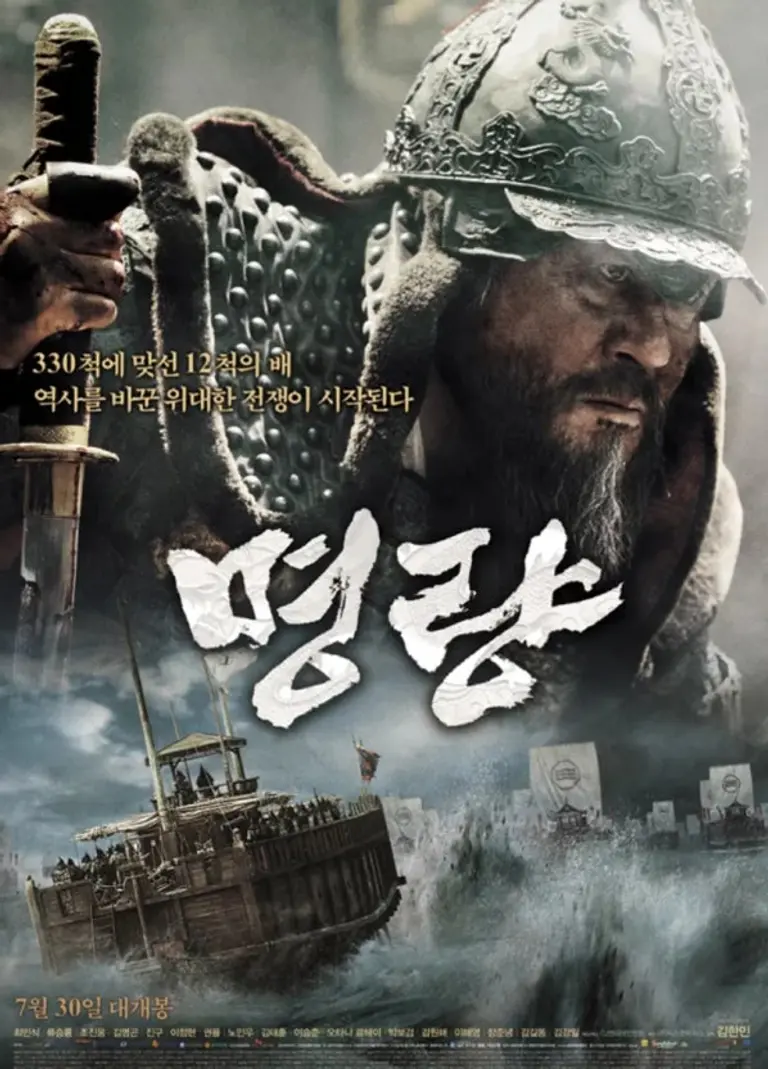
On a sea covered with dark clouds, the flags of the Joseon navy are pitifully sparse. The navy, once called the strongest in East Asia, has collapsed without a trace, and only twelve ships remain. The movie 'Myeongnyang' begins by throwing this dismal number into the center of the screen. The fact that the last shield protecting the country is merely twelve ships is already etched in the audience's eyes before it is explained in subtitles. Just as the Spartans in '300' held off the Persian army with 300 men, Joseon must face 330 ships with only 12. Looking at the numbers alone, it is closer to 'Mission Insane' than 'Mission Impossible.'
In this desperate situation, Yi Sun-sin (Choi Min-sik) returns to the position of the Commander of the Three Provinces Navy after being dismissed, imprisoned, and serving as a common soldier. However, the look in his eyes upon his return shows more deep doubt, fatigue, and an unknown resolve than the certainty of victory. The court has already given up on the navy. Instead, among the officials advocating for a reorganization of the defense line centered on the army, Yi Sun-sin insists on holding the sea alone. However, the atmosphere among the soldiers is that of a funeral home. Fear that they will all be slaughtered if a battle occurs fills the cabin and deck. Those remaining on the twelve ships are more likely to be looking for an opportunity to flee than holding a belief in patriotism.
Yi Sun-sin is not unaware of their fears. He, too, has developed deep doubts about the country of Joseon he has believed in while enduring severe torture, dismissal, and imprisonment. Just as Batman in 'The Dark Knight' felt disillusioned with Gotham City, Yi Sun-sin has lost trust in the court and the system. But just as Batman protects Gotham, Yi Sun-sin ultimately returns to the sea. Not to protect the country, but to protect the people, not the system, but lives.
War is not a history of hope
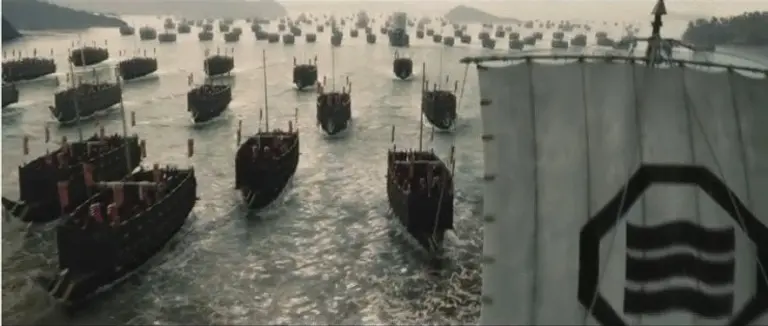
Meanwhile, the Japanese army across the sea wears a completely different expression with overwhelming power and confidence. Kurushima (Ryu Seung-ryong) plans to break through the Myeongnyang Strait and cut off the breath of the Joseon court. It is an ambition to wipe out the Joseon navy in one fell swoop and join the Japanese army on land to finish the war. The Japanese generals accurately grasp the internal strife of Joseon, the collapse of the navy, and the morale of the soldiers. In the scene where the powerful warships fill the black horizon and advance, the audience is reminded that they are witnessing the advance of the Japanese navy during the Imjin War, not a U.S. blockbuster. It evokes a suffocating sense of powerlessness, akin to seeing the overwhelming power of the German army in 'Dunkirk.'
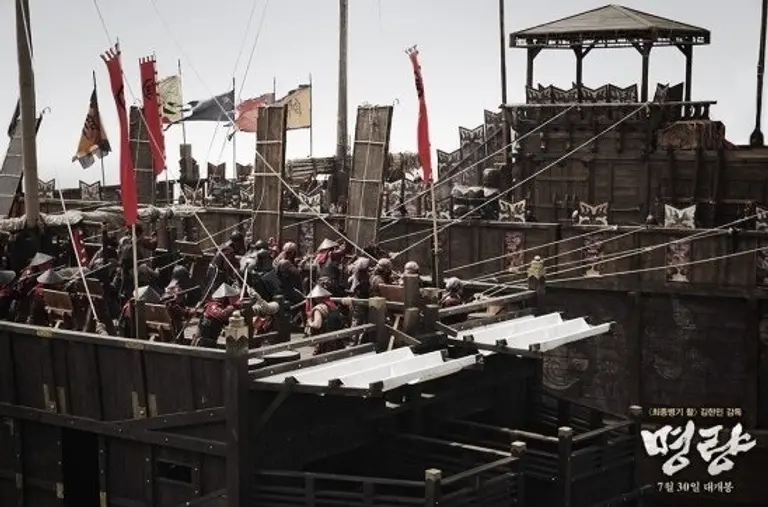
The film shows the prologue of this massive war from multiple perspectives, including those of soldiers, civilians, and even prisoners. Within Yi Sun-sin's camp, there are generals and soldiers dreaming of escape, and common people who must survive. The fishermen and merchants near the Myeongnyang Strait know better than anyone that the sea is both their livelihood and the stage of death. These people must think of their family's survival today before the orders of the court. The film does not merely set these common people as background decorations of war; it sometimes draws them into rebellion against Yi Sun-sin and sometimes as supporters, capturing the weight of war with a realistic sense. Just as 'Saving Private Ryan' portrayed war from the soldier's perspective, 'Myeongnyang' encompasses the perspectives of generals, soldiers, and civilians.
The space of the Myeongnyang Strait is not just a simple background. The narrow channel, fierce currents, and ever-changing tides move like a massive character in itself. Yi Sun-sin is the one who understands the nature of this sea. The film repeatedly shows him pondering 'where to fight' while looking at maps, waves, and tide tables. While many war films focus on 'how many faced off against how many,' 'Myeongnyang' persistently clings to the question of 'where to fight.' Just as Gandalf in 'The Lord of the Rings' shouts, "You shall not pass!" while guarding the bridge, Yi Sun-sin seeks the point to defend the narrow neck of Myeongnyang. The narrow and fierce waters of the Myeongnyang Strait are the only variable where hope can be placed, even in the worst disparity of forces.
It is merely a desperate bloodbath of Yi Sun-sin and the soldiers...
As the battle approaches, the soldiers' fear reaches its peak. Night after night, attempts to desert continue, and secret retreat opinions arise among the generals. Instead of persuading them, Yi Sun-sin makes a colder choice. The scene where he uses chains and ropes to bind the fleet to prevent retreat is one of the most symbolic moments in this film. The idea of binding each other to prevent retreat is not just a tactic but a desperate measure to ensure that fear does not consume courage. Just as Ulysses in 'The Odyssey' ties himself to the mast to resist the Sirens' temptation, Yi Sun-sin binds his soldiers to the ship to overcome the temptation of fear. Initially, the soldiers resent this choice, but gradually they accept the reality that 'if we cannot escape anyway, we have no choice but to fight.'
Finally, on the day of battle, the sails of the Japanese fleet gradually reveal themselves over the foggy and misty Myeongnyang Strait. The twelve ships of Joseon look pitifully small. The Japanese ships are filled with warriors on every deck, equipped with various cannons, arrows, ladders, and hooks. Kurushima sees this battle of Myeongnyang as an opportunity to engrave his name in history and commands an unrestrained advance. Yi Sun-sin boards a single panokseon and moves forward directly. When the soldiers, paralyzed with fear, stop rowing, he personally beats the drum and takes the oars. And shouting, "Do not fear my death," he tries to bear the weight of fear with his own body. Just as William Wallace in 'Braveheart' charges while shouting, "Freedom!", Yi Sun-sin also moves forward through the fear.
The subsequent naval battle sequence is literally the heart of the film. Ships capsizing in the currents, collisions of ships crashing into each other, and the movements of Joseon soldiers leaping onto enemy ships fill the screen without pause. The structural advantages of the panokseon and the weaknesses of the Japanese ships, along with the currents of the Myeongnyang Strait, intertwine, causing the battle to unfold in a completely different manner than initially expected. However, there is no moment when this fight turns into an easy hero story. Fear and pain are etched on Yi Sun-sin's face until the end, and the death of each soldier is depicted without exaggeration, yet never lightly. It is better to witness how the battle concludes, who falls at what moment, and who meets their end with what expression firsthand. The important thing is that this fight is not just about winning or losing, but a process in which people oppressed by fear choose courage for themselves.
If you are a fan of war, especially 'naval battles'
It is the scale and physicality of the naval battle scenes. Until now, there have been few cases in Korean cinema that have shown large-scale battles at sea this long and persistently. This film dedicates almost the entire runtime, which is close to a full movie, to the Myeongnyang naval battle instead of handling it in just a few montage cuts. The sound of ships colliding with the waves, the vibrations when cannons are fired, and the chaos of arrows and gunpowder smoke are relentlessly pushed forward. At some point, the audience feels not like they are following the flow of the story, but rather that they have been thrown into the middle of a chaotic scene. Just as '1917' captured the trenches of World War I in a single take, 'Myeongnyang' allows you to experience the Myeongnyang Strait with your whole body.
The seamless blend of CGI, sets, and actual filming is also noteworthy. The movements of the waves and ships, collisions and damage, fires and sinkings provide a level of physicality that makes you feel, 'That could really hurt.' In particular, the scene where the panokseon and Japanese ships collide, the deck breaks, and soldiers fall off shows the brutality of war with grandeur. The reason this spectacle is not consumed merely as a visual treat is that the camera frequently returns to the faces of Yi Sun-sin and ordinary soldiers. The scale of the battle and the emotions of individuals continuously intersect, allowing the audience to witness not a 'cool battle' but a 'terrifying fight.' Just as 'Master and Commander' depicted naval battles from a human perspective during the Napoleonic Wars, 'Myeongnyang' also views naval battles through the eyes of soldiers.
The key word of the direction is 'fear.' While many war films emphasize courage, sacrifice, strategy, and tactics, 'Myeongnyang' confronts how easily humans crumble under fear from beginning to end. Yi Sun-sin is portrayed throughout the film as a leader who acknowledges fear rather than forcing courage upon the soldiers. He knows fear better than anyone and understands that the way to overcome that fear is not through individual bravery but through structure, environment, and the gaze of others. Binding the ships, beating the drum, and deliberately provoking the enemy's momentum are all strategies predicated on fear. Just as 'Band of Brothers' captured the fears of soldiers in World War II, 'Myeongnyang' prominently features the fears of Joseon soldiers.
Because it is 'our history,' it is linear
At this point, the film distances itself from the common evaluation of being a 'nationalistic film.' Of course, since it deals with the history of the Imjin War and the figure of Yi Sun-sin, some degree of national pride and emotion is unavoidable. However, the emotional line chosen by 'Myeongnyang' is closer to 'we were weak and afraid, but we had to fight nonetheless' rather than 'we were originally strong.' Yi Sun-sin, the soldiers, and the people all start not as heroes but as very ordinary and weak individuals. Therefore, the small changes and choices in the latter half resonate more strongly. Just as Andy in 'The Shawshank Redemption' starts not as a hero but as an ordinary prisoner, the heroes of this film also begin from ordinary fears.
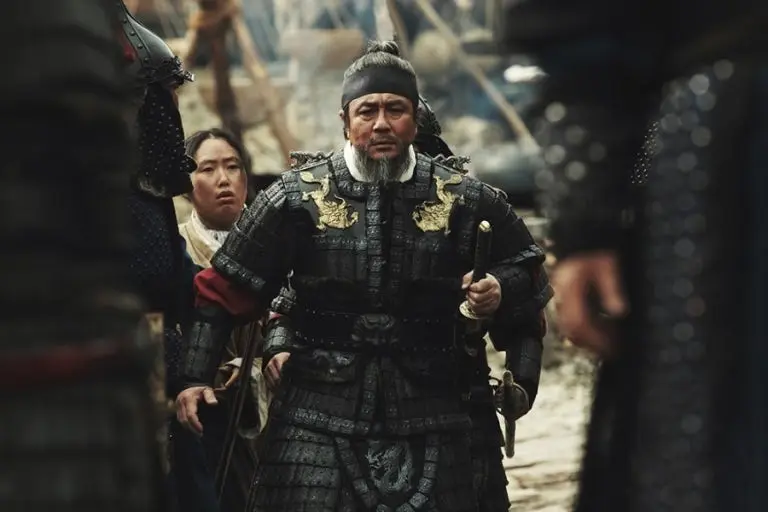
Nevertheless, the portrayal of the villains is clearly linear. Kurushima and the Japanese generals consistently present cruel and arrogant faces. Their lines and actions do not deviate significantly from the mold of 'ruthless invaders.' This is a traditional heroic narrative that the film has intentionally chosen, but it remains a disappointing point for audiences expecting a more complex war drama. Compared to the complex inner lives of Yi Sun-sin and the Joseon navy, the Japanese characters are mainly consumed as devices to create fear and tension. As a result, while the thrill of battle is clear, the perspective of viewing both sides of the war in a three-dimensional manner becomes somewhat blurred. Just as 'Gladiator' simplified the Romans as villains, 'Myeongnyang' also depicts the Japanese army in a somewhat flat manner.
The interpretation of the character of Yi Sun-sin is the film's greatest achievement and point of contention. Choi Min-sik's Yi Sun-sin is not the perfect hero often seen in textbooks. He is weary, suffering, and sometimes cold and cruel. He is the one who understands the soldiers' fears but binds them with chains to prevent them from fleeing. Yet, he is a leader who shows rather than forces or preaches to others, standing at the forefront until the end. His figure beating the drum on the deck, where arrows and cannonballs rain down, makes the audience question, 'What is a hero?' Not perfect morality and correct words, but a person who takes a step further even in the face of fear. The Yi Sun-sin depicted in this film is closer to that. Just as 'Lincoln' showed not a perfect president but a tormented human, 'Myeongnyang's Yi Sun-sin shows not a perfect general but a suffering leader.
Face the Hero of the Korean Peninsula, General Yi Sun-sin
I think of audiences who enjoy the thrill of war films felt through the big screen. In a situation where there are not many Korean films that properly realize the genre of naval battles, the spectacle of 'Myeongnyang' still has few comparisons. If you want to experience the sensation of waves, cannon fire, and metal fragments bursting out of the screen, this work is a good choice. Just as you must see 'Mad Max: Fury Road' in theaters to appreciate its true value, 'Myeongnyang' should also be watched on a big screen with loud sound to fully enjoy it.
Those who have pondered leadership, organization, fear, and courage will see this film from another angle. In conditions of imperfect leaders, members who cannot trust each other, and overwhelming inferiority, it reads as a drama showing how a group begins to move again. The anxiety of the soldiers at that time is not much different from the anxiety we feel in today's companies or society, creating unexpected empathy. Just as 'Apollo 13' demonstrated leadership through a space disaster, 'Myeongnyang' addresses the same theme through naval battles.
Even for those who have already encountered many historical films or narratives about Yi Sun-sin, 'Myeongnyang' is a work worth revisiting. The Yi Sun-sin presented in this film is not a heroic figure on a statue but a person standing on a ship with a body full of wounds. If you want to see a hero standing with fear rather than deifying them, this work provides a good answer. On a day when you want to experience spectacle and emotion, heroism and human drama all at once, I would recommend going back to the fierce waters of the Myeongnyang Strait. And after the movie ends, you will reconsider how the number twelve is both a despairing and simultaneously hopeful number.