

[magazine kave]=Reporter Choi Jae-hyuk
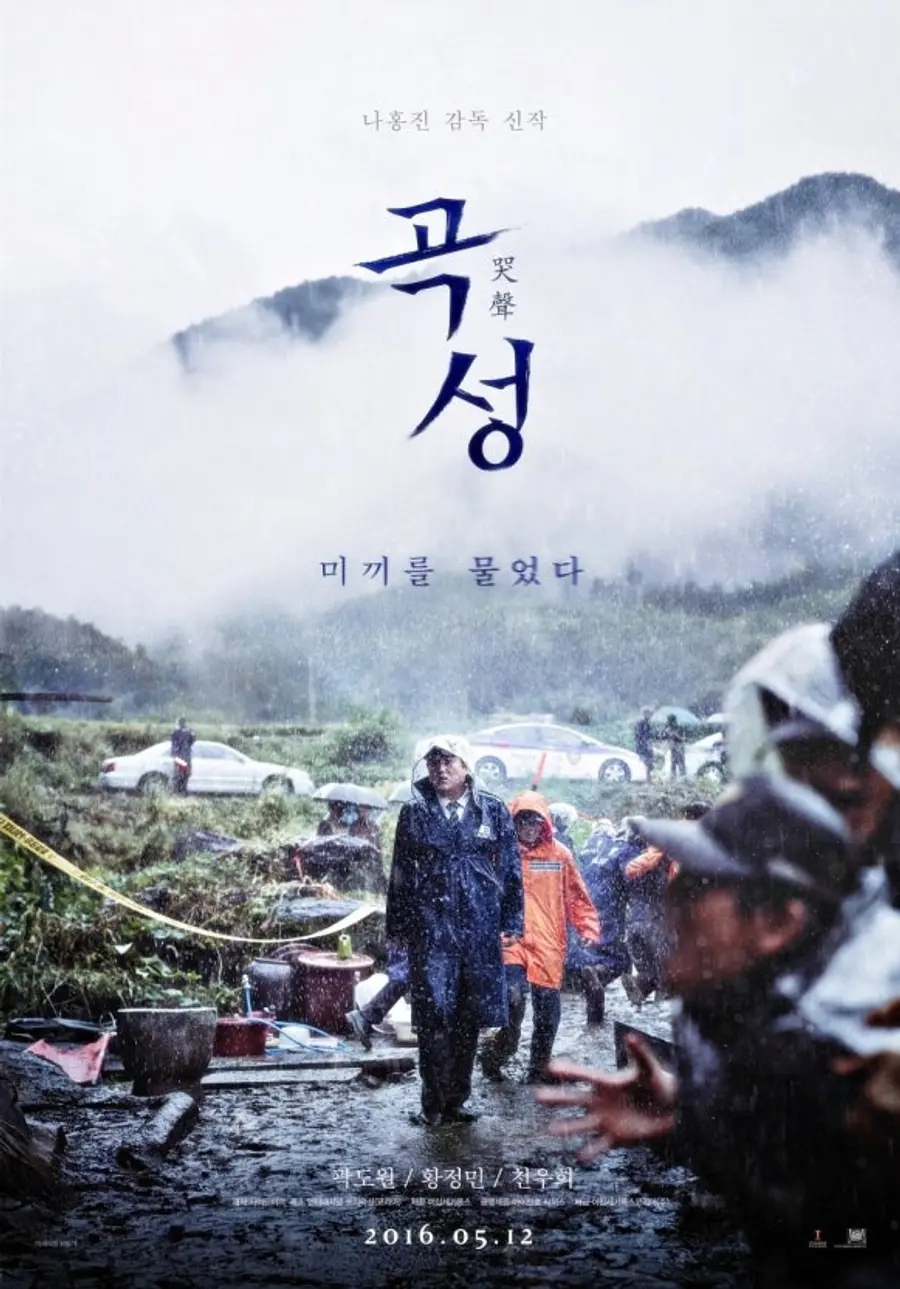
In the early dawn of a dark mountain village, fog covers the valley and rainwater drips from the eaves. Police officer Jong-goo (Kwak Do-won) steps out of his house, suffering from a hangover after a night of heavy drinking. As usual, he deals with domestic disputes and minor incidents, chatting with his colleagues as the day in this 'noisy but uneventful village' seems to begin. Like the first scene of 'Twin Peaks', a foreboding feeling lingers that this mundane life will soon turn into a nightmare. However, a bizarre murder case that occurs somewhere on the rain-soaked mountain road completely turns the atmosphere of the village upside down. The perpetrator stands there, covered in blood, with a vacant stare, while the bodies of the family lie gruesomely scattered inside the house. Jong-goo feels that this horrific scene is closer to a 'nightmare' than reality, but at first, he tries to dismiss it as the act of a drugged psychopath. He is still unaware that he is standing in the midst of a supernatural mystery like Dale Cooper from 'Twin Peaks'.
The problem begins when similar incidents start to occur in a domino effect. The perpetrators all develop dark red rashes on their skin and slaughter their families with vacant eyes. The homes of both the perpetrators and victims are located in a remote village called Gokseong, surrounded by mountains, forests, rain, and fog. As an inexplicable collective madness spreads, rumors about an 'old Japanese man living in the mountains' circulate among the villagers. One day, Jong-goo's mother-in-law exclaims in an agitated voice that an outsider (Jun Kunimura) who has started living near the village is a monster that eats people. As testimonies from those who have seen him in the mountains add up, this unknown man gradually becomes the scapegoat for the entire village's fear and hatred. Just like the villagers in 'The Wicker Man' searching for a sacrifice, the residents of Gokseong also yearn for an explainable evil.
What is the identity of the demon that has consumed my daughter?
Jong-goo's life completely collapses the moment that fear enters his home. His daughter Hyo-jin (Kim Hwan-hee) suddenly starts cursing, mumbling incomprehensible words, and strange rashes and bruises begin to appear on her body. Watching his once quiet and kind child suddenly spew harsh language like Regan from 'The Exorcist' and her complexion darkening, Jong-goo is overwhelmed first by the fear of being a father rather than his job as a police officer. Even after visiting the hospital and giving her medication, no cause is found. An elderly villager knowledgeable in shamanism asserts, "This is not a human illness," and the entire village gradually slips into an area that cannot be explained by science and reason. Just as 'Hereditary' depicted an evil that slowly consumes a family, 'Gokseong' precisely captures the process of daily life gradually collapsing.
At this point, another character appears. A shaman named Il-gwang (Hwang Jung-min) arrives from Seoul, dressed in flamboyant clothes and speaking in a loud manner. After quickly assessing Hyo-jin's condition, he declares that the root cause of the disturbances in the village is the outsider in the mountains. The shamanic ritual that Il-gwang performs is a symbolic scene in the film. As drums and gongs sound madly, red blood and yellow colors cover the screen, with one side showing a curse of death ritual and the other side showing the outsider's suspicious offerings, edited in a cross-cut manner. Like the baptism montage in 'The Godfather' or the exorcism duel in 'Constantine', both rituals send spells toward each other, gradually increasing in speed to match the audience's heartbeat. This scene is a miniature of a religious war where Korean shamanism, Japanese Shinto, and Christian symbols collide.
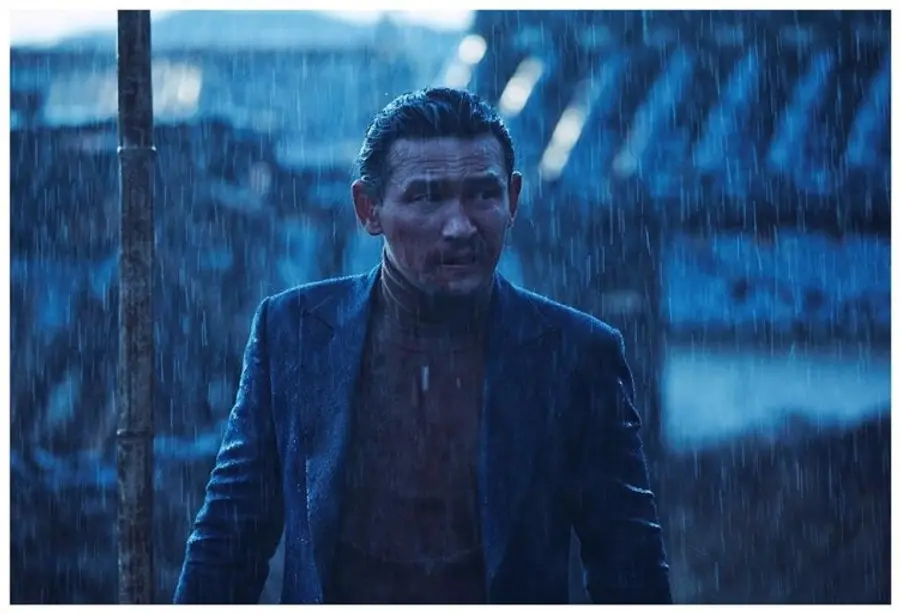
At the same time, somewhere on the mountain path, a mysterious woman named Mu-myung (Jeon Woo-hee) in white clothes wanders like a ghost. One day, she suddenly appears before Jong-goo, throws stones, and leaves strange warnings. She says that the outsider is a demon and that he is devouring Hyo-jin's soul. However, when Il-gwang reappears, he tells a completely opposite story. He claims that Mu-myung is the real evil, and the outsider may actually be the one trying to contain that evil. In a situation where it is impossible to discern which side is telling the truth or if both are lying, Jong-goo is completely shaken. Just as in 'The Usual Suspects' where one is confused about who Kaiser Soze is, the audience of 'Gokseong' cannot be sure who the real demon is until the end.
Jong-goo endlessly wavers between the rational language of a police officer, the instincts of a father, the rumors and prejudices built up by the villagers, and the symbols of shamanism and religion. The village has already transformed from a space of 'logical deduction' into a psychological battlefield tangled with belief and distrust, rumors, and fear. The unknown altar found in the outsider's house, the photos and belongings of the victims, and the bizarre scenes witnessed in the mountain caves all seem to prove the existence of a demon while leaving room for alternative interpretations. The film does not provide the audience with a kind answer until the very end. What choice Jong-goo makes and what conclusion that choice leads to remains the most brutal mystery the film holds. Just as 'No Country for Old Men' gazes at the essence of evil without explaining it, 'Gokseong' leaves only questions instead of answers.
Na Hong-jin's 'Comprehensive Gift Set'
Thus, the narrative of 'Gokseong' starts from a very typical police investigation framework and gradually pulls in images closer to folk horror, religious thriller, and zombie horror. The constant flow of jokes and everyday humor initially makes the audience let their guard down, but as the film progresses, that humor also acts like a shadow of chilling foreboding. It’s funny but you can’t laugh, and the more you try to explain it, the more holes appear in the story. This is where the true aesthetics of the work unfold.
When dissecting the artistic value of the film, the most significant feature of 'Gokseong' is the collision and hybridity of genres. This film is a crime thriller set in a rural village, a horror film featuring ghosts and demons, and at the same time, it is a grand faith drama intertwined with Korean rural landscapes, folk beliefs, shamanism, and Christian mythology. Director Na Hong-jin does not allow these multiple layers of genres to be consumed separately but overlaps them within a single frame. Just as 'Parasite' captured comedy and thriller in one frame, 'Gokseong' also plays back humor and horror simultaneously. The rustic jokes occurring in the police station, the banter of local men in a bar, and the scene where a seminary student awkwardly translates Japanese all feel like the weight of reality. Yet, over this ordinary imagery, the rain-soaked mountains, black dogs, bloody corpses, and shamanic rituals overlap, causing the audience to lose the ability to distinguish 'where reality ends and where the nightmare begins.' Like a David Lynch film, the boundary between reality and hallucination becomes blurred.
At the core of the direction lies an obsessive fixation on 'ambiguity'. Does evil exist, and if so, whose face does it wear? The film does not solve this question as a basic problem until the end. The outsider is portrayed as an old other in Korean society, easily becoming an object of suspicion and hatred. He wanders like a wild beast, is seen near blood and corpses, and is a figure who has filled his house with talismans and altars. However, fear and injustice flicker in his gaze, and he sometimes wears an expression close to that of a hunted beast. Conversely, Mu-myung appears in white clothes and bare feet, like a sacred being, but the camera repeatedly looks down on her or deliberately obscures her face, constantly breaking the audience's certainty. Just as 'Shutter Island' betrays the audience's trust, 'Gokseong' also undermines the reliability of perspective.
The Unknown World Only the Director Knows
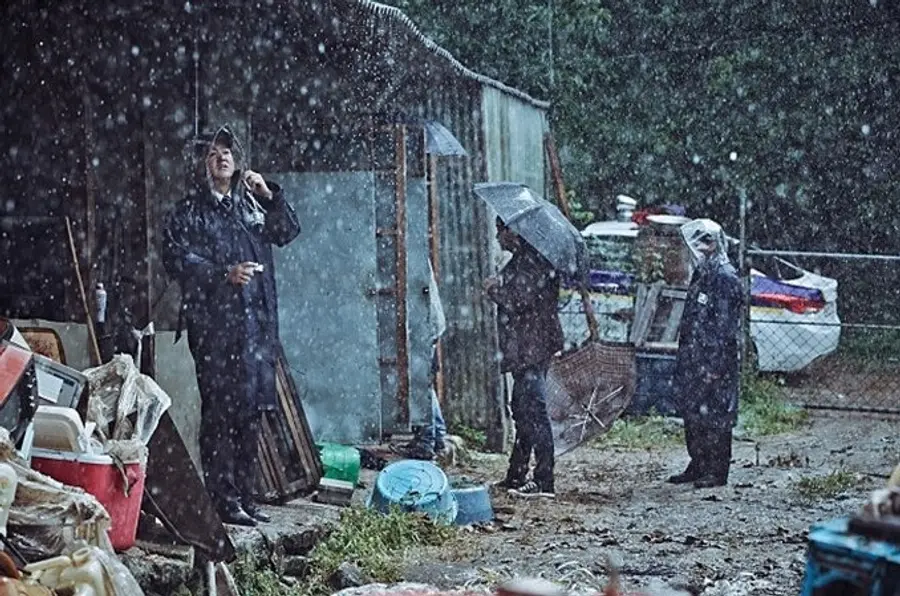
This ambiguity permeates not only the narrative structure but also the film's mise-en-scène and cinematography. Mountain fog, rainwater, the darkness of night, and the blue light of dawn constantly mix throughout the screen. The mountain village is shot not as a 'landscape' but as a 'mood'. The details of jars, greenhouses, narrow mountain paths, old police stations, and chaotic rural village scenery are meticulously arranged, but these familiar images gradually transform into a backdrop of horror. Just as 'Signs' turned an ordinary Pennsylvania farm into a stage of terror, 'Gokseong' also transforms the Korean countryside into the territory of demons. Even after the film ends, when passing through a mountain path on a rainy day, the afterimage of Gokseong will creep back into the viewer's mind.
The sound design and music are also elements that have established 'Gokseong' as a landmark in Korean horror films. This film virtually has no traditional jump scares. Instead, the sounds of beasts, rain, insects, breaking trees, and distant screams serve as layers of horror. With the addition of music during the shamanic ritual scene, it creates an almost trance-like immersion. The rhythm repeats steadily, but the timbre and instruments change slightly, gnawing at the audience's nerves. Instead of horror hitting suddenly, it gradually consumes the body from within. Just like the horror that unfolds under the sunlight in 'Midsommar', the shamanic ritual in 'Gokseong' also unfolds nightmares amidst bright colors.
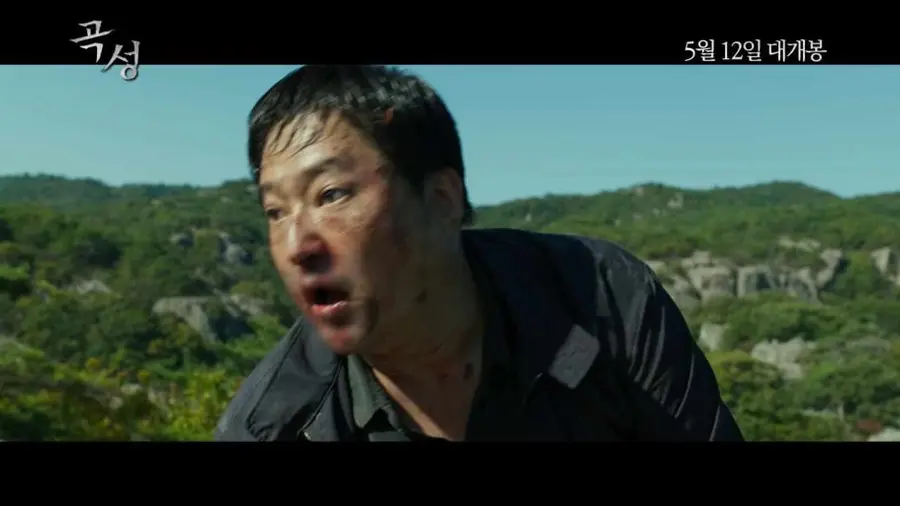
The performances of the actors cannot be overlooked. Jong-goo appears at the beginning of the film as a typical rural police officer, more annoyed than responsible. He is startled while taking pictures at the crime scene, exchanges curse-laden jokes with his colleagues, and seems like a 'dazed' father swayed by the shaman's words. However, as the film progresses, the fatigue, fear, guilt, and doubt accumulating on Jong-goo's face build layer by layer. At some point, the audience begins to wonder, 'Is this person really incompetent to crumble like this, or would anyone collapse under such circumstances?' This question itself connects to the way the film views humanity. Just as Chief Brody in 'Jaws' is merely a powerless human in front of a shark, Jong-goo is just a father in front of evil.
Il-gwang's presence is another axis. He first appears with a flamboyant shamanic ritual and confident speech, resembling the character of a 'capable shaman' familiar to Korean audiences. However, as the events deepen, it becomes clear that he is also just a human caught up in fear. What he truly believed in and how much confidence he had in his words and rituals are never clearly revealed. Mu-myung is remembered more for her gaze, gestures, and timing of appearance than for her lines. The moment she appears, the air in the frame twists slightly. Sometimes like salvation, and other times like disaster. The outsider explains himself more through silence than words. His house, his belongings, and the direction he looks only pose riddles to the audience. Like Anton Chigurh in 'No Country for Old Men', he is the embodiment of unexplainable evil.
A Remarkable Work That Cannot Be Dismissed as Just 'Horror'
Of course, this film is not a friendly work for all audiences. The running time is long, and the narrative structure is far from typical Hollywood horror. For audiences expecting clear evil, perfect answers, and refreshing catharsis, 'Gokseong' may feel somewhat frustrating and unfriendly. The latter part, with its interpretative battles and twists and counter-twists, requires concentration. Some viewers may find the mix of genres too distracting. However, if one endures this unfriendliness and follows through to the last scene, they will feel that the emotion of 'horror' is something beyond mere surprise or disgust. Just as 'The Blair Witch Project' created invisible horror, 'Gokseong' also creates an uncertain fear.
Those looking for a film that cannot be defined simply as a 'horror movie' come to mind. It is not just a work that is scary, but a film that leaves the viewer's mind tangled for days after watching, making 'Gokseong' an excellent material for those who want to chew over each scene and attach their own interpretations. If you enjoy experimental horror that breaks the mold of genres, the confusion and anxiety that 'Gokseong' offers will come as a great pleasure. Just as audiences who love 'Twin Peaks' or 'True Detective' Season 1 will find the mystery of 'Gokseong' captivating.
If you have ever felt somewhat exhausted by life and questioned through the news, "Why do such things happen?" Jong-goo's shabby back will linger painfully. With a family to take care of, a world that does not go as planned, and a time when reliable standards are becoming increasingly blurred, 'Gokseong' brutally and honestly shows what choices a human can make. From Jong-goo, who cannot find a perfect answer, the audience catches a glimpse of their own face. Just as Charlie in 'The Cable Guy' confronts his own powerlessness, Jong-goo also faces his limitations.
Finally, if you want to see the emotions of Korea's mountain villages and traditional beliefs, this film is almost a must-watch. The images in this film, where Western demons, Korean mountain spirits, shamanism, Christianity, rain, fog, blood, and earth are all intertwined, are hard to forget once seen. The experience of watching 'Gokseong' is perhaps similar to entering a deep mountain path without any guaranteed answers. The way back will not be easy. However, once you walk that path, you will realize that subsequent horror films feel much simpler. In that sense, 'Gokseong' is not just a simple horror film but showcases the strength of Korean cinema.