
[magazine kave]=Choi Jae-hyuk reporter
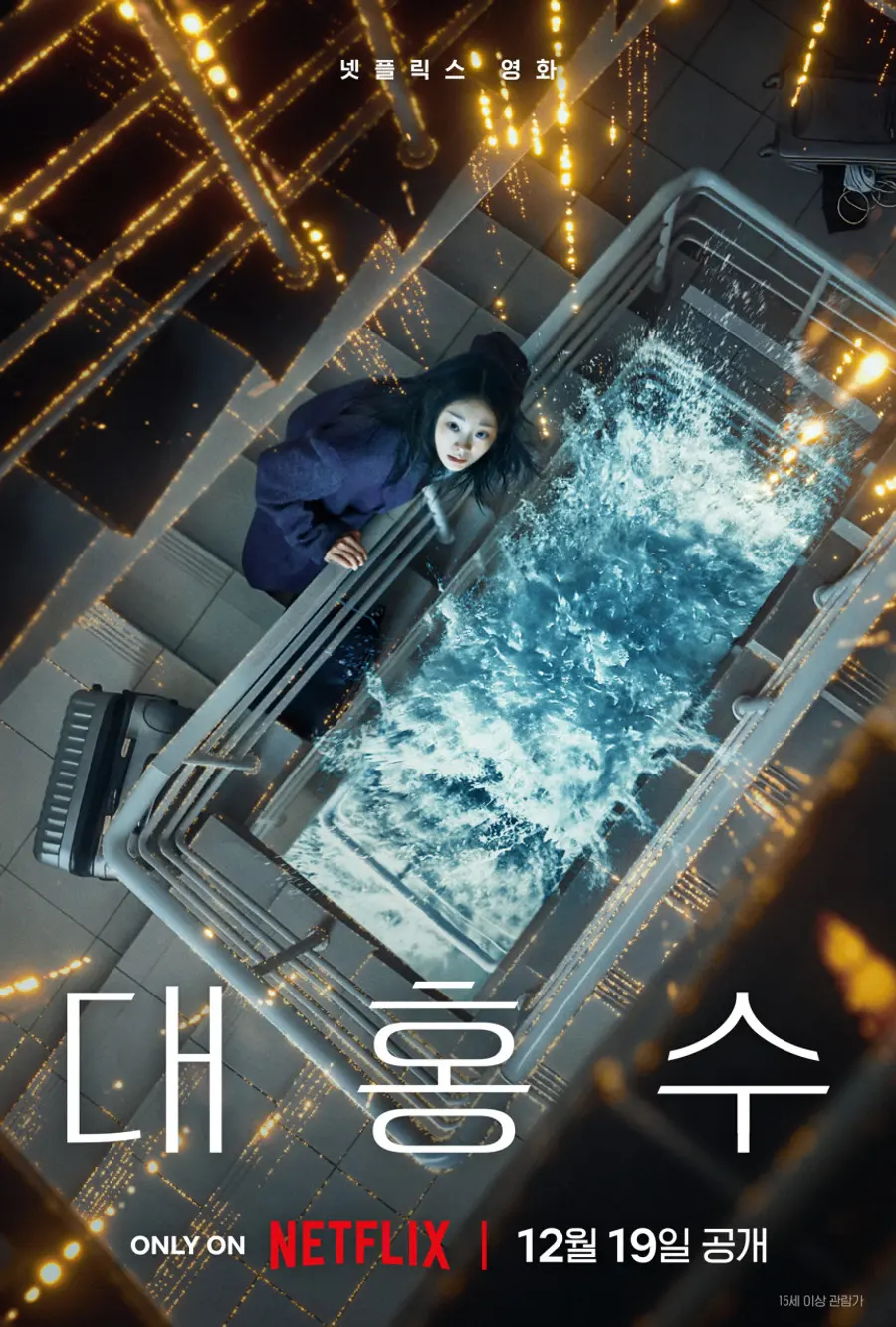
The city is submerged. Only the high-rise apartments barely stick their heads above the water, floating like islands, and the view outside the window has long turned into the sea. Researcher Koo Anna (Kim Da-mi) continues to ascend somewhere in the apartment, holding her young son Jae-in in her arms, amidst the intermittently ringing alarms and flickering lights. The end of the stairs is not visible, and behind her, murky water swallows each step. Outside, the last remnants of human civilization float by, and Anna clutches a small device tightly in her hand. It is not just a simple research result but something akin to a 'key' developed for the survival of all humanity.
The film immediately throws the audience into a world after this massive flood has already occurred. There is no time to check the situation through the news or wait for the government's official briefing. Humanity is on the brink of extinction, and people struggle to survive in their own ways. The apartment where Anna lives is depicted as a special space among them. Inside the submerged building, there are still people waiting for rescue, families who have not given up, and those who want to protect something until the end. Anna was originally an artificial intelligence researcher, but now she bears the excessive roles of a scientist, a mother, and humanity's last hope.
Her goal is not simply to escape with her son. She must transport the results of a secret project she participated in to a specific location. Early in the film, it hints that the project is not just a technological development but an attempt to preserve humanity's memory and identity. Amidst the flooded corridors, severed power lines, and the rushing water filling the elevator shaft, Anna throws herself to protect the device. The stairs and corridors are designed almost like a maze, with new obstacles and characters appearing on each floor.
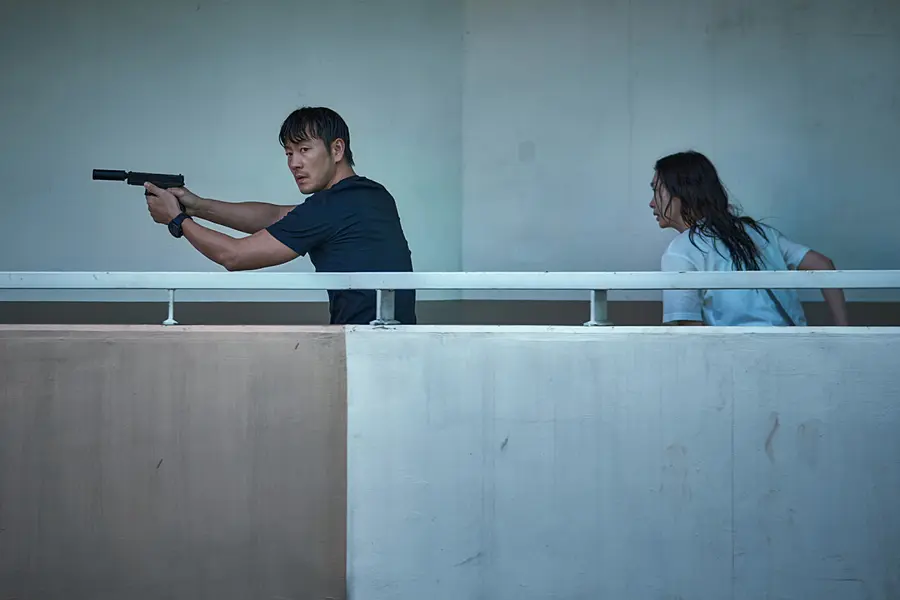
At one point, a former soldier agent, Son Hee-jo (Park Hae-soo), appears before Anna. He seems to have more information about Anna's research results, having been dispatched for a top-secret national mission. Their relationship is more of a temporary partnership based on overlapping interests rather than cooperation from the start. Son Hee-jo urges Anna to make a choice with the coldness typical of a soldier, and Anna continues to waver between her instincts as a mother and her responsibilities as a researcher. Amidst their conversation, the sounds of rescue requests and collapse echo from beyond the apartment walls.
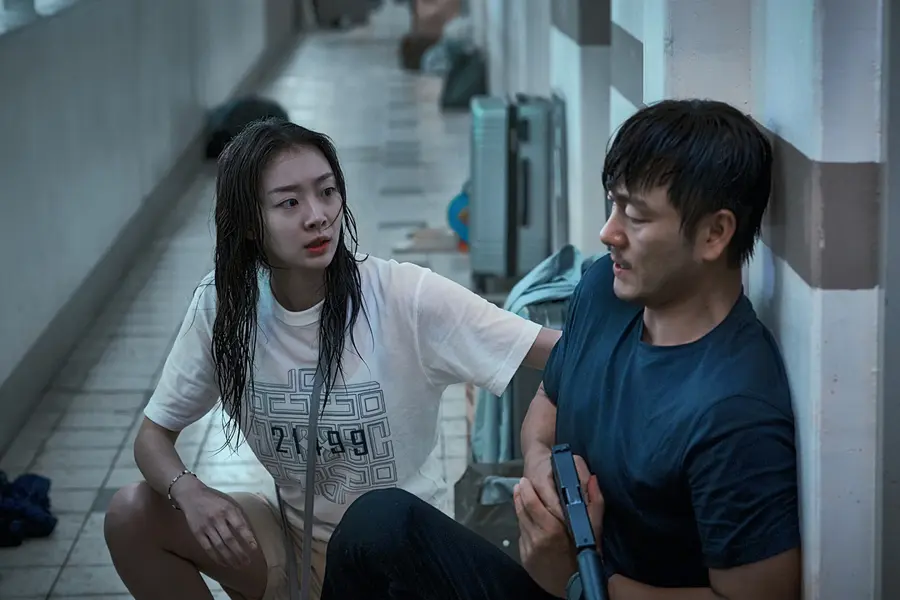
Throughout the film, brief glimpses of the world outside the apartment are shown. Most cities have already sunk underwater, and satellite communications are nearly cut off. Survivors send signals from the rooftops of high-rise buildings, maintaining their last connections. Images of rescue helicopters cutting through the sky, debris floating on the water, and distant explosions flashing by are briefly shown. However, the central stage remains inside the apartment until the end. The film attempts to create urgency by intersecting the movements of Anna, Jae-in, Son Hee-jo, and other survivors within this confined space.
As they move between floors, the situation becomes more complicated. On one floor, an elderly man insists on holding onto his home, while on another, a group appears trying to control others with food as bait. Various types of survivors pass by, including a pregnant woman holding a child, a patient waiting for rescue, and people struggling to save their own families. Anna is forced to make choices among them. Whose hand to hold, what to give up, the film repeatedly poses these questions. In this process, the identity of the 'key' she possesses and the implication that this flood is not just a natural disaster gradually become clear.
As the film progresses, the outer shell of the disaster movie becomes thinner, and elements of science fiction such as artificial intelligence, simulation, and the storage and replication of memories come to the forefront. Anna gradually realizes what purpose the system she has developed is actually being used for and its relationship to the flood. It is also hinted that Son Hee-jo is not just a simple rescue agent but part of a larger plan surrounding that system. However, the film crams this grand narrative and philosophical questions into the narrow space of the apartment and the limited conversations of the characters. The audience learns that Anna's choices are not just a personal maternal issue but a matter that determines the direction of all humanity, yet they must confirm for themselves where the conclusion leads. The core twist of this work and the final choice scene are best experienced firsthand, so I will only take you to the doorstep here.
A Grand Ambition of a Sinking Ship
Unfortunately, while 'Flood' appears to be quite an ambitious disaster SF movie based on its premise, it feels like it has almost failed to connect that ambition to actual cinematic completion. The biggest problem is not the mixing of genres but the collision of genres. It tries to embrace disaster blockbusters, maternal dramas, hard SF dealing with artificial intelligence and simulation, and philosophical plays questioning humanity's ethics all at once, but the narrative pathway that stitches them together is flimsy. It's like going shopping, filling the cart, and then finding that the ingredients don't match when you open the fridge at home. Therefore, the audience's experience feels more like 'disorganized' than 'abundant.'
The early disaster depiction is not bad. The submerged apartment stairs and corridors, the underground space where the generator is dying, and the view of the flooded city outside the window showcase visuals rarely seen in Korean commercial films. The water rises along the stairs, and there is a clear tension in the scenes where characters gasp for breath in the confined space. The problem is that this tension does not properly align with the progression of the story. Visually, there is a crisis, but the lines spoken by the characters feel awkward, as if they were cut and pasted from different genres, and the emotional arcs of the characters pop out in each scene. While the water rises terrifyingly, the dialogue casually engages in philosophical discussions, and scenes where people on the brink of life and death suddenly share family histories feel more like a drama lost in the editing room than a thrilling thriller.
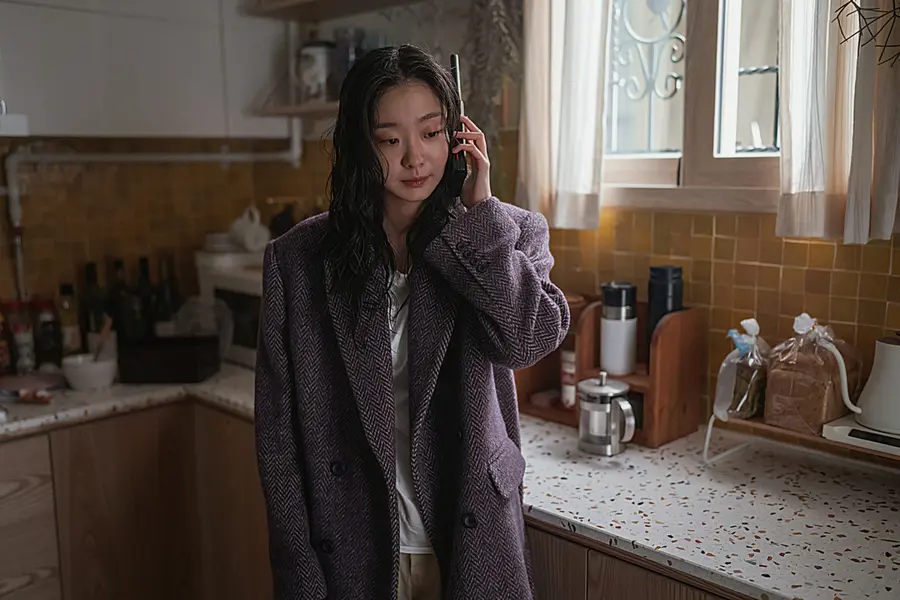
The character of Koo Anna seems very attractive based on her setup. She is an artificial intelligence researcher, a single mother, and holds the key to research that will determine the future of humanity. However, the film fails to fully develop this complex character. Anna shifts between her roles as a mother and a researcher depending on the situation, but the conflicts and psychological changes between them do not build convincingly. Her emotions quickly switch from tears to determined expressions to anger, leaving no room for the audience to enter. It feels like skimming through a sampler of emotions at a rapid pace. Kim Da-mi's performance tries to fill that gap but feels scattered in the weak dialogue and structure. This is a textbook example of what happens when a good actor meets a bad script.
Son Hee-jo is no different. Park Hae-soo can show both the coldness of a former soldier and human turmoil, but the film consumes this character at the level of an 'information delivery agent.' There is almost no narrative about why he undertakes this mission, what he believes in, and what he fears. Instead, he appears at crucial moments to explain the setup or deliver unnecessarily grand lines, breaking the tension of the scene. After hearing lines like "We don't have much time left" about four times, the audience begins to resent the screenwriter more than the clock. The character who should lead the audience in a disaster movie feels lost within the story itself.
The Laziness of a Script That Tries to Solve Everything with Explanations
The most serious problem with the script is that it tries to resolve the core setup solely through 'explanation.' Why the flood occurred, what the artificial intelligence project aims for, and how human memory and consciousness are handled are mostly thrown out through dialogue and brief flashbacks. In the process, instead of leaving room for the audience to think, it repeatedly uses vague terms and sentences, only increasing confusion. Good SF shows its worldview visually, through situations, and through the actions of characters, but 'Flood' feels like it's reading a PowerPoint presentation, explaining everything. In the latter half, there are setups that flip the nature of the story, but this twist also drops suddenly without sufficient foreshadowing or emotional preparation. Therefore, from the audience's perspective, the feeling is more 'just random' than 'surprising.' It's like a magician revealing a trick instead of showing it, saying, "Actually, there's a mirror here."
There is also a lack of pleasure as a disaster movie. There are scenes utilizing the material of water, and certain sequences definitely bring thrills, but overall, there are many repetitions and gaps in scale and direction. Given that it chose a limited space like an apartment, the pressure of a closed disaster drama should emerge, but the design of movements and space utilization is monotonous, making it feel like there is no significant difference even when changing floors. Whether it's the 15th floor or the 20th floor, similar corridors and stairs continue, and the water rises the same way. Thus, the sense of crisis felt by the audience gradually fades. The water continues to rise, but the film feels like it's spinning in place. It feels like running on a treadmill, sweating a lot but not moving forward at all.
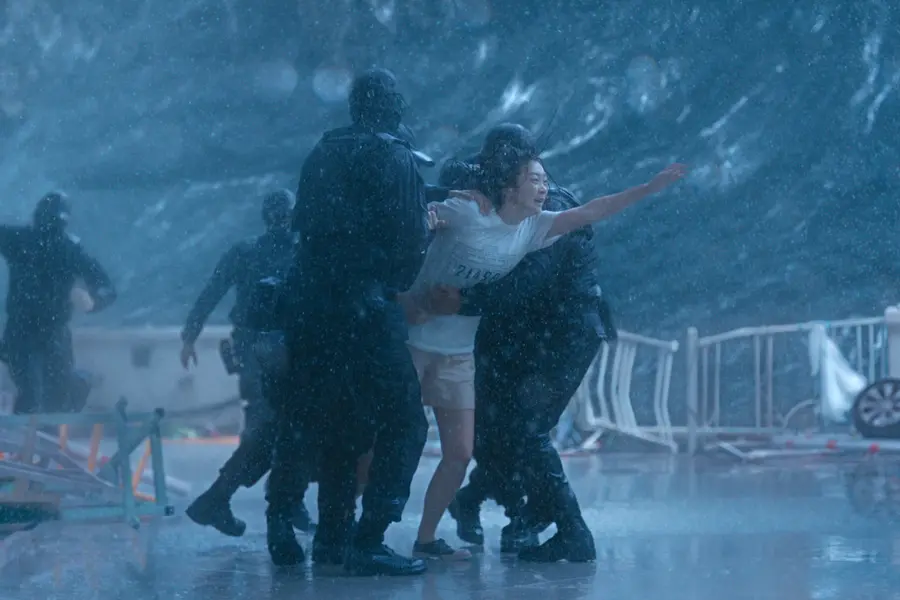
The directorial tone is also inconsistent. In some scenes, it seems to pose serious reflections and philosophical questions, while in the next scene, it brings in embarrassingly exaggerated emotional lines and melodramatic clichés. When discussing choices that determine the fate of humanity, suddenly pouring out lines close to melodrama confuses the audience about where to invest their emotions. Genre experimentation is good, but if the basic structure and rhythm to support that experiment are not in place, it ultimately results in an 'in-between' outcome. 'Flood' seems to have fallen into that trap. Disaster, SF, and drama are all awkwardly scattered, holding each other back.
Lost in the Editing Room
Editing and rhythm are also problematic. Despite not being a long runtime, the perceived speed in the middle is close to boredom. Unnecessary dialogues drag on when important information should come out, and scenes of characters going up and down the stairs and corridors are repeated with similar compositions and movements. The audience begins to confuse whether Anna is climbing the stairs again or if it's a new scene. Conversely, important clues related to the worldview in the latter half pass by too quickly or cut to the next scene before the emotional aftertaste can be felt. The overall rhythm is dominated by a reversed sense of pacing, where shallow parts that should be deeply explored are glossed over, while parts that could be omitted are dragged out. It feels like the night before an important exam, where instead of studying the exam material, one spends three hours reading irrelevant appendices.
Nevertheless, the performances of the actors consistently fulfill their roles. Kim Da-mi, even in the physically demanding environment of a submerged set, brings out the fear and responsibility of a mother as realistically as possible. The trembling of her arms holding her son, her wet clothes, and her exhausted gaze all convey desperation. Park Hae-soo also embodies the tension and fatigue unique to soldiers, even amidst weak dialogue. Supporting actors also convincingly portray the faces of survivors in their respective roles. However, good acting does not directly translate to a good movie. This work lacks the directorial and script strength to tie together the emotional moments created by the actors. Therefore, while a few impressive scenes come to mind, they do not connect into a cohesive film. It feels like excellent ingredients are left separately in the corner of the kitchen, never completed into a dish.
The Paradox of the Netflix Chart
An interesting point is that while it has received much criticism domestically, it ranks high on the Netflix global chart. From the perspective of global audiences, the format of 'Korean disaster SF' may still feel fresh. Due to the nature of streaming platforms, as long as there is enough power to get someone to hit the play button, the initial ranking can be easily boosted. A flashy poster, familiar actors, and a grand introduction of the setup can all garner a click. However, the completeness of the work and its lasting impact are entirely different issues. This film certainly has attention-grabbing material and star casting, but it falls far short of the depth and completeness that would make it memorable for a long time. While the chart ranking can show the film's 'popularity,' it does not prove its 'value.'
Who Should Board This Ship?
Now, thinking about which audience to recommend 'Flood' to, honestly, I wouldn't want to recommend this movie to those expecting a high-quality disaster film or solid SF. For those wanting both the thrill of the genre and the persuasiveness of the narrative, frustration and disappointment are likely to come first. After the movie ends, instead of the question, "What did I just watch?" a sigh of "Ah, what a shame" is more likely to escape.
Rather, for film students or creators who want to study the difficulties of filmmaking and the pitfalls of genre mixing through a failed work, it may serve as a cautionary tale. It kindly illustrates that 'good intentions and flashy setups alone do not complete a film.' There are plenty of scenes that could be used as samples in screenwriting classes for "This is how you shouldn't write." Overly complex setups, reliance on explanations, tonal inconsistencies, and failures in character utilization all come together as a case study of the script's pitfalls.
Still, there are times when I want to watch such a movie. After work, when I turn on Netflix without thinking and watch an automatically playing work, I want to ask, "Why is the story not unfolding this much?" On days when I want to confirm both the possibilities and limitations of Korean-style disaster melodrama. Or on days when I'm curious about how much my favorite actor can endure through adverse conditions. If that's the mood, 'Flood' is a strangely ambiguous choice to put on and grumble about in my heart.
Lastly, one more thing to add is that the first thought that comes to mind after watching this movie is "What a waste." It had good actors, an interesting premise, and a genre mix worth trying, but it lacked a solid narrative framework to tie them all together. While the film itself lacks entertainment value, it may come at the audience with a force of criticism and cynicism, much like its title suggests. And in that wave, we are reminded once again that in filmmaking, how to cook those ingredients is far more important than just gathering good materials, a truth that is all too obvious.