

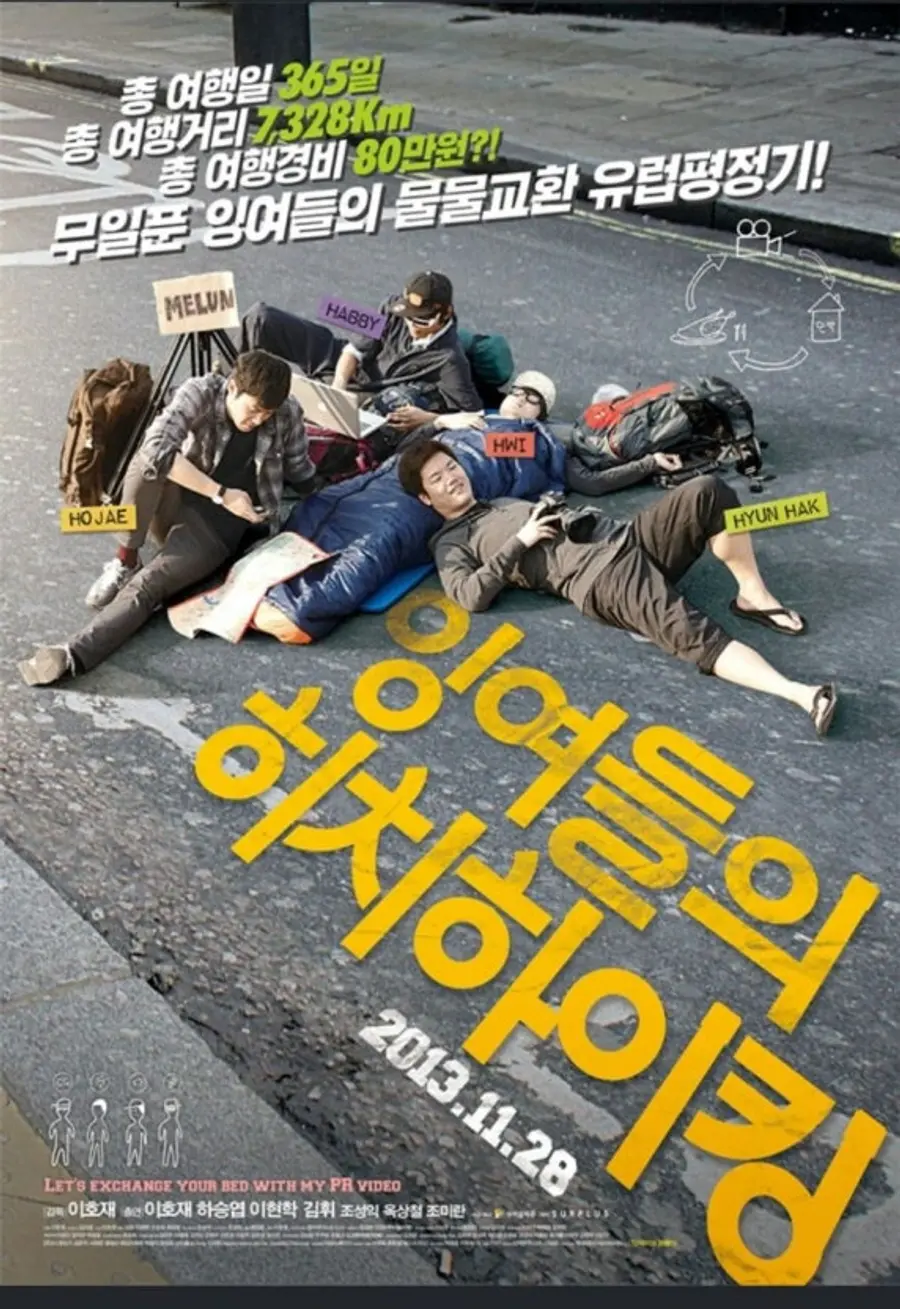
|Kave Magazine=Reporter Choi Jae-hyuk In front of the airplane boarding gate, instead of a large suitcase, there are a few old backpacks and a camera bag. Four friends who call themselves 'surplus'—Ho-jae (Lee Ho-jae), Ha-bi (Ha Seung-yeop), Hyun-hak (Lee Hyun-hak), and Hwi (Kim Hwi)—board a flight to Europe. All they have left in their bank account is 800,000 won and a camcorder in hand. Their plan is simple yet reckless. "We'll shoot a promotional video for your hostel, so please provide us with accommodation and a little money." They will travel around Europe for a year, repeating this barter, and ultimately find a musician to complete a music video. And they will document the entire process and screen it in theaters. It's as if they are turning the film 'Eternal Sunshine of the Spotless Mind' backward, turning on the camera first to create memories. The movie 'The Hitchhiking of Surplus People' begins right at the ignition point of that plan.
The four are classmates from the film department. At school, they were treated as 'useless kids' and always struggled between tuition and living expenses. Even when they worked part-time jobs in filming, they couldn't even cover half of their tuition, so they made a completely different choice. "Should we earn tuition and return to school, or should we just try something completely absurd?" Ultimately, they choose the latter. They decide to embody the recklessness of their twenties, which may be the first and last time. This moment is akin to when Jesse and Celine got off the train in 'Before Sunrise', abandoning calculated rationality and embracing intuition.
However, from the moment they land in Paris, the plan begins to crack little by little. There are hardly any hostels that readily accept the proposal, "I'll shoot a promotional video, so please let me stay." Even when they send emails, there are no replies, and when they visit in person, they are often turned away. The camera mercilessly captures the faces of their frustrations. The four stare at their nearly empty bank account with a laptop in between, making jokes to comfort themselves, saying, "Isn't this still fun?" while their expressions grow quieter at night. Instead of the usual exclamations like "Wow, it's Paris!" seen in travelogues, this film gazes longingly at the humid dawn air of Paris and the backs of young people wandering the hostel corridors. Just as 'Lost in Translation' reinterpreted Tokyo as a stage of loneliness, this film repositions Paris not as a romantic backdrop but as a frontline of survival.
In Youth, Should We Suffer?
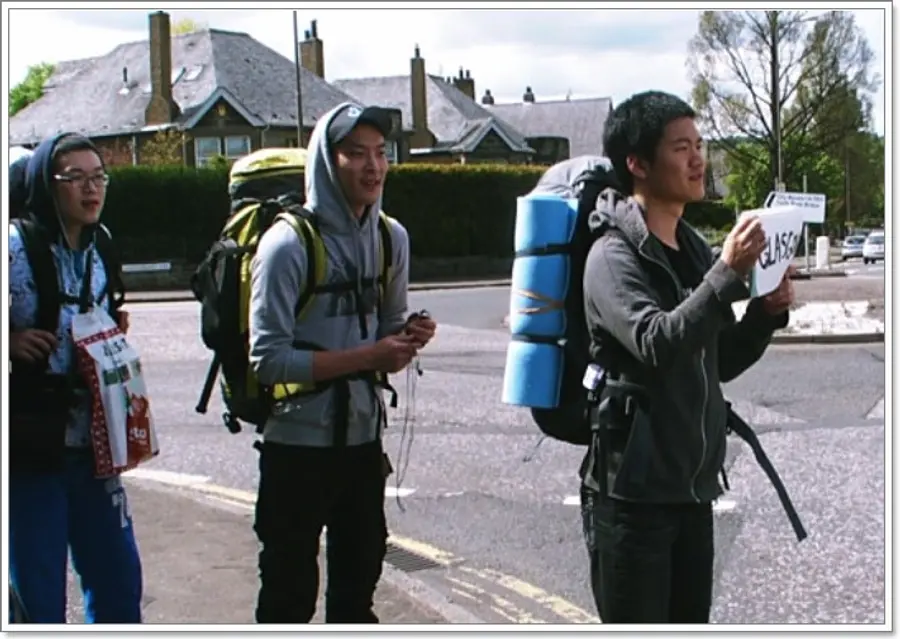
As their bodies and minds become exhausted, the initial plan becomes increasingly powerless. The four friends eventually descend to southern Italy and summon another reckless skill called 'hitchhiking'. They raise their thumbs on the road and squeeze themselves into the car that finally stops. Inside the car, foreign languages, gestures, and broken English intertwine. Repeating the introduction, "We are filmmakers from Korea" dozens of times, they gradually shed the face of travelers and adopt the expression of 'workers on the road', much like Frances McDormand in 'Nomadland'. They can manage to sleep roughly, but they cannot hide their hunger, leading to days of rationing food or even fasting. There are moments when they freeze the camera for nearly a month due to cold and fatigue. This void remains as 'silence' on screen.
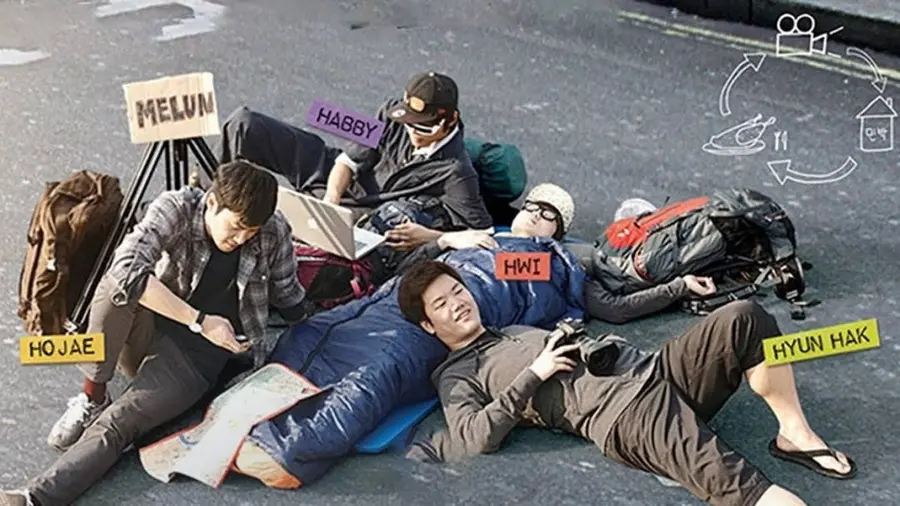
Then, finally, the first deal is made. A hostel has accepted their proposal. The four's eyes light up. They explore the room, film the lobby, and collect interviews from guests, building the 'promotional video' they had imagined. The screen at this moment is particularly vibrant. It is the first time their prepared skills and equipment ignite into action. As this video begins to spread by word of mouth, they start receiving contacts from hostels all over Europe. They still have no money, but at least they secure a place to sleep. From France to Italy, Turkey, and the UK, new cities, hostels, and faces are archived on camera. The film captures moments of cooking together in the kitchen, singing along while playing guitar in the lobby, and scenes of editing with heads together behind the check-in counter, more than pretty landscapes like postcards. This is a process of reconstructing community through labor, just as 'Chef' (2014) rediscovered family through food trucks.
However, the reason 'The Hitchhiking of Surplus People' does not simply end as a brag about a no-money trip is that it does not conceal the cracks and conflicts within this journey. When they run out of money, scenes of conflict arise over whether to continue filming or return home, moments when dissatisfaction erupts over each other's shares, and conversations questioning, "What are we doing right now?" are archived by the camera. Sometimes, the person in charge of filming intentionally avoids capturing fights, while at other times, they get too close and mercilessly capture someone's tears. The documentary's core energy is like the needle of a seismograph shaking. Just as 'Birdman' captured the chaos of the filming site in one take, this film reconstructs the chaos of travel through fragmented shots.
As they reach the final destination of their journey, the four friends recall the last goal they initially set: the 'music video'. They promised to meet the British musician Arco and complete a music video for them. There are only a few days left. Their equipment is worn out, and their stamina is depleted. But they stubbornly carry the camera and dash through the alleys of London. The film carries the results of this final sprint to the end, but how that music video is completed and how this film encounters the world after returning to Korea is something the audience should discover for themselves. What is important is that this 365-day journey is not just about "We had a great time" but rather a story of growth showing "how we endured and how far we clashed."
If You Want to See the Reality of Youth in South Korea
'The Hitchhiking of Surplus People' may seem like a cheerful road documentary on the surface, but in reality, it is a raw record of the early 2010s generation of Korean youth. After the IMF crisis, during the time when the term '880,000 won generation' was popular, the self-identification as 'surplus' was not just a self-deprecating joke but a kind of survival strategy. Just as the protagonist of 'Slumdog Millionaire' did not shy away from his slum background but used it as a weapon, this film engraves that word in its title. "We are surplus." Youth that has not yet properly docked in school or the labor market, fluid and transient. But precisely because of that, they are the ones who can soar the farthest and the most recklessly. This paradox is visualized through the expressions and bodies of the four characters.

Formally, this work is a model case of DIY documentary. The director Ho-jae (Lee Ho-jae) crosses between in front of and behind the camera, explaining the situation and sometimes boldly exposing the raw faces of the four. The screen often vibrates, and scenes with mismatched exposure or out-of-focus shots are adopted as they are. It is far from what is commonly referred to as 'high-quality visual aesthetics'. Instead, it is saturated with a sense of presence. The scenes of the lens fogging up in the dawn, hitchhiking on the roadside in the rain, and editing with heads close together in a cramped hostel room penetrate more persuasively due to their rough texture. It is not a declaration of "We shoot as we are" but rather an attitude of "We shoot as much as we can right now." This is a strategy that transforms limitations into aesthetics, just as 'The Blair Witch Project' or 'Paranormal Activity' reinvented horror through found footage.
A noteworthy point is the coordinates of the camera. In typical travel documentaries, the camera aims at the outside world, capturing landscapes, people, and tourist attractions. However, in 'The Hitchhiking of Surplus People', the camera often reverses direction towards the four. While they film the locals who help them hitchhike and the hostel owners, the most frequently appearing faces are ultimately their own. Faces that are annoyed from exhaustion, moments of suddenly becoming serious while laughing at absurd jokes, and scenes where the question "Can we go all the way with this?" hangs in the air. This is not just a travel record but also a process of dissecting oneself through the camera. Just as Watson in 'Sherlock' reconstructed his experiences through his blog, they also reassemble their identities through the camera. Thus, at some point, the 'us filming' and the 'us as subjects' collide. The tension between those who want to stop filming and those who want to keep it running is etched into the screen.
In terms of content, it precariously straddles between the praise and criticism of youth. On one hand, this film declares, "Do not be afraid, go out, and clash." It repeatedly conveys the message that even if the plan is not perfect and money is insufficient, a path will be forged if action is taken. The laughter and optimism of the four friends in the documentary resonate with the audience's hearts. However, at the same time, the film does not conceal how precarious this journey was. Romanticizing a no-money trip is disproven by scenes of sitting idly due to hunger and moments when emotions build up and explode. The criticism that "Wasn't it possible because of you?"—in other words, that this recklessness was only possible due to a certain level of safety net, talent, and stamina—can certainly be raised. Just as the criticism that Cheryl Strayed in 'Wild' could walk the Pacific Crest Trail thanks to the privilege of being a middle-class white woman. The film does not directly respond to this criticism. Instead, it leaves that question embedded in the conversations and expressions of the four friends.
Considering the social context, the meaning of this work becomes clearer. In their mid-twenties, young people from the film department, crushed by tuition and future prospects, choosing to drop out of school and 'burn a year' was shocking and liberating for many viewers at the time. They tilt in a direction that no one has authorized. An attitude of wanting to fully own that failure, even if it happens. This is what distinguishes 'The Hitchhiking of Surplus People' from a simple travel vlog. The journey in this film ultimately culminates in the film itself. In other words, they did not just travel; they practiced the labor of "making a movie" in another continent. Just as 'Boyhood' recorded growth over 12 years, this film documents self-discovery over a year. When this documentary shot on the roads of Europe is actually screened in theaters and encounters the audience, that recklessness gains another meaning.
A Youth Film from the Time When the Term 'Surplus' Was Popular
For those in their twenties today, especially those often surrounded by the anxiety of feeling like they are falling behind, this work can provide a strange comfort. It does not mean that the friends' choices are the right answers. Rather, it is a process of proving that there are no right answers. Even if things do not go as planned, even if they clash and regret along the way, the film visualizes the possibility that one can still attempt something at least once. Watching it, one can sense, "Ah, I'm not the only one vibrating like this."
Additionally, I would recommend it to aspiring creators who want to create content but hesitate to start. This film proves that even without enormous equipment and capital, or meticulous storyboards and large teams, if there is a story you want to tell, you can just start filming. Of course, a certain level of stamina, persistence, and skill like those of the four friends is necessary. However, the fact that those who started, even if imperfectly, ultimately completed 'one piece' is a greater stimulus than one might think. The key point is that attitude came first, and that attitude eventually led to completion. This film can be positioned in the lineage of punk creations armed with DIY spirit, like 'Tank Girl' or 'Clerks'.
For those who love travel but are a bit tired of Instagram-style 'curated travel', 'The Hitchhiking of Surplus People' will be an interesting experience. Instead of carefully selected cafes, exhibitions, and viewpoints, there are roads where cars do not stop, hostels with reservations stuck, and rain that disrupts schedules. Yet, the cities, roads, and people of Europe still beautifully penetrate. Not just postcards, but as backgrounds of people colliding, collapsing, and rebuilding.
After watching this film, you might find yourself pondering this question: "How do I want to invest my twenties, my present?" For those who want to confront that question head-on at least once, 'The Hitchhiking of Surplus People' will serve as a rather honest mirror. Ultimately, what this film proves is simple. Surplus does not exist. There are only variables that have not yet discovered their equations.