

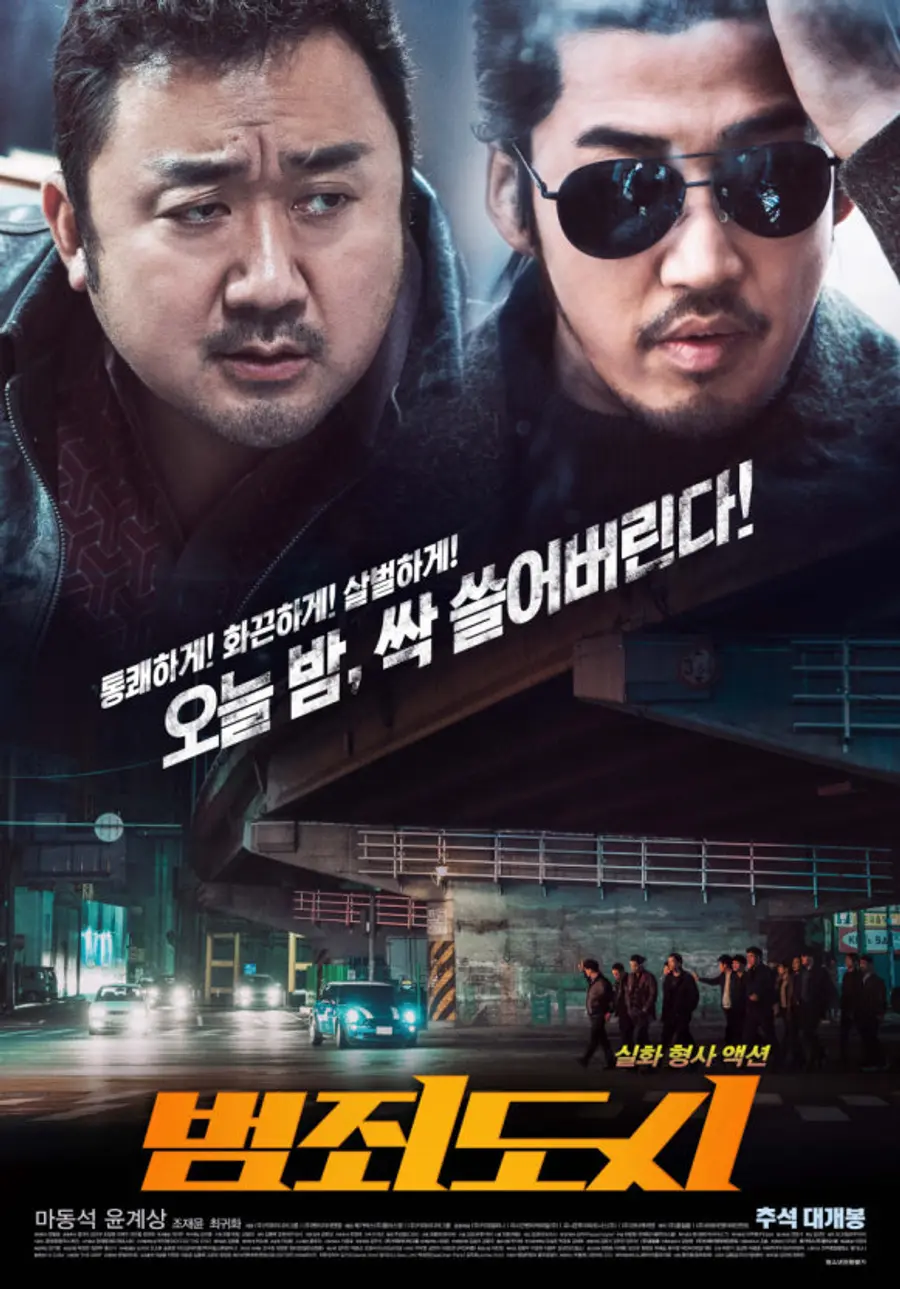
In the narrow alley of Garibong-dong's Chinese street, on a rainy night, neon signs spread across the asphalt as men grab each other by the collar and negotiate. Instead of promises to pay back money, fists fly first, and in the middle of it all, a figure that looks nothing like a detective pushes through like an icebreaker. This is Ma Seok-do (played by Ma Dong-seok), a detective from the violent crimes unit responsible for this neighborhood. If persuasion doesn't work, Seok-do negotiates with his body instead of words. He pins people against poles, breaks windows, all while grumbling, "I told you not to get hurt." The movie 'Crime City' is, like this rough phrase, a work that pushes forward with a blatantly rough tone from start to finish. Not quietly, but with a 'thud' like putting down a soju glass.
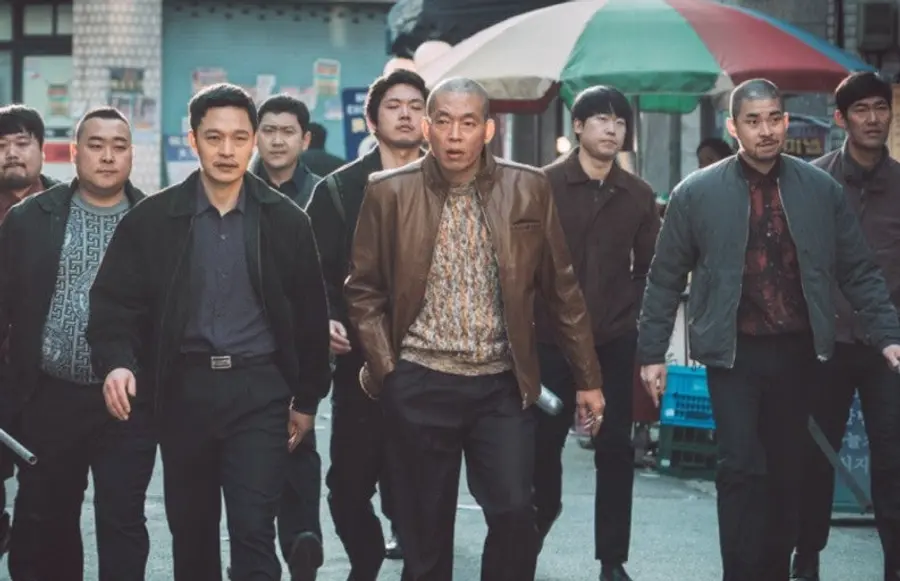
In the film, Garibong-dong is a narrow and complex ecosystem where Koreans, Chinese compatriots, Joseonjok, and various organizations live together. From the Hong Gi-cheol faction, Chairman Wang's organization, to Chinese restaurant owners and currency exchange brokers, Seok-do and the violent crimes unit leader Jeon Il-man (played by Choi Gwi-hwa) have barely managed this complicated game with fists and information. It's a bizarre world of balance where they share interests without crossing lines, like a carousel that turns while everyone is watching each other. When a shop owner reports, Seok-do goes out and says, "Brother, let's stop here," shaking down the gangsters, and in return, the next time, a detective turns a blind eye to another case, following an unspoken rule.
The one who completely overturns this balance is Jang Chen (played by Yoon Kye-sang). The leader of a gang that crossed over from Yanbian, China, Jang Chen knows nothing of the existing organizations' rules. From his first appearance, he feels different. He lounges in the back seat of a shabby van, and when a target appears, he flicks his cigarette and pulls out a knife. His movements are as indifferent as a worker heading to the office. The way he kills people and disposes of bodies is overtly brutal. He swings a hammer and knife in narrow alleys, and in the middle of the night, he smiles while butchering people in motel hallways. This brutality is literally a "beast that has come to devour the city," precisely an invasive species that does not recognize the concept of a food chain.
Jang Chen's gang systematically takes over existing gangster organizations. On the surface, they buy rounds and pass drinks, but when they turn their backs, they stab. It's like flipping a chessboard. They quickly seize money-making shops, currency exchange lines, and casino funding, unleashing unimaginable violence on local merchants. Garibong-dong is plunged into fear, and even the restaurant owners and elderly people who used to greet Seok-do become victims. Only then does Seok-do say, "This has crossed the line," and begins a full-scale eradication operation, but the opponent is different from any criminal he has ever encountered. It's like a player who has brought a rulebook from another game.
More of a Neighborhood Cleanup than an Investigation
The investigation methods of the violent crimes unit are not elegant. There is no scientific investigation like in CSI, nor deduction like Sherlock Holmes. It's almost like "sweeping the entire neighborhood with a carpet cleaner" rather than an investigation. From morning to night, they storm into Chinese restaurants, entertainment spots, and currency exchange offices, rounding up owners and employees. Shouting back and forth with an interpreter, handcuffed suspects sit lined up in the hallway. The question, "Do you know Jang Chen?" repeats like a song's chorus, and every time a lie is exposed, the table is flipped. Yet, the detectives cook ramen and complain, saying, "I don't even remember who is who," showing an oddly relatable investigation scene. It's like a neighborhood hardware store owner catching a thief.
Meanwhile, Jang Chen's violence escalates more overtly. Kidnappings and threats between organizations, hostage situations, and murders happening in the middle of the street. More and more blood flows onto the streets, and the police department pressures, "Wrap this case up quietly." Seok-do and Il-man decide to overturn the game with preemptive strikes while keeping an eye on the central authorities. The chase with Jang Chen, the stakeouts and ambushes moving between karaoke rooms, hotels, and saunas lead the film toward its climax. Ultimately, the moment Ma Seok-do and Jang Chen face off is condensed and bursts like the one scene the entire film has been preparing for. It's better to see for yourself how someone falls and what conclusion that fight brings to the neighborhood people. The weight of the final action is such that explaining it in words beforehand would deflate it like a beer losing its fizz.
Pushing the Basics of the Genre to the Limit
Now, let's look at the artistic strength of 'Crime City.' The film's greatest strength is that, while the story itself is not remarkably new, it has extremely well executed the basics of the genre. If you think about it, the simple structure of "a rough detective takes down a cruel external force disturbing the neighborhood" has been around since the days of Westerns. Yet, this is built up densely without wasting a single sequence, character, or line. The running time is relatively short at 121 minutes, but within it, character introductions, world-building, tension buildup, humor, and action are tightly arranged, pulling you along without a moment to breathe. Like a well-made hamburger, even if the ingredients are familiar, if the assembly is perfect, it proves the truth that it tastes good.
The direction opts to trust space and bodies. The narrow alleys, stairs, kitchens, motel rooms, and karaoke hallways of Garibong-dong keep reappearing. They are not glamorous sets but spaces that could realistically exist. The camera moves heavily, following the characters' bodies rather than quickly whipping through the space. When Ma Seok-do swings his fist, the audience almost feels with their whole body where and how hard his shoulder and arm collide with the opponent's body. It's like watching a boxing match from ringside. The editing also does not chop up the action into quick cuts like the 'Bourne series' style but shows each action in its entirety. So, everyone involved—those hitting, those getting hit, and those watching—are all out of breath together.
The Birth of a New Action Hero
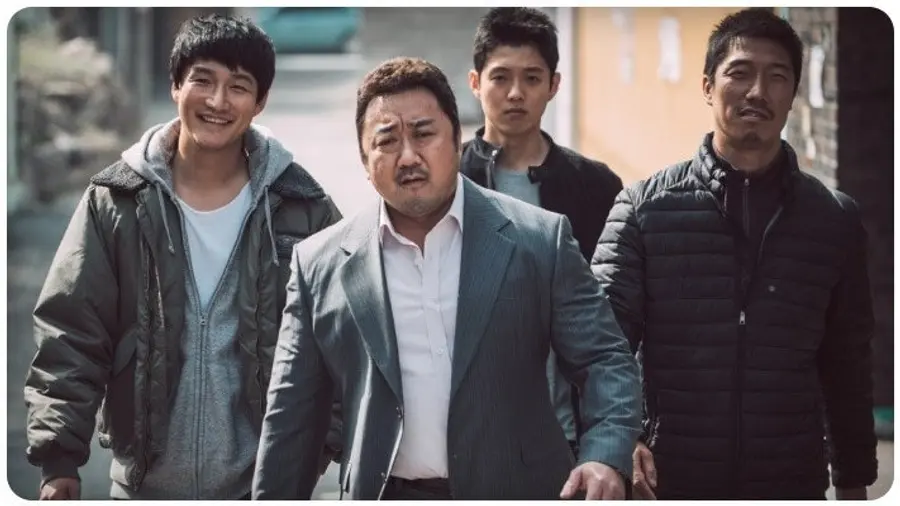
The character Ma Seok-do (played by Ma Dong-seok) has created a new archetype of a Korean action hero. He is not the typical image of a detective. He is neither the intelligent and cold analytical type nor the charismatic type who shoots well like Jung Woo-sung. Rather, he resembles a 'big brother' who would buy tteokbokki in the neighborhood and smack kids on the back. More precisely, he is closer to a neighborhood gym owner. However, the violence that comes from this bulk creates a strange catharsis mixed with a sense of justice and everyday life. Even in the scene where he drags a criminal covered in blood, Seok-do's face shows a human fatigue that says, "Did this guy do this again?" Like the sigh of an office worker who has gone past quitting time. Thanks to this, the violence in this film feels less like unconditional heroism and more like a weary city's self-defense.
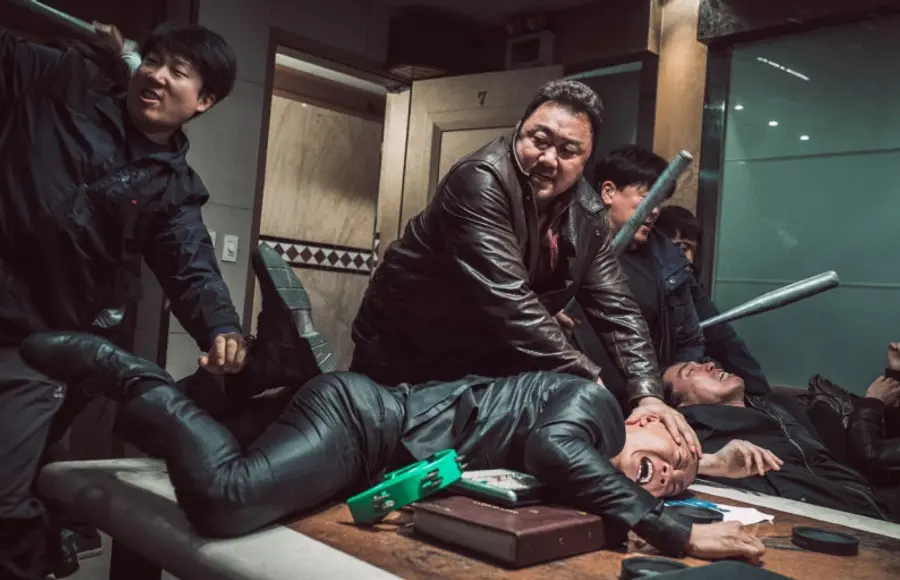
On the other hand, Jang Chen (played by Yoon Kye-sang) is a character that firmly engraves his name in the lineage of villains in Korean commercial films. He completely sheds the image of an idol-turned-actor, showing an exotic accent and cruel actions, a slow demeanor, and sudden explosiveness simultaneously. When he chases with a knife, Jang Chen's face is closer to the emptiness of someone who casually stabs people rather than exaggerated madness. His expressionless demeanor is like a factory producing parts. That emptiness is even scarier. The surrounding subordinates do not become exaggerated comic characters but move as a violent unit, so every scene featuring Jang Chen's gang freezes the air on screen.
An essential aspect of this work is the exquisite combination of violence and humor. 'Crime City' deals with quite brutal violence while planting humor points throughout. Misunderstandings arising from the Chinese interpreter in the suspect interrogation room, detectives sneaking glances and chatting, and Seok-do's attitude of eating first before catching a criminal all bring laughter. It's like watching a comedy show. However, that laughter does not trivialize the violence. Just as laughter erupts, a knife suddenly appears, and blood splatters. This sharp contrast in temperature is the unique rhythm of the film. It's like singing a meat restaurant song at a summer camping site and suddenly encountering a bear.
Nevertheless, the reason 'Crime City' is particularly loved by audiences is clear. For a long time, Korean commercial films have leaned toward darker and heavier themes in the crime and noir genres. Exploring moral gray areas and depicting a dirty world has been the trend. However, this film revives the thrill of an "action movie that strangely relieves stress after watching" through rough violence, cool humor, and a simple yet powerful narrative. The laughter and cheers from the audience when Ma Seok-do knocks down a criminal are not merely an endorsement of violence but rather an outlet for the desire that someone should at least "land a proper hit" even in a frustrating reality. It's like the relief of landing a punch on a punching bag.
Refreshing Action Thrill: The 'Maseokdo Universe'
This is a work that anyone who loves genre films must experience at least once. It shows well what the taste of straightforward action that competes with characters, action, and rhythm is, rather than relying on flashy tricks or twists. It is also essential for those who want to confirm the starting point of Ma Dong-seok's action, the so-called 'Maseokdo Universe.' The subsequent series will expand its scale, traversing Vietnam and Japan, but the first film's Garibong-dong leaves a particularly vivid sense of presence, like the rough yet pure energy of a debut album.
On the contrary, for viewers sensitive to the violence on screen, it can be quite a challenging experience. Knives, hammers, and bare fists run rampant, and scenes of characters getting violently hurt repeat. The R rating is certainly not just for show. Also, as mentioned earlier, those with a sensitive perspective on the representation of immigrants and minorities may feel discomfort. It is advisable to consider this when choosing to watch.
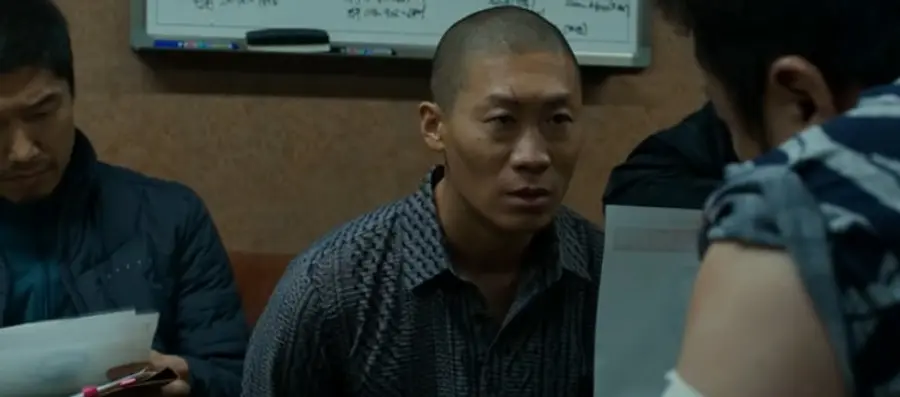
For those who often think that 'recent movies are too long and complicated,' I would cautiously recommend 'Crime City.' This film does not stretch out explanations. From the beginning, it is clear who the bad guy is and who is trying to catch him. Instead, it pours all its energy into how refreshingly and vividly that simple goal is achieved. If you want to surrender to such straightforward energy at least once, it wouldn't be bad to run through the alleys of Garibong-dong together. When you leave the theater after watching, you will likely still feel the vibrations left by Seok-do's fist somewhere in your body. Like the tremor that remains in the air after striking a large drum.