


|Cave Magazine=Reporter Choi Jae-hyuk A seemingly ordinary high school in Seoul. Kim Bong-seok (Lee Jung-ha) in his gym clothes always walks with slumped shoulders to the end of the hallway. He dozes off in class, and on the bus, he nods off, hitting his head on the window frame. His friends just think he has a weak constitution, but Bong-seok knows one truth. If his mind wavers even a little, his body starts to float in the air. Like a helium balloon. To avoid floating away, he carries a heavy bag on purpose and sleeps at home wearing a vest filled with lead. His mother, Lee Mi-hyun (Han Hyo-joo), always blocks the windows for her son and lays thick mats on the floor of his second-floor room. It's a house where parents worry not about their child's fall, but their child's 'ascent.' This is the world of Moving.
Meanwhile, Jang Hee-soo (Go Yoon-jung), who transferred in the new semester, draws all the attention from the first day. Even when caught in a fight, she hardly gets hurt, and if she seems to bleed, the wound heals in no time. Like a high school girl version of Wolverine. Hee-soo is not a perceptive child. She just thinks she's "a bit sturdy." But one day, surrounded by thugs in front of a convenience store, as she gets hit repeatedly, she realizes her body is regenerating at an unbelievable speed. The person watching from afar is Bong-seok, who always sits quietly. The meeting of superhumans always disguises itself as coincidence.
Another student is watching the two. Lee Kang-hoon (Kim Do-hoon), the model student and class president. There's nothing he lacks in test scores, athletic ability, or leadership. In gym class, he easily outruns other kids, and when he grabs the pole, he climbs it at a speed hard to believe is human. Like a game character with cheat codes. Kang-hoon also hides his 'special body' inherited from his father, Lee Jae-man (Kim Sung-kyun). His father, close to a single dad, runs a local convenience store, suppressing the outbursts that come like seizures. The irony of a man with super speed choosing the slowest job in the world—a convenience store clerk.
The Secrets of the Parent Generation, Monsters Created by the State
'Moving' begins its story by cross-editing the school lives of Bong-seok, Hee-soo, and Kang-hoon with the secrets hidden by each of their parents' generation. Mi-hyun is a former NIS intelligence agent and genius agent, with senses of sight, hearing, smell, taste, and touch beyond human levels. If Marvel's Daredevil lost only his sight and gained the rest, Mi-hyun gained all senses simultaneously. Her husband, Kim Doo-sik (Jo In-sung), is a secret operative with the ability to fly, who becomes pursued by the organization while on a mission to assassinate a high-ranking North Korean official. Jang Joo-won (Ryu Seung-ryong) is a former special agent with incredible regenerative abilities, now living as the shabby owner of a chicken restaurant.
All three parents once worked in a 'unit of monsters' created by the state and eventually went into hiding to escape the organization's grasp, living under the guise of ordinary heads of families. If the mutants of X-Men are welcomed at Xavier's school, Korea's superhumans are used as expendables by the NIS. This is the biggest difference between K-heroes and Hollywood heroes. In America, superheroes are praised, but in Korea, they are 'cleaned up' by the state without even proper pay.
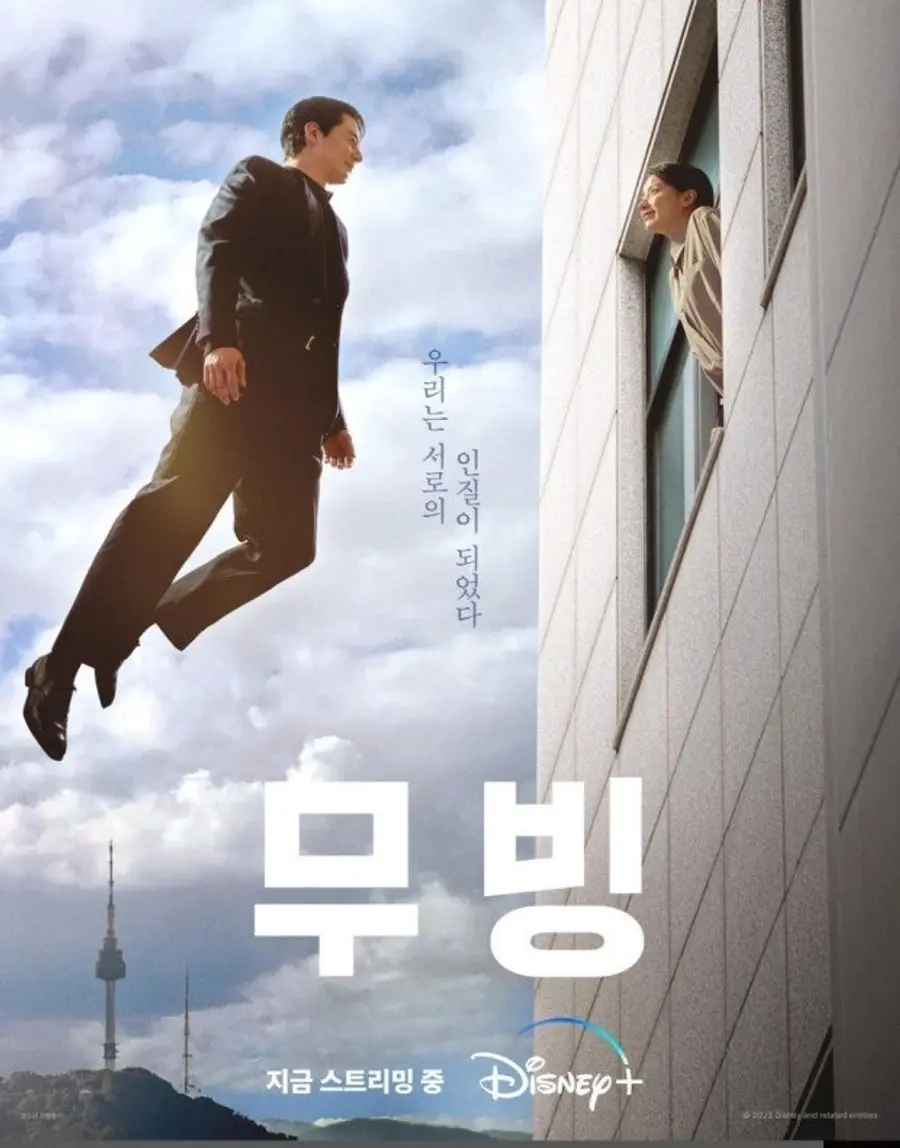
This peace soon breaks. As the mysterious killer Frank (Ryu Seung-bum), dispatched from the U.S., begins eliminating former agents who have come to Korea one by one, the past of the parent generation starts to seep into the present. Jang Joo-won, returning home after work at the chicken restaurant, is attacked by an unknown assailant. Just as his body reattaches no matter how many times it's cut, the memories of violence that endlessly revive come with it. Simultaneously, a new force within the NIS begins tracking Mi-hyun, Doo-sik, and the children's existence. Gym teacher Choi Il-hwan (Kim Hee-won) subtly tests the children's physical abilities, examining the limits of their powers. Jeongwon High School gradually becomes a kind of 'experiment ground' for gathering and monitoring children with superpowers. It's closer to the set of The Truman Show than Hogwarts from Harry Potter.
Bong-seok, Hee-soo, and Kang-hoon vaguely sense each other's secrets but do not confirm them with words. Like queer teenagers recognizing each other before coming out, superhumans cautiously sense each other. However, due to an 'accident' in the school auditorium, the three's abilities are revealed to a level that can no longer be hidden. A boy floating in the air, a girl who doesn't fall even when stabbed, a class president who springs out like lightning to subdue an opponent. As this video spreads online, the NIS, foreign forces, and past colleagues and enemies converge in one place. In the SNS era, a viral video becomes the fuse for a world war.
The stage naturally narrows to Jeongwon High School in the latter half, leading to a large-scale battle where the parent and child generations fight in their own ways within the same school. It's best to directly check who risks their life for whom, who makes what choices, and how far they endure until the end. The ending of this drama is a point where emotions towards family, generation, and nation pour out all at once, making it a kind of experience too precious to spoil in advance. If the final battle of the Avengers was in the middle of New York, the final battle of Moving is in a Korean high school playground. The scale is smaller, but the density of emotion is several times thicker.
The Victory of Genre Hybrid? Superhero + Family Drama + Spy Thriller
'Moving' has created a unique genre 'hybridity.' On the surface, it appears to be a Korean-style superhero film that puts superpowers, espionage, and action at the forefront. However, what actually fills the screen is the grammar of family drama, coming-of-age stories, and melodrama. Bong-seok and Hee-soo's narrative flows like a typical high-teen romance, then suddenly shifts to the bloody past of the parent generation, and then back to the lives and responsibilities of middle-aged heads of families. It's a structure where generational genre experiences are layered within one work. Like a mille-feuille, each layer has a different taste, but together they achieve harmony.
The direction boldly chooses to split and show these complex layers. The early part is from the perspective of the 3rd-year 3rd class students of Jeongwon High School, the middle part focuses on each parent's past episodes, and the latter part returns to the present-day group battle. Each episode has a completeness like a mini-movie, so some episodes are almost Jang Joo-won's noir, some are Mi-hyun and Doo-sik's spy melodrama, and others focus on Lee Jae-man's tragic family history. Thanks to this, despite the long running time of 20 episodes, it gives the feeling of having watched 'one piece' no matter where you start. It's a composition that accurately understands the drama grammar of the Netflix era.
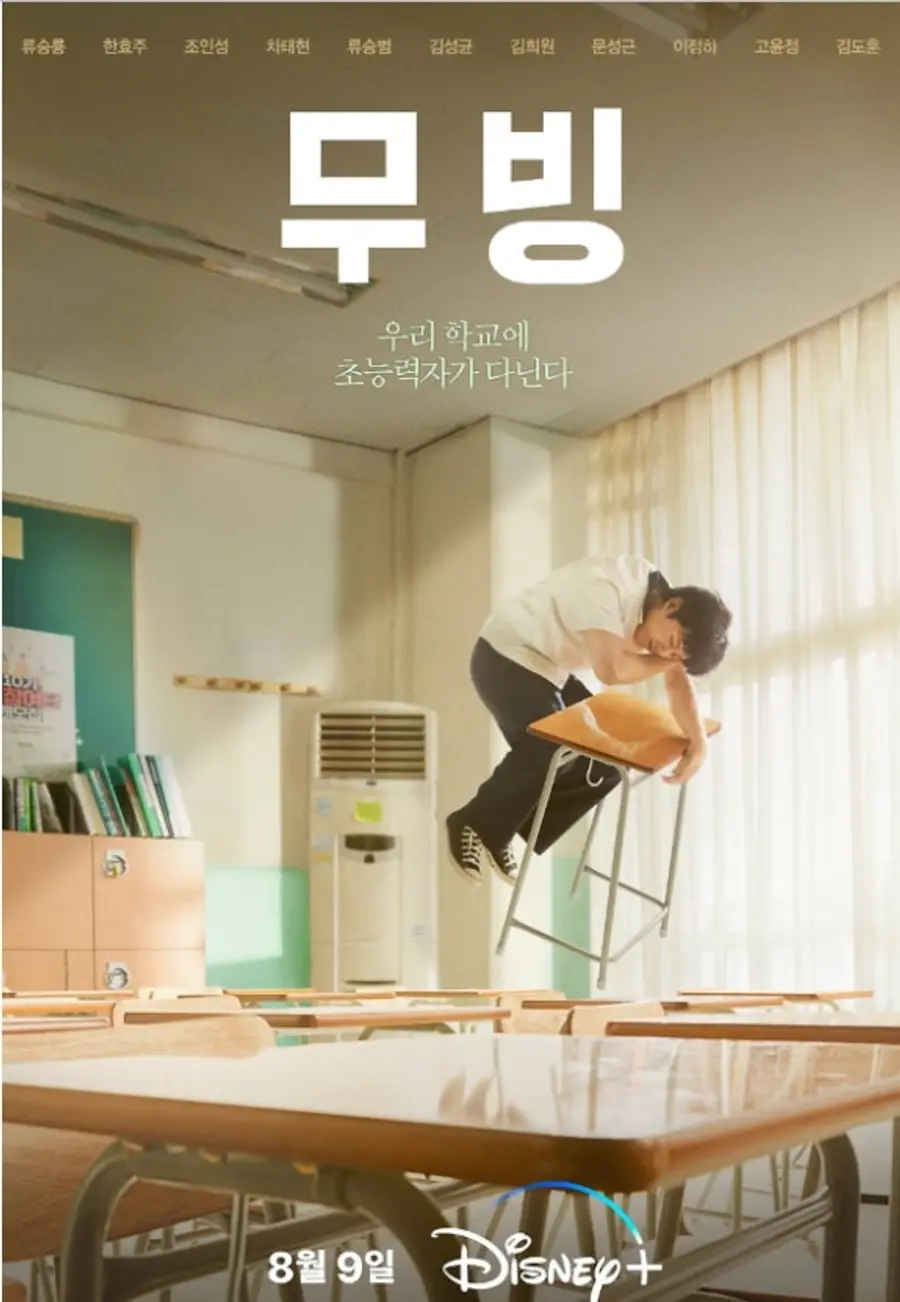
The action and visual effects push to a level hard to see outside the OTT era. Thanks to the thousands of CG cuts invested, scenes like Bong-seok cutting through the sky, superpower battles shaking the entire school, and bloody fights with North Korean agents are implemented more like a theatrical blockbuster than a TV drama. Visuals that do not fall behind even when compared to Disney+'s Marvel series. At the same time, it's important that this splendor always moves towards the bottom of emotions. In the scene where Jang Joo-won gets stabbed dozens of times but rises again, what the audience feels is closer to 'pity' than 'thrill.' Because the fate of a worker who is dragged back to work despite being endlessly beaten overlaps with a body that rises again because it cannot die. This is the decisive point where Moving differs from Hollywood hero films. CGI is used not for spectacle, but to visualize pain.
The actors' performances are the key adhesive connecting all these layers. Lee Jung-ha makes Bong-seok not just a 'gentle and cute superhuman,' but a boy who always fears the ground because of his floating body. Like someone afraid of drowning, but instead afraid of floating away into the sky. Go Yoon-jung's Hee-soo stands on the boundary between adult and child, becoming more numb because of a body that heals quickly. It's possible to express the sadness of a person who cannot feel pain with a face. Kim Do-hoon's Kang-hoon hides the face of a boy who fears his rampaging power inside the shell of a 'perfect class president.' The emptiness behind perfection, it's amazing that a teenage actor captures this so well.
The parent generation's Ryu Seung-ryong, Han Hyo-joo, Jo In-sung, and Kim Sung-kyun each show the sorrow of "superhumans used by the state" in different ways, leading both action and emotion. Ryu Seung-ryong's Jang Joo-won exudes a tragic beauty like Rocky Balboa running a chicken restaurant, and Han Hyo-joo's Mi-hyun is portrayed not as a supermom but as a 'trauma survivor with super senses.' Jo In-sung's Kim Doo-sik flies in the sky but looks like a man carrying the heaviest burden. The irony of a person who defies gravity being crushed by the weight of the world.
The Miracle Created by Disney+...The Global Conquest of K-Heroes
Above all, 'Moving' is a clear example of what approach is needed on an OTT platform to compete globally. Shortly after its release in August 2023, this work emerged as a flagship IP of the platform, recording the most viewing hours among Korean original series on Disney+ and Hulu. It swept awards at the Asia Contents Awards, Baeksang Arts Awards, etc., proving both critical acclaim and popularity. It can be understood in the same context as being mentioned as another K-content storm after 'Squid Game.' The story of 'people who have to hide their superpowers within their family,' different from Western hero films, also had persuasive power for viewers in various regions worldwide.
While Marvel sells the fantasy of "saving the world with superpowers," Moving sold the reality of "living hidden in the world because of superpowers." And it's interesting that people around the world resonated more with the latter. Perhaps because we all have abilities and wounds we need to hide somewhere.
Of course, not every part is perfectly smooth. As the story progresses towards the latter half, with character and national narratives pouring out simultaneously, the ambition to unravel even the stories of North Korean agents feels somewhat excessive. Some characters' narratives are deeply explored, while others are consumed as functional devices. Like a buffet with too much food to taste everything. Still, in the big picture, this excess is the energy of 'Moving.' It gives the impression that the director and writer have so many stories they want to tell that the screen overflows. The aesthetics of restraint are good, but sometimes such excess creates a more intense experience.
For those feeling a slight fatigue with hero films, 'Moving' will be a good antidote. There is no cool-suited hero team or grand narrative of saving the world here. Instead, there are middle-aged heads of families standing under the fluorescent lights of convenience stores, the smell of chicken oil, and the steam from a tonkatsu restaurant kitchen. Superpowers are not flashy skills but burdens that must be hidden to protect the family. Like a world where Superman works as a day laborer and Wonder Woman runs a local snack bar. If this perspective resonates with you, most of 'Moving' will feel persuasive.

It also suits those looking for a drama that parents and children can watch together. Children get immersed in the school life and action of Bong-seok, Hee-soo, and Kang-hoon, while parents empathize with the hard lives of characters like Jang Joo-won, Lee Mi-hyun, and Lee Jae-man. The fact that you can laugh and cry at different points within one work is a rare advantage as a family drama. Like Pixar animations, children laugh at the characters' actions, and adults cry at the hidden meanings.
For viewers who like webtoon originals but have built up distrust that 'live-action adaptations always fail,' 'Moving' is worth checking out at least once. Thanks to the original author Kang Full himself writing the script and expanding the universe, the emotion of the webtoon and the newly added narrative are relatively stably combined. A textbook example of how things change when the writer directly participates in adaptation. After watching this work, you might become curious about the next stage of Korean-style superheroes.
And just before Bong-seok floats into the sky, you might quietly realize that the emotion like a lead weight hanging from his toes is also somewhat inside you. Because we are all contradictory beings who want to defy gravity in some way but also want to be held to the ground. Moving is the drama that most honestly shows that contradiction. The story of people who want to fly but shouldn't. That's our story.