

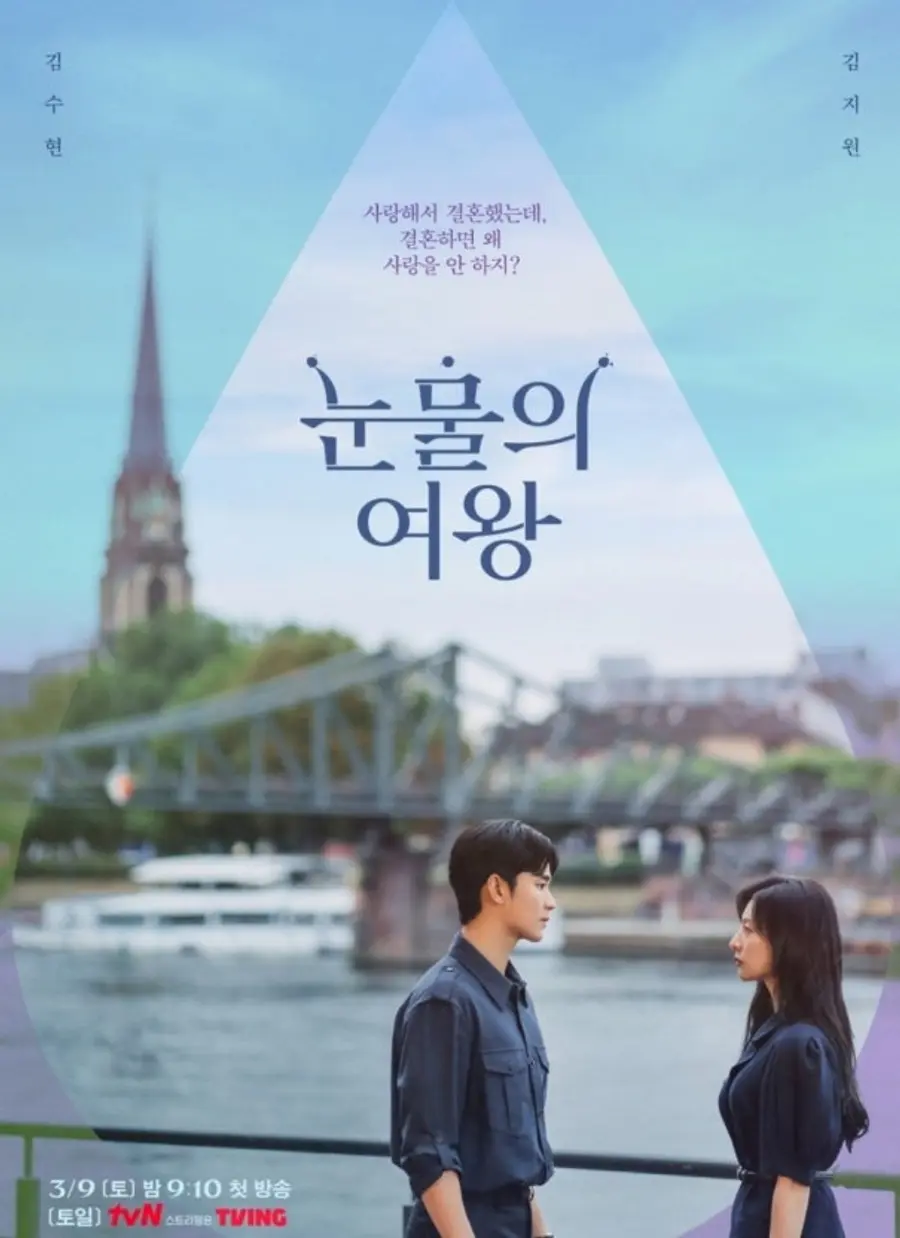
On the seemingly endless driveway of a chaebol mansion, a black car slowly pulls in. As the door opens and the son-in-law Baek Hyun-woo (Kim Soo-hyun) steps out, he immediately bows his head, while the chaebol third-generation Hong Hae-in (Kim Ji-won) walks out like a high-fashion photoshoot. The drama 'Queen of Tears' begins in the landscape of a couple in their third year of a marriage that has already passed the wedding and excitement. It’s as if the ending credits of a Disney animation have rolled, and the camera starts to show 'Three Years Later.' From the start, it sets the premise of "after the happy ending."
Hyun-woo hails from the rural Yongdu-ri. He is the protagonist of a 'dirt spoon success narrative' who graduated from Seoul National University Law School and became a legal director at a large corporation, but the reality is far from the glamorous reversal dramas seen in 〈Sky Castle〉 or 〈The Last Son of a Chaebol〉. At home, he constantly has to watch his wife’s family, fighting against the label of being a 'country bumpkin.' Even when he voices his opinions in meetings, they are not taken seriously, and at the dining table, he endures subtle dismissals. Just like the Gitaek family in 〈Parasite〉 felt the walls of class at CEO Park's house, Hyun-woo feels it every morning at the dining table. The only difference is that he lives in a grand mansion instead of a semi-basement and eats French cuisine instead of jjapaguri.
On the other hand, Hae-in is the CEO responsible for the Queens Group's department store and the favored heir of her grandfather. A cold and ambitious manager, she lives draped in the world's most expensive clothes and jewelry. She is a character that seems to reinterpret Miranda Priestly from 〈The Devil Wears Prada〉 as a Korean chaebol version. They married out of love, but at some point, they have become the kind of couple that asks their secretary to relay messages instead of exchanging words. Although they lie in the same bed, the distance between them is as far as Seoul and Yongdu-ri.
Thus, the word Hyun-woo thinks of most is not love, but "divorce." He cautiously seeks advice from his college friend and successful divorce lawyer Kim Yang-ki (Moon Tae-yu). Like Charlie and Nicole in 〈Marriage Story〉, he imagines the scene where two once-loving people divide their assets and emotions on paper. While organizing the divorce conditions in his mind, he still finds himself habitually taking care of Hae-in's late-night work and buying medicine when she says she feels unwell, confusing himself. Has love really cooled down, or have wounds and misunderstandings piled up, causing them to lose their way? Like a photo stuck between old bookshelves, are their feelings also stuck somewhere, unable to be found?
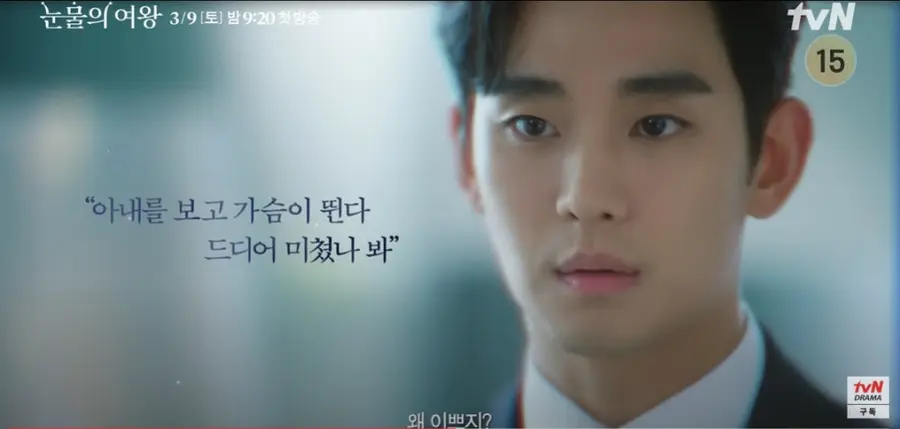
This precarious balance completely collapses with a single diagnosis. One day, Hae-in receives the cruel verdict of 'brain tumor, poor prognosis' at the hospital. The word terminal doesn’t even come out of her mouth, and she tries to endure alone, hiding the truth even from her family. Just like Ji-an in 〈My Mister〉 hides the traces of violence, Hae-in embraces the shadow of death alone. However, Hyun-woo soon notices his wife's unusual symptoms. Unexplained headaches, mistakes, sudden fainting. The husband can only watch the person who was once cold and perfect slowly break down from the closest distance. The heart that once thought, "I should get a divorce" begins to walk a tightrope between guilt and love, thinking, "I must stay by her side until the end."
Meanwhile, another war breaks out within the chaebol family. The appearance of Hae-in's childhood acquaintance and Wall Street investment expert Yoon Eun-sung (Park Sung-hoon) gradually reveals a merger and acquisition conspiracy targeting the Queens Group. Eun-sung acts like a reliable ally and gentle friend on the surface, but his true intentions are entirely different. Like Frank Underwood in 〈House of Cards〉, he hides a blade behind a calculated smile. He subtly stimulates the vanity and desires of the Hong family, including Hong Soo-cheol (Kwak Dong-yeon) and Cheon Da-hye (Lee Joo-bin), preparing to shake the group's share structure and power dynamics. His presence hovering around Hae-in creates another crack in the already creaking marital relationship. The situation of love, conspiracy, jealousy, and betrayal boiling in one pot is a typical recipe for a makjang drama, but this work cooks the ingredients a little differently.
A Journey Across Classes from Seoul to Yongdu-ri
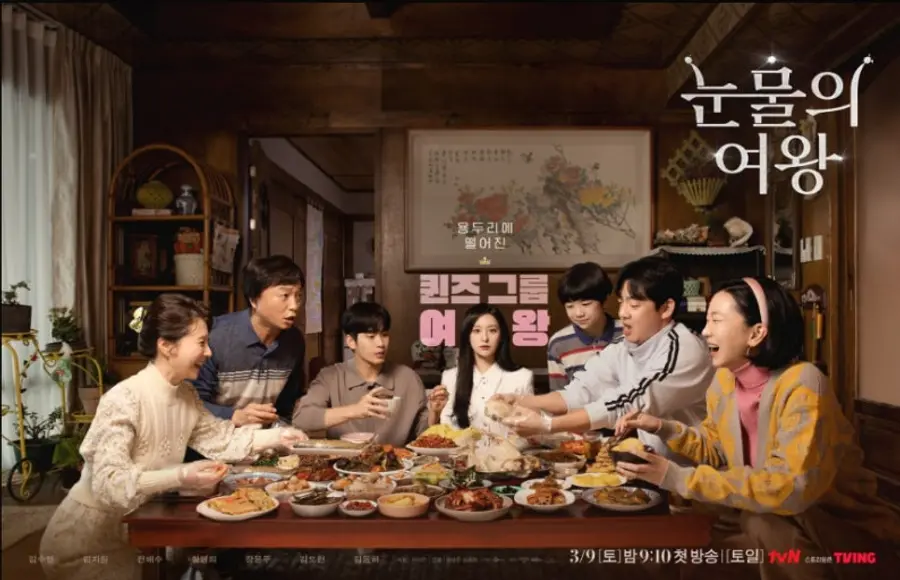
As the crisis deepens, the story moves beyond Seoul and the chaebol mansion to Yongdu-ri, Hyun-woo's hometown. With somewhat rustic but warm parents Baek Du-gwan (Jeon Bae-soo) and Jeon Bong-ae (Hwang Young-hee), a sister Baek Mi-sun (Jang Yoon-joo) who nags more than she speaks, an older brother Baek Hyun-tae (Kim Do-hyun) who was once a boxing player, and a nephew, this 'country family' stands in stark contrast to the glamorous Queens family. It resembles the 'ideal rural landscape' that remains in the collective unconscious of Koreans, as seen in 〈Little Forest〉 or 〈Three Meals a Day〉. For the first time, Hae-in steps into the rural village not as "the chairman's granddaughter" but simply as a person.
Sweating in the greenhouse, bargaining at the market, and sharing daily moments over snacks, the relationship between the two slowly but surely changes. Hae-in trades her Chanel tweed jacket for work clothes and her Hermes bag for a plastic bag. As she falls in the field, gets dirt on her, and her hair gets messy, this drama asks, "Isn't it when we throw away perfection that we truly become human?" Just like Princess Anne in 〈Roman Holiday〉 tasted real life while walking the streets of Rome, Hae-in lives for the first time as "Baek Hyun-woo's wife" rather than "Hong Hae-in" in Yongdu-ri.
In this process, the drama does not merely follow the familiar melodrama formula of "a sick wife and a devoted husband." Hae-in is portrayed as someone who tests the sincerity of her family and husband using her illness as leverage, while Hyun-woo is not just a husband bound by guilt but a character shaken by his own desires and fears. Each time they stand at a crossroads of choice—how to handle the divorce papers, how much truth to tell his wife, whether to expose or hide the chaebol's corruption and conspiracy—they reveal slightly different facets of themselves. And as those choices accumulate, they move toward an irreversible final conclusion. It would be better to follow the drama to the end to see the specific conclusions and who loses and gains what. This work is the type where a few scenes at the end rearrange the weight of the entire narrative, much like the final twist in 〈The Sixth Sense〉, having the power to make you see everything again.
The Quintessential Premium Makjang Melodrama
Now, let’s examine the artistic quality. The biggest feature of 'Queen of Tears' is that it starts from the brink of marriage. While typical romantic comedies rush toward first meetings, flings, confessions, and marriage, this work takes 'a couple exhausted from each other after three years of marriage' as its starting point. Just this setting alone differentiates it from ordinary K-melodramas. Rather than starting sweet and exciting, it is cold and uncomfortable. Just as 〈Before Midnight〉 showed the boring daily life of lovers without embellishment, this drama also tears apart the romantic packaging of marriage to show its bare face. However, the process of peeling away this cold air and returning to love becomes a strong hooking point for viewers.
In terms of direction and rhythm, this drama perfectly fits the term 'premium makjang melodrama.' It brings together all elements of melodrama: chaebol power struggles, stepmothers and illegitimate children, cold-blooded mothers-in-law, conspiracy-laden M&A, rural vs. urban contrasts, and terminal illness. It lays out all the elements of melodrama like a buffet. However, it does not consume them merely in a sensational manner. Even in exaggerated situations, it follows the emotional lines of the characters quite meticulously. In particular, the dialogue and gaze direction are excellent. After a blunt line like "I don't love you anymore," it completes the emotion with a scene where they cannot hold each other's tightly clenched fists while turning their backs. Moments where silence conveys more than dialogue, and gaze conveys more than words, are the true strength of this drama.
The performances of the actors are the greatest asset of this work. Kim Soo-hyun, who plays Baek Hyun-woo, delicately portrays a character who seems like a perfect husband on the surface but harbors inferiority and anger deep inside. The difference in his expression when pouring drinks with a smile in front of the chaebol family and when he is relaxed in front of his Yongdu-ri family is clear. You can think of it as the face of a psychopath shown in 〈It's Okay to Not Be Okay〉 and the innocent rookie PD shown in 〈Producers〉 switching within one character. Kim Ji-won, who plays Hong Hae-in, effortlessly transitions between the cold chaebol CEO and the human Hong Hae-in shaken before her illness, and the woman rediscovering love. In one scene, you can feel arrogance, fragility, and cuteness all at once. It feels like Go Ae-shin from 〈Mr. Sunshine〉 has been reincarnated into a 21st-century chaebol. The chemistry between the two is literally the "heart" of this drama. The fact that the ratings surged vertically in several episodes proves that those were the episodes where their emotional lines exploded.
The supporting actors' performances cannot be overlooked either. Yoon Eun-sung (Park Sung-hoon) shows both the cold investor and the obsessive man, completing the presence of a villain that sends chills down your spine. He is a character as charming yet dangerous as Jordan Belfort in 〈The Wolf of Wall Street〉. The couple Hong Soo-cheol (Kwak Dong-yeon) and Cheon Da-hye (Lee Joo-bin) traverse between comedy and tragedy, showing that "even the second generation of chaebols are ultimately adult children." They are a couple that would have fainted if they met Coach Kim Joo-young from 〈SKY Castle〉, but within that childishness lies a strange humanity. The Yongdu-ri family, while appearing to be a typical 'rural family' cliché, is depicted as characters who make the wisest choices at crucial moments, balancing the narrative. Like the families in 〈Reply〉 series, the warmth and wisdom hidden behind their rusticity shine through.
The music is a device that delicately presses the tear button. The lyrical theme songs by music director Nam Hye-seung play in key scenes, elevating the viewers' emotions once more. Especially, scenes where the OST flows against the backdrop of rainy nights, hospital windows, and rural rice paddies have the power to remain in the playlist and be replayed even after the drama ends. Just like the OST of 〈Goblin〉, there are magical moments in this drama where music and scenes are etched into one memory.
Why the Whole World Cried Together
In terms of box office success and buzz, 'Queen of Tears' is already a record-breaking work. It has surpassed 〈Crash Landing on You〉 by renewing tvN's highest viewership ratings and has remained in the global TOP10 on Netflix for the longest period among Korean dramas, garnering word-of-mouth from viewers worldwide. Various foreign media outlets have cited it as one of the best K-dramas of 2024, evaluating it as "a new standard for marriage melodramas." This is because it is not just a story that resonates only in Korea but is read as a universal couple's story.
Of course, there are clear drawbacks. As the story progresses into the latter half, there are criticisms that the chaebol conspiracies and the actions of the villains feel somewhat excessive. As the dramatic devices take precedence over a sense of reality, some viewers felt that the delicate couple's psychological drama from the beginning gradually twisted. It feels as if the makjang DNA from 〈Penthouse〉 was suddenly injected, and there are moments when the scale of the conspiracy dilutes the characters' intimate emotional lines. There are also criticisms that the themes of illness and death are excessively used as tear-inducing devices. Some characters awaken suddenly, while others hastily resolve their misdeeds, leading to a lack of smooth character arcs.
Nevertheless, the reason this work has made many people cry and laugh is clear. 'Queen of Tears' is ultimately a story about "two people who believed their love had ended, only to look at each other again when faced with the real end." When the fatigue of married life, the responsibilities torn between family and work, and the unspoken truths that have hurt each other begin to surface, viewers recall their own experiences and empathize. Just like the trilogy of 〈Before〉, this drama captures something that remains even after the expiration date of love.
A Visually Explosive Drama
Whether in love or marriage, anyone who has experienced a time when sighs became more frequent than words will find themselves laughing and crying a lot while watching Hyun-woo and Hae-in's fights and reconciliations. Thoughts like "We used to be like that" or "I'm afraid we might end up like that" intersect, making the drama feel like a kind of relationship simulation rather than just entertainment.
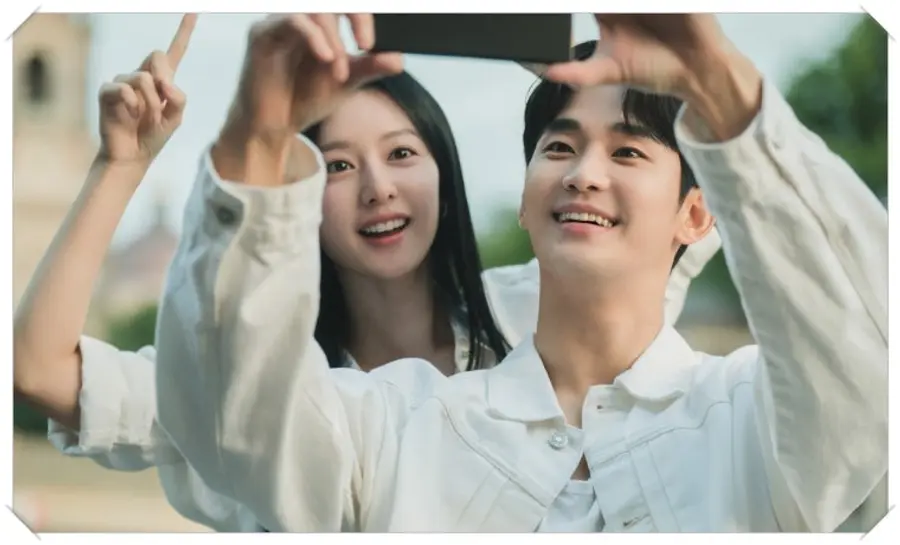
It also suits viewers who want to see a mix of chaebol, rural, corporate, and family dramas all at once. This work combines glamorous upper-class drama, heartwarming rural family drama, chaebol thriller, and core melodrama in one pot, but surprisingly, the combination is not bad. It tastes like mixing 〈Parasite〉 and 〈Little Forest〉 in a blender and lightly sprinkling 〈Penthouse〉 and 〈Hospital Playlist〉. As long as you are prepared to enjoy the exaggerated settings to some extent, you can ride the roller coaster throughout the 16 episodes.
For fans of Kim Soo-hyun and Kim Ji-won, this is a must-watch. Both actors deliver their best performances of their careers, and especially when they are together, their chemistry is so strong that it makes you wonder, "Aren't they actually in love?" From a fandom perspective, it is truly a feast.
It is also a good choice for international viewers who want to experience the archetype of K-melo once again. This one piece serves as a pretty good answer to the question, "Why do Korean dramas make people cry and laugh so much?" If you want to taste the emotions of reality and fantasy, tears and laughter, love and separation all at once, 'Queen of Tears' lives up to its title.
After watching this drama, you might quietly think, "Even in the moments I believed it was over, there was still a little bit of heart left." In moments when you thought the expiration date of love had passed, it might just be that the label faded and was no longer visible. For those who want to confirm that heavy feeling once more, I cautiously recommend this work. Just be sure to prepare plenty of tissues. The title is not an exaggeration.