
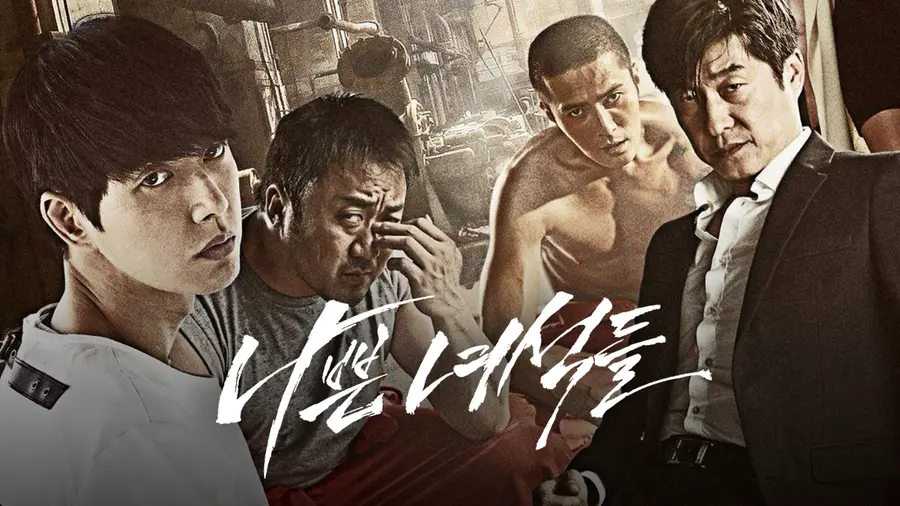
In the heart of the city, on a cold night street. Suddenly, blood splatters like a fountain on the road where a police transport vehicle is running. Death row inmates being transferred to prison are slaughtered in an instant, and the only one who survives disappears like smoke. As the saying "a monster hunted a monster" spreads like fear, detective Oh Gu-tak is summoned again. A problematic detective who has been suspended and placed on standby due to disciplinary action, notorious for solving cases by any means necessary. After losing his daughter a long time ago, he has become a relentless fierce dog. The higher-ups throw him a bait-like proposal. "Let’s catch evil with evil."
The drama 'Bad Guys' opens like this. The story ignites as a detective who casually crosses the line that even within the police organization is considered unacceptable, forms a team with three criminals he has gathered. The first is the legendary gangster, Park Woong-cheol. Once a first-generation gang boss who dominated the city, he is now serving his sentence 'exemplarily' in prison, but his fists still carry the weight of a current fighter. Like a retired boxing champion who still cannot forget how to punch. The second is the contract killer, Jung Tae-soo. A professional killer who can eliminate anyone at any time if needed, but a past connection he could not touch is stuck in his heart like a dagger. The third is Lee Jung-moon, a genius with an IQ of 165, the youngest PhD in criminal psychology, and a serial killer. Outwardly a quiet and polite young man, but inside his skull, cruel memories like experiments on people are organized like files.
Oh Gu-tak throws a realistic bait to these three. He will reduce their sentences or create an escape route for them. In return, they must do what the police cannot do. In a very violent manner. Formally, the team leader is prosecutor Yoo Mi-young. He believed that investigations should be conducted according to the manual, within the boundaries of the law, but 'bad guys' thrust into him how thin and blurry the line between law and justice is.
Each episode captures a violent crime occurring in the city. Unprovoked serial murders, rapists and murderers targeting only young women, retaliatory violence, gang wars, and the concealment of crimes by the powerful. The police are always a step behind, and it is difficult to protect victims with investigations that operate within the boundaries of the law. Each time, Oh Gu-tak's team is deployed. They do not appear as apostles of justice. Park Woong-cheol openly uses gangster-style threats and violence, Jung Tae-soo accurately targets vital points like a surgeon, and Lee Jung-moon tracks the psychology of criminals and calculates the next move. Their methods are closer to greater violence than salvation. However, the fact that without that violence, someone else would have died, constantly pricks the viewers uncomfortably throughout the story.
Four people who shouldn't fit together, hence the Avengers
On the surface, it seems like a bizarre combination, but as the cases pile up, the four begin to decode each other's pasts and wounds little by little. Why Oh Gu-tak obsessively hates Lee Jung-moon, how aware Lee Jung-moon is of his own crimes, why Park Woong-cheol left the organization in the past, and the existence of the only 'target' Jung Tae-soo could not touch. The secrets of these characters that stitch together the cases are the backbone of the drama. In particular, how the case of Oh Gu-tak's daughter being murdered connects to Lee Jung-moon's past, what police organization corruption is entangled like a spider web behind it, and who the real monster is, are the central arteries that drive the drama to its conclusion.
The scale of the incidents also gradually amplifies. At first, it seems like an omnibus structure solving individual violent crimes, but gradually a larger force manipulating the threads behind the scenes is revealed. The collusion between the high-ranking officials and the police, the system that mass-produces criminals, the structure where some go to prison while others escape with a smile. Initially, Oh Gu-tak operates with a sense of revenge that simply says, "I will deal with the vicious criminals in a more vicious way," but at some point, he senses that this game board itself is being used by someone. And at the very center of that board stand the 'bad guys' he has gathered. No matter what choice is made, no one can escape cleanly, and the drama does not shy away from that uncomfortable point. It is better to directly check how they lower their guns towards each other or aim them in the conclusion. This drama is more about saving a big twist until the end rather than a small twist.
Bad Guys focused 100% on hardboiled
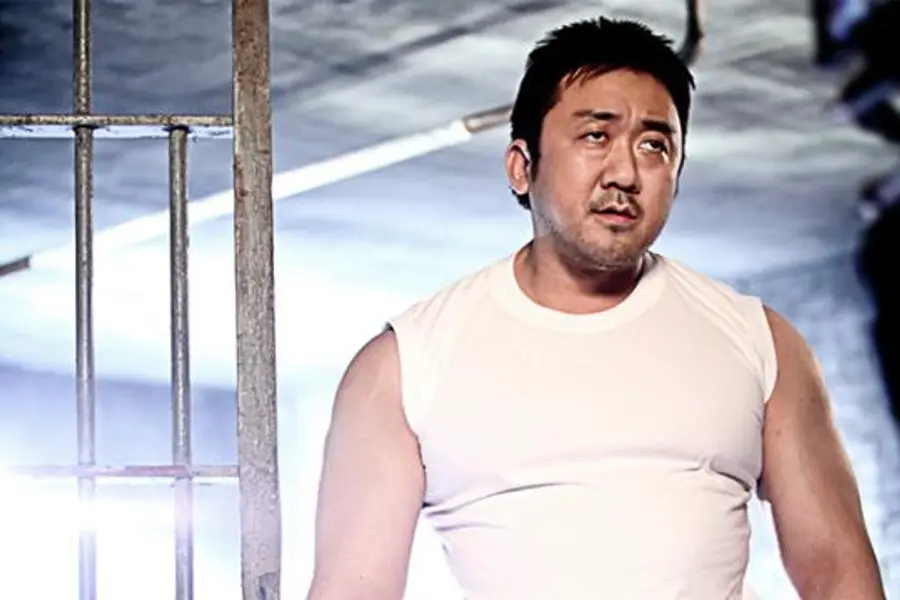
The greatest strength of 'Bad Guys' is its density as a genre piece. It is not an exaggeration to say that it is one of the works that best inherits the DNA of hardboiled crime dramas that the OCN channel has pursued. Even though the running time per episode is not long, the development of the case and the psychological changes of the characters are tightly compressed. There is almost no unnecessary space between dialogues and scenes, so by the end of an episode, one feels somewhat physically drained. However, it is not just dark for the sake of being dark. The fist comedy of Park Woong-cheol, played by Ma Dong-seok, and the black humor that comes from the chemistry of the three provide oxygen tanks everywhere. Even the laughter is not gentle, but rather rough jokes that pop up in the middle of a bloody scene, making it more memorable.
The tone of the direction is consistently dark and rough from the beginning to the end. Night scenes dominate, and the street lighting is intentionally adjusted to be cold. Spaces favored by crime dramas, such as rainy alleys, abandoned factories, and empty warehouses, are fully mobilized, but the reason it does not feel clichéd is that the camera is always close to the characters. Many compositions saturate the screen with the characters' faces and bodies, focusing not on 'who is hitting whom' but on 'how much someone is collapsing.' The action is designed to be closer to weight rather than flashy choreography. Park Woong-cheol's punch feels like it would actually 'kill you if you get hit,' and Jung Tae-soo's movements are designed like a killer's trajectory, trying to end things as efficiently as possible while conserving movement. It is like the economical violence shown by Jason Bourne in the fight scenes of the 'Bourne series.'
The script amplifies the simple concept of 'overcoming evil with evil' into quite a complex moral dilemma. The police organization in this drama is by no means clean. The detectives on the scene sometimes cross the line for a sense of justice and sometimes for results, while prosecutors and higher-ups conceal cases according to political interests. Within this, the existence of Oh Gu-tak's team is a crystallization of contradictions. They are clearly criminals, people who will have to be imprisoned again someday, but only when they take the stage does the city quiet down. Viewers naturally face this question. Are they really the "bad guys," or is the system that manufactured them more vicious? That discomfort is the aftereffect of this drama and its unique charm. It is like the question posed by Batman and the Joker in 'The Dark Knight': "Are we really different?"
Character building is also excellent. Oh Gu-tak is a truly rough detective rarely seen in recent dramas. A person tangled with a sense of justice and anger, guilt and self-destructive desires. The trauma of losing his daughter drags him around, but at the same time, he is aware that he is becoming more violent using that trauma as an excuse. Rather than a righteous protagonist, he is a character who barely stops at the last line while endlessly falling. Lee Jung-moon is the most bizarre axis of this drama. A murderer and a genius, a victim and a perpetrator, he occupies a complex position. His hollow gaze and somewhat misplaced kindness give a feeling of unease, as if you cannot be assured even after saving a life. Like Hannibal Lecter in 'The Silence of the Lambs,' who helped Clarice but was never trustworthy. Park Woong-cheol is the character that most richly embodies human affection. Once a boss who dominated the city, his sense of family, subordinates, and 'loyalty' is clearer than anyone else's. Jung Tae-soo is a character that makes one ponder, "How did it come to this?" A calm and rational killer, but emotionally collapses more than anyone else in the past intertwined with a specific person.
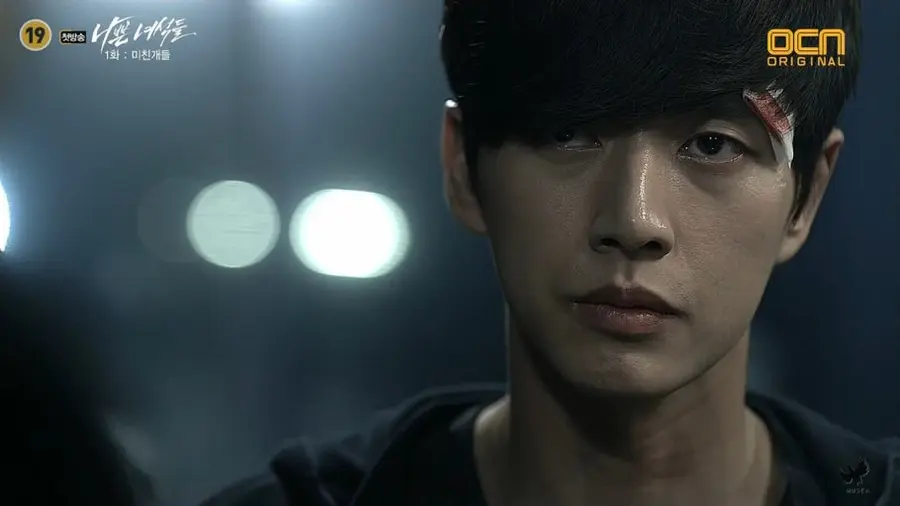
When these three characters operate as a team, the true value of the work explodes. They are all criminals, but they look at each other differently, and their moral coordinates are different. At one moment, they understand and embrace each other, but at another moment, they draw the line saying, "You really crossed the line." This subtle distance transforms into tension. Their relationship does not neatly resolve into solid camaraderie, and the structure that vibrates uneasily until the end makes 'Bad Guys' an unforgettable genre piece. Like Neil McCauley and Vincent Hanna in 'Heat,' there is tension in the relationship of being enemies while also understanding each other the most.
The reason for gaining public love lies here. Due to the high level of violence and darkness that was hard to find on cable channels at the time, and the solid construction of each character's narrative, it was treated as almost a 'must-watch' for genre enthusiasts. Even in a worldview that seems to say, "All good people have already been exterminated," the way it shows how a very small and personal sense of justice can move people is impressive. The subsequent production of spin-off films and follow-up seasons proves how intense the fandom for this worldview and characters was.
If evil catches evil, who do we support?
There is no completely innocent character in 'Bad Guys.' Everyone is somewhat contaminated, wounded, and a perpetrator to someone. This makes it feel more realistic and thus more uncomfortable. If you can endure this discomfort while tracking the characters, your skull will be quite noisy long after watching the last episode.
Also, for those exploring Korean-style hardboiled genre pieces, this work is almost a textbook. It is not a superhero story with excessive style, but a battle between criminals and detectives that you might actually encounter in an alley. Instead of flashy chases and shootouts, it features hand-to-hand combat in narrow staircases and rooms. For those who want to confirm the basics and emotions of the genre, it is definitely worth experiencing at least once. Just like how one must go through 'The Maltese Falcon' or 'Chinatown' when discussing noir films.
Finally, I want to hand this drama to those who are holding onto the question, "Can people change?" 'Bad Guys' does not declare a clear answer. Some characters seem to improve a little but then collapse again, while others cannot redeem themselves until the end. However, despite that, someone makes a different choice at the last moment. Even if that choice does not overturn their entire life, at that moment, it is certainly different. This ambiguous yet realistic conclusion leaves a lasting impression beyond the genre. If you are exploring such stories, 'Bad Guys' will darken your night for a while and make it strangely hot.