
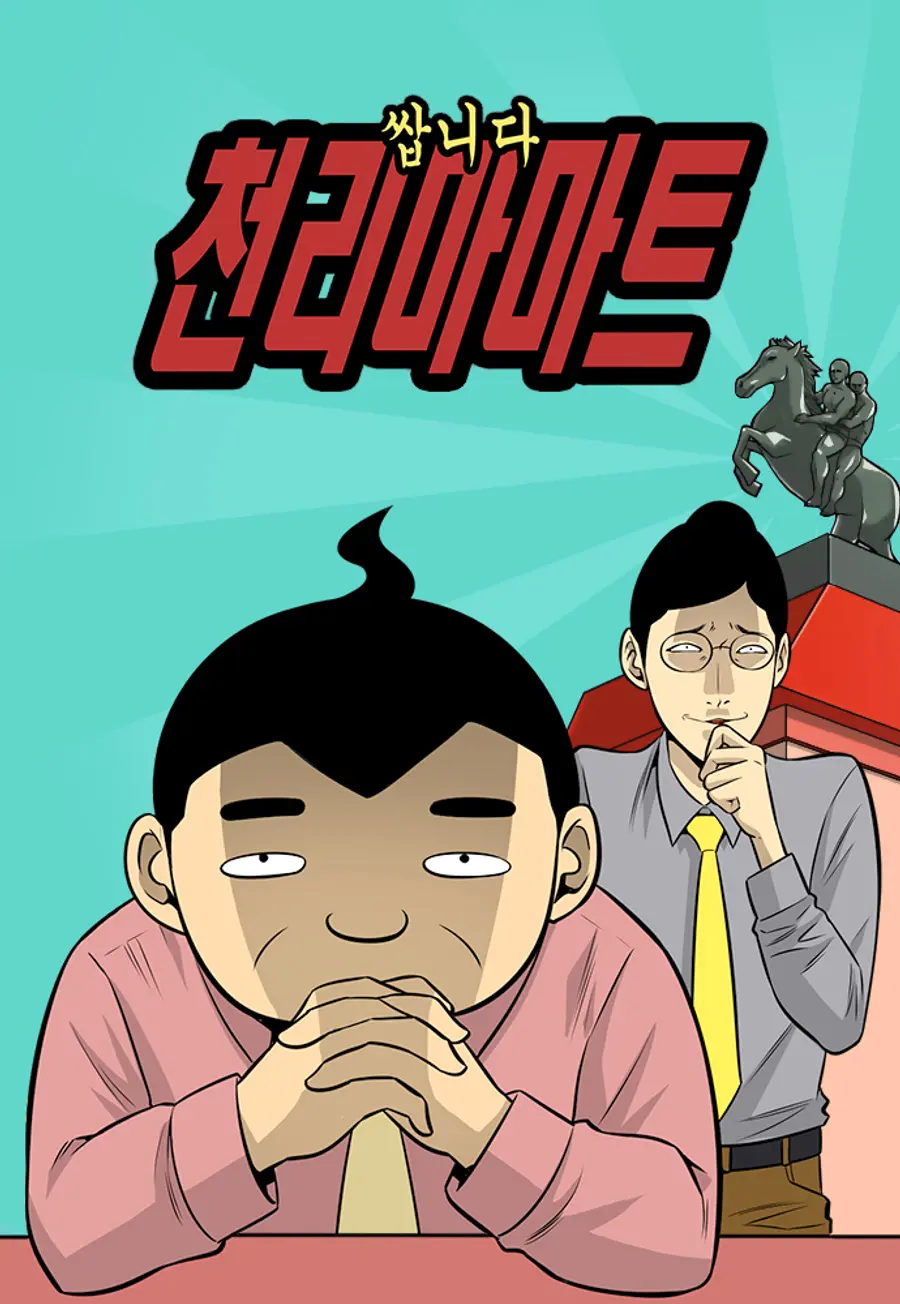
|Kave Magazine=Choi Jae-hyuk Reporter What would happen if a revolutionary landed in the middle of a failed mart? Naver Webtoon 'We Sell Cheonlima Mart' is a work that pushes this absurd question to the end. The starting point of the story is the provincial hypermarket, Cheonlima Mart, which is so poorly regarded that it barely has a name. There are no customers, stock is piling up, and the employees' motivation has hit rock bottom. From the parent company's perspective, it is practically a 'ghost store' just waiting to close down. It is like a cell marked in red on an Excel sheet, ready to be deleted at any moment.
One day, the troublesome manager from headquarters, Jeong Bok-dong, is demoted to this abandoned store. Everyone shakes their heads, saying, "If you go there, your promotion is over," but Jeong Bok-dong has a completely different expression. As if Che Guevara had suddenly been appointed as a convenience store manager, his eyes seem to say he will make this place a "base for revolution." And indeed, he does just that.
Talents Rescued from the Trash Can of Capitalism
Jeong Bok-dong is not interested in the normal methods to save Cheonlima Mart. Increased sales? Customer satisfaction? Headquarters KPIs? Such things do not exist in his vocabulary. The first thing he does is hire people who would never be selected in a regular mart, calling them 'talents.' People with criminal records, workers blacklisted for union activities, social misfits, self-proclaimed revolutionaries, aspiring philosophers... These individuals, filtered out by HR and bounced out of society, begin to gather at Cheonlima Mart one by one.
Their resumes would be considered trash by corporate standards, but in Jeong Bok-dong's eyes, they are "the driving force to shake the system." Just like the Avengers are made up of criminals and oddballs, the employees of Cheonlima Mart are an all-star team of society's dropouts. Thus, Cheonlima Mart transforms into a strange space where those who have been ejected from a 'system that discards people' gather to redesign themselves.
The way the mart operates is also bizarre. Instead of selling what customers want, projects that the employees want to push forward begin to emerge one after another. Products that no one would buy, random experiential events, cultural programs that have nothing to do with the mart are implemented in succession. Customer-centric? Market research? Such basic principles of capitalism are left outside the automatic doors of Cheonlima Mart.
Sales do not increase, and the headquarters is anxious, but a strange vitality begins to circulate inside the mart. Jeong Bok-dong sees people first, not numbers. He starts to evaluate the store and the people marked with the stigma of 'deficit' by different standards. This is not management; it is an experiment, and it is not business; it is resistance.
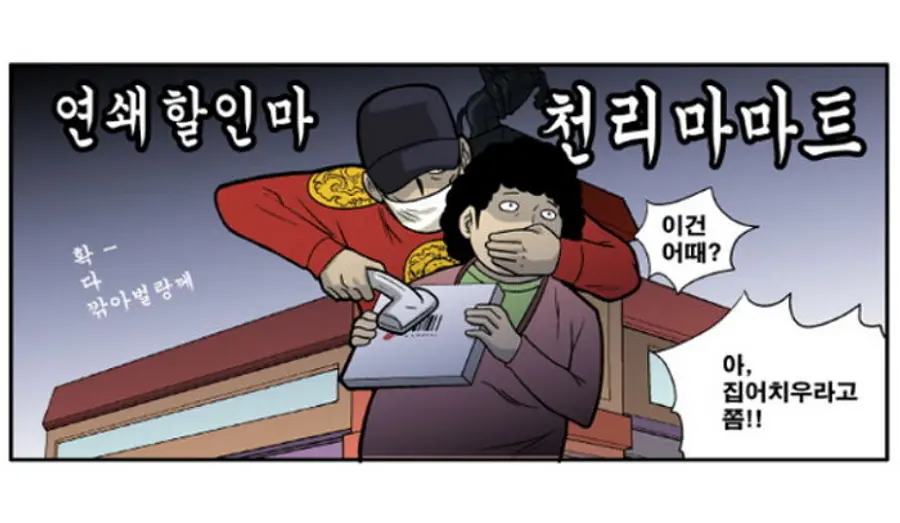
Meanwhile, there is a character at headquarters who is the complete opposite. Moon Seok-gu, a typical elite salaryman of a large corporation, wants to use Cheonlima Mart as a stepping stone for promotion. His goal is simple. To manage quietly so that no problems arise and to be recognized by headquarters and rise up someday. Therefore, he is horrified by Jeong Bok-dong's actions, which only seem to do "strange things."
Plans that do not seem to help sales, personnel decisions that ignore the hiring system, and actions that openly violate headquarters' guidelines. To Moon Seok-gu, Jeong Bok-dong seems like a madman or a terrorist against the company. Like someone suddenly throwing Go stones onto an orderly chessboard. However, as time goes on, he begins to question who he is and what the company is on this crazy board.
The conflict between Moon Seok-gu and Jeong Bok-dong is not a simple good versus evil scenario. It is a clash between living as a faithful part of the system and rejecting the system itself. Both have their own logic and survival strategies. Moon Seok-gu is not necessarily a bad person wanting promotion; it is just the rules of the world he has learned. Conversely, Jeong Bok-dong is not necessarily a hero shouting for revolution; he is someone who has already bounced out of that system. Thanks to this delicate balance, the work transcends simple moral tales.
The 'Sociology' Hidden Behind Absurdity
The webtoon continuously pours out various characters in an episodic structure. Surrounding a single mart, there are entangled laid-off workers, non-regular workers, corporate headquarters employees, local merchants, customers, and even local politicians. Each character is a caricature that seems familiar from somewhere in society, yet has subtly specific details. They are characters that make you think, "I have worked under such a boss" or "There is always someone like that in the local mart," blending reality and absurdity appropriately.
The main conflict in the early stages appears to be a clash between "people trying to save a failing mart" and "those who want to let it fail completely." However, as the episodes progress, the story shifts from simple sales competition to the relationship between 'company and human.' Some are discarded as parts of the company, some are in the position of replacing those parts, and some want to overturn the entire system.
Cheonlima Mart is an experimental ground set in the middle of this clash. Of course, it is better to read for yourself how the conclusion wraps up. What is important is that this webtoon does not let go of the question, "Wasn't what was truly cheap not the goods but the lives of people?" The space of the mart is symbolic. It is a place where everything has a price tag, and everything is traded. Yet, it seeks to find values that are not traded there.
The greatest charm of 'We Sell Cheonlima Mart' is that, while presenting itself as an absurd comedy, it hides quite sharp social satire within. The various commotions happening in a lowly mart are, in fact, a massive parody of the landscapes produced by Korean-style capitalism. The 'failed store' evokes a business unit that could be subject to closure at any time within the corporate structure that calls for restructuring and efficiency, and Jeong Bok-dong, who has been pushed out of the performance evaluation, embodies the face of "someone too smart for the organization, making it uncomfortable." Although it appears to be demoted, he is actually someone the headquarters would want to eliminate.
The people Jeong Bok-dong gathers at Cheonlima Mart are each a miniature version of those pushed out from society's shadows. Young people who have fallen out of the competition for academic background and qualifications, workers blacklisted for union activities, non-regular workers who have bounced out of employment stability. They are treated as "problematic personnel" everywhere, but at Cheonlima Mart, they become 'unique and valuable talents.'
This transformation is not just a play on words. The webtoon consistently poses the question, "Who sets the standards for evaluating people?" through this absurd hiring process. Just as 'Parasite' discussed class through the contrast of semi-basement and mansion, 'We Sell Cheonlima Mart' tells the same story through the contrast of headquarters and branches, regular and non-regular workers, successful stores and failed stores. However, Bong Joon-ho stabs with a knife, while Kim Gyu-sam hits with slapstick.
The tone of direction is remarkably light and absurd, yet the content of the dialogue often hits hard. For example, when a character complains, "Why is it so inefficient here?" Jeong Bok-dong retorts, "What do you gain from dedicating yourself to the company?" Or when asked, "What if we go bankrupt like this?" he responds, "Even if we go bankrupt, people remain."
Without packaging it as a tremendous famous line, such dialogues resonate heavily with readers suffering from organizational and work issues in Korean society. It is a skillful insertion of quite serious labor and capital discourse disguised as absurd humor. If Marx were a comedian, he might have written Capital in this way.
The Spectrum of Laughter: The Politics of Comedy
The quality of the comedy is diverse. It employs various layers of laughter, from simple slapstick comedy, exaggerated character reactions, wordplay using internet memes, to settings pushed by excessive imagination. Just as a jazz musician moves between various ranges, the work freely shifts from light humor to bitter satire. At the same time, it frequently evokes emotions to prevent the thematic consciousness from becoming dry.
Scenes where Cheonlima Mart employees take care of each other, where someone demoted from headquarters is welcomed with "Welcome," and where a customer works diligently in a nearly empty store to maintain their dignity leave an oddly calm resonance behind the laughter. It is a technique that salvages human dignity amidst absurdity, just as Charlie Chaplin did in 'Modern Times.'
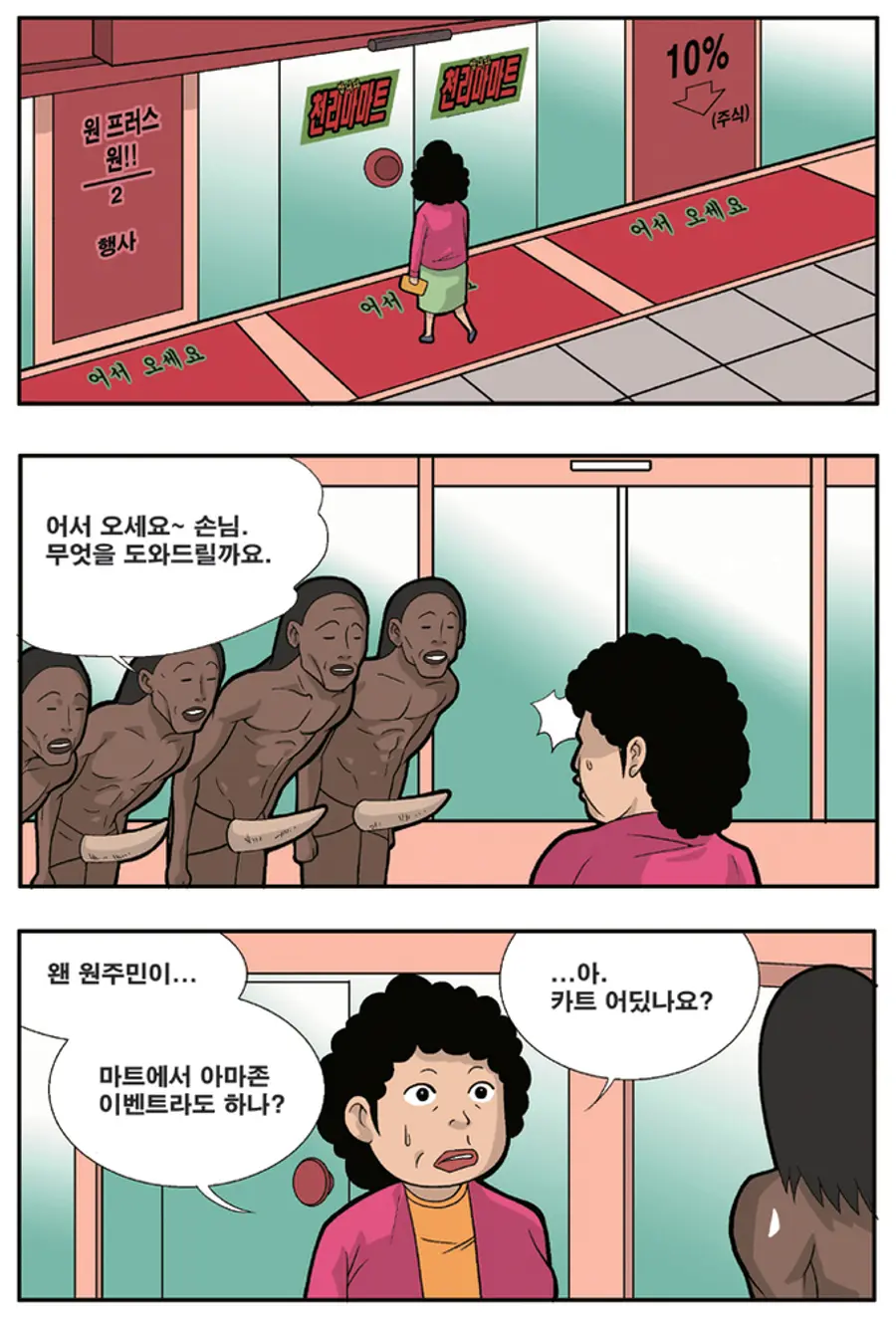
Character narratives generally take cartoonish exaggeration as the default, but there are moments that align perfectly with reality. For instance, the process in which Moon Seok-gu, who only looked forward to promotion at headquarters, continues to waver while observing Cheonlima Mart's 'strange movements' will not be unfamiliar to many office workers. Someone who has lived faithfully according to the company's logic and has forgotten what they have been working for.
Jeong Bok-dong constantly pressures Moon Seok-gu, saying, "You must choose too." Thanks to this conflict structure, the work has a structure where people inside and outside the system reflect each other, rather than being a simple 'rebellion of the bottom.' Just as 'The Office' or 'Parks and Recreation' depicted human figures in the workplace, 'We Sell Cheonlima Mart' does the same against the backdrop of the Korean chaebol structure and the reality of non-regular workers.
The Politics of Space: The Stage of the Mart
The art style is clean and easy to read, comfortably conveying comedy, emotion, and setting. The characters' expressions and gestures are heavily exaggerated, allowing emotions and situations to be easily understood at a glance. It is as if the exaggerated expressions of Cartoon Network animations have been transferred to webtoons.
The space of Cheonlima Mart is also an important stage. Escalators, checkout counters, storage rooms, break rooms, rooftops, etc., each part of the mart carries entirely different meanings in each episode. Sometimes it becomes a revolutionary assembly hall, sometimes a refuge, and sometimes a small theater stage. Thanks to this, readers feel as if they are witnessing "everything that can happen inside a mart." The mart is no longer just a place to sell goods; it becomes a site of micro-politics where class and power collide and negotiate.
A Work That Can Become an Oasis for Office Workers
For office workers who are chased by numbers and reports every day and wonder, "Why am I living like this?" the scenery of Cheonlima Mart will not feel like someone else's story. While reading this webtoon, one might laugh, thinking, "This place is hell too, but that place is really hell," while simultaneously imagining, "If only I had the courage to turn things upside down like that." It is a kind of safe vicarious satisfaction and a dangerous thought experiment.
For readers interested in social criticism or labor issues but lacking the mental space to pick up heavy books, this work can serve as a good entry point. Following the absurd humor, one will eventually find themselves standing in the midst of questions about the system and humanity, efficiency and dignity. Like a Trojan horse, this webtoon hides critical thinking within the packaging of comedy.
I would also recommend it to those who want to keep the phrase "Even if we fail, people remain" in their hearts. 'We Sell Cheonlima Mart' is ultimately a story of people that began in a failed mart. However, after reading this work, strangely, the word 'failed' no longer feels like an end. What matters more is how it failed, with whom they endured, and what they preserved in the process.
If you want to confirm that feeling once again, it wouldn't be bad to sneak open the automatic doors of Cheonlima Mart. There are cheap products and strange employees, but there is something even more precious. The comfort that it's okay to fail, the dignity that remains even in failure, and the human face that capitalism has overlooked. That is the true sale item of Cheonlima Mart.