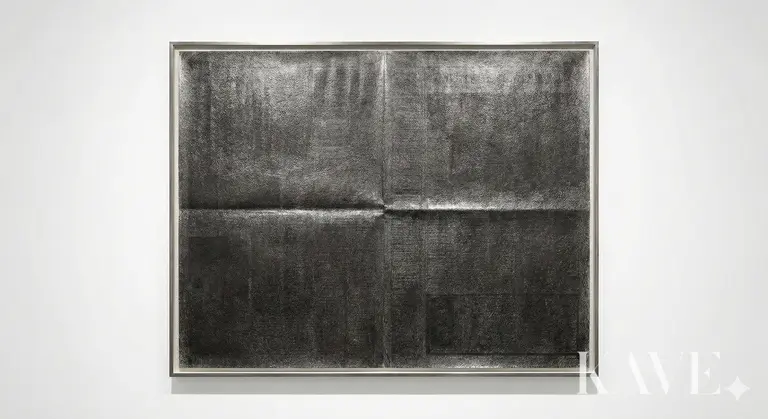
In February 2026, the winter in Seoul is particularly cold and dry. As we enter the doors of Perrotin Seoul, we face a massive wall of silence. The wall is black. But it is not just a simple black. It is a geological layer of time created by thousands, tens of thousands of hand movements, and a trace of a desperate struggle that occurred in the process of language being reduced to matter. In September 2025, the master of Korean experimental art, Choi Byung-so, passed away at the age of 82. This exhibition 《Untitled》 (January 20, 2026 - March 7, 2026) opens four months after his death and transcends the dimension of a simple retrospective. It is a grand requiem that proves how the aesthetics of 'erasing' that an artist devoted his life to can silence the noise of the times and reach the essence of art, and ultimately the roots of human existence.
Choi Byung-so's art is intertwined with the specificity of modern Korean history from the choice of materials. In the 1970s, canvas and oil paints were almost a luxury for a poor young artist. Instead, he focused on the most commonly available materials around us, namely newspapers and cheap ballpoint pens. In particular, the 'Monami 153 ballpoint pen' that he adhered to throughout his life has been a writing instrument that has accompanied Koreans since its production in 1963. The artist made a subversive attempt to produce the noble value of 'art' using this most popular and inexpensive tool.
The 'newspaper' or 'newsprint' that forms the base of his work symbolizes the poor papermaking technology of the post-war recovery period in the 1950s. The rough surface and yellowish color of the newsprint have a weak materiality that can easily tear and fray with just writing. The memory of this newsprint, which was used as a textbook in his childhood, became a deep trauma and a source of inspiration for the artist. He sublimated the physical limit where the paper tears, that is, the state just before the material collapses, into an artistic formative language.
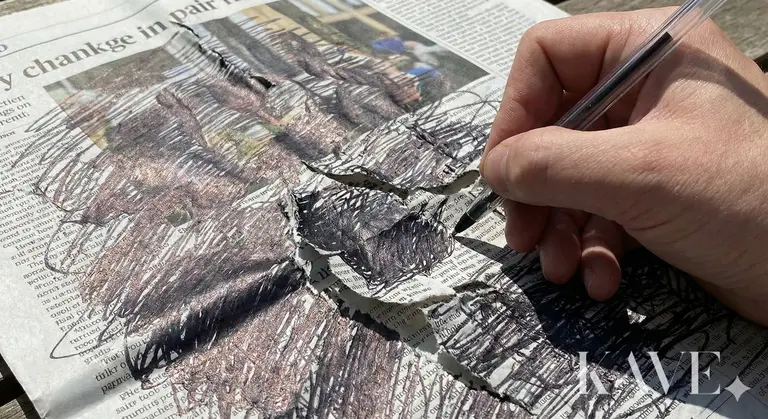
Choi Byung-so's working process requires arduous physical labor. He first draws lines on the newspaper with a ballpoint pen. He draws densely until the text is no longer visible. The ink of the pen seeps into the paper fibers, and due to frictional heat, the paper thins and tears in places. He then overlays it with graphite from a 4B pencil.
Through this process, the newspaper transforms from mere paper into a metallic surface imbued with the luster of graphite. The large works filling the exhibition spaces on the 1st and 2nd floors of Perrotin Seoul exhibit textures reminiscent of black steel plates or old leather. This is a third material born from the chemical combination of ink, graphite, and the artist's sweat. The fragility of the paper disappears, leaving only the solid materiality as a product of labor. Here, the viewer experiences overwhelming visual density and sublimity.
To understand the artistic roots of Choi Byung-so, one must closely examine the spatial and temporal background of 'Daegu' in the 1970s. At that time, Daegu was a mecca of experimental art that rebelled against the Seoul-centered National Art Exhibition (Korea Art Exhibition) system and the conservative atmosphere of the art world. Choi Byung-so was a founding member and key figure of the 《Daegu Contemporary Art Festival》, the first contemporary art festival in Korea, established in 1974.
In 1975, he formed the avant-garde art group '35/128' with Kang Ho-eun, Kim Gi-dong, Lee Myung-mi, and others, which signifies the latitude (35 degrees) and longitude (128 degrees) of Daegu. This group led conceptual experiments that broke the authority and formalism of the existing art world, asserting that "art can exist without being drawn." During this period, Choi Byung-so stood at the forefront of Korean avant-garde, traversing various media such as video, installation, and happenings. This was a process of forming a spirit of the times shaped through exchanges with contemporary experimental artists like Kim Ku-rim, Lee Kang-soo, and Park Hyun-ki, establishing the uniqueness of Korean experimental art distinct from Western minimalism or Japan's Mono-ha.
In the mid-1970s, the decisive moment that led Choi Byung-so to begin working with newspapers is not unrelated to the bleak political situation of the time. Under the Yushin dictatorship, the press was thoroughly controlled, and newspapers only carried censored truths. In an era where the function of the press was paralyzed, newspapers became mere aggregates of deceptive texts rather than a medium for conveying information.
Choi Byung-so
For Choi Byung-so, then in his 30s, the act of crushing and erasing newspaper articles with a ballpoint pen was an expression of anger towards the suppressed words, a passive yet powerful resistance against false print. Some critics interpret this as 'resistance against media oppression.' However, the artist later expanded this to a dimension of 'self-cultivation' beyond political acts. His statement, "It is not about erasing the newspaper, but about erasing myself," shows that he submerged the pain of the times into his inner self and sublimated it into artistic practice.
Choi Byung-so's early activities were relatively overlooked for a long time due to the monochrome painting (Dansaekhwa) craze. However, the 2023 exhibition 《Korean Experimental Art 1960-70s (Only the Young: Experimental Art in Korea, 1960s–1970s)》, co-hosted by the National Museum of Modern and Contemporary Art and the Solomon R. Guggenheim Museum, became a decisive moment in repositioning him as a major artist in Korean experimental art. This exhibition announced to the international stage that Choi Byung-so's work is not merely flat painting but 'conceptual performance art' born within the rapidly changing political and social context of Korean society. The current exhibition at Perrotin Seoul, being the first solo exhibition after this international reevaluation and after the artist's passing, will be an important moment to solidify his historical status in art.
A particularly noteworthy point in this Perrotin exhibition is that the artist presented a large number of works where he intentionally left certain parts or shapes instead of completely erasing the newspaper surface. This suggests that the artist's act of 'erasing' is not random destruction but a highly calculated formal choice and philosophical question.
Some of the exhibited works left the upper part of the newspaper, that is, the header area with the title, date, and issue number, untouched. The main body articles below are thoroughly concealed with black ink and graphite, making their contents unknown, but the date and title at the top remain vividly intact.
This composition anchors the work in a specific time and space.
Specificity: While a completely erased newspaper is an abstract 'material', a newspaper with the date left is a concrete evidence of history, '19xx year x month x day'.
Evocation of Memory: Viewers recall events or personal memories of that day when they see the remaining date. However, the article content that would validate that memory is erased. The tension between memory (residue) and forgetfulness (disappearance) maximizes the drama of the work.
This is closer to an existential affirmation that "everything disappears" rather than nihilism, but rather "nevertheless, time is recorded."
This exhibition also introduces works that leave shapes like circles. The intentionally left circular space amidst the dense act of drawing straight lines provides a breathing hole in the black screen.
Formative Rhythm: Amidst the obsessive repetition of vertical and horizontal intersecting lines, the organic curve of the circle provides visual rest.
Symbolic Meaning: The circle may evoke the Buddhist 'One Circle' and symbolize the moon or the universe. Alternatively, it can be interpreted as a window looking into a closed world (the blackened newspaper).
Presence of Absence: The blank space left un-erased paradoxically emphasizes the act of 'erasing'. If the painted part is the 'result of the act', the remaining part reveals the original materiality of the paper through the 'absence of the act'.
The artist also worked by cutting out pages from famous magazines like The New York Times, TIME, and LIFE. Here, he also chose to leave the words 'TIME' or 'LIFE' untouched.
This is Choi Byung-so's unique wit and insight, transforming the clichéd headlines of the media into fundamental philosophical questions about human existence. By erasing the flood of information (the content of TIME/LIFE magazines), he paradoxically questions the true meaning of 'time' and 'life' that we have lost.
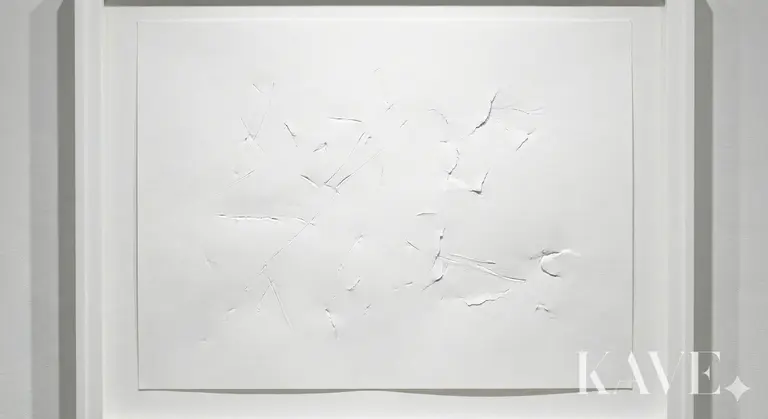
The rarest and most shocking work in this exhibition is the 'white work' 〈Untitled 0241029〉(2024). While previous works filled the screen with black ink and graphite, this work was created with an empty pen that has run out of ink.
The artist took a pen that does not produce ink and drew over the newspaper repeatedly. Thousands of drawing actions exist, but the resulting color does not exist. What remains on the screen are the pressed traces made by the pen tip, the scars of torn and loosened paper, and fine textures.
This is a state where even the act of 'erasing' has been erased, or where the minimum condition of painting, 'pigment', has been castrated. This white work, where only pure action and the resulting physical transformation remain, can be seen as the final destination of Choi Byung-so's art. By removing the visual element of color, the viewer can fully focus on the texture of the paper and the reflection of light. This is a crystallization of the 'nothingness' that he has pursued throughout his life.
Choi Byung-so's world of work is deeply connected to the phenomenological thought of Maurice Merleau-Ponty, in whom he was immersed. In 1998, he borrowed the title of Merleau-Ponty's book 『Meaning and Non-Meaning』 as the title of his work.
Just as Merleau-Ponty criticized the logic centered on reason and emphasized the importance of bodily perception, Choi Byung-so dismantled the logical world of newspapers dominated by language (Logos) through the non-logical act of physical labor (drawing with a ballpoint pen). The object work where he continued to scratch the corners of the book 『Meaning and Non-Meaning』 until it became tattered symbolically represents this philosophy. By physically damaging the repository of knowledge that is the book, he reduces the textual meaning contained within it to meaninglessness (matter), while simultaneously generating new artistic meaning through the act itself, a dialectical process.
In 2026, we live in an era where generative AI endlessly churns out text and images, and fake news and information overload have become everyday occurrences. All information is converted into digital code, consumed, and disappears at the speed of light. At this point, the torn and holey newspapers left by the late Choi Byung-so pose a heavy question to us.
The works of his displayed in the Perrotin Seoul exhibition paradoxically serve as the most powerful 'testimony of matter'. Unlike the smooth surfaces hidden behind digital screens, Choi Byung-so's works are rough, scarred, and tangible realities.
Choi Byung-so is gone, but the traces he drew and erased remain as an eternal 'present'. The 'TIME' in his works has stopped, but the questions of 'LIFE' he left behind have not ended. This 《Untitled》 exhibition will not be a period marking the end of an artist's life, but a loop that carries the universal value of his art to the next generation.
In the exhibition space with a faint smell of ink, in front of the blackened paper, we finally hear the sound of a world without noise. It is the great silence that only art can provide.