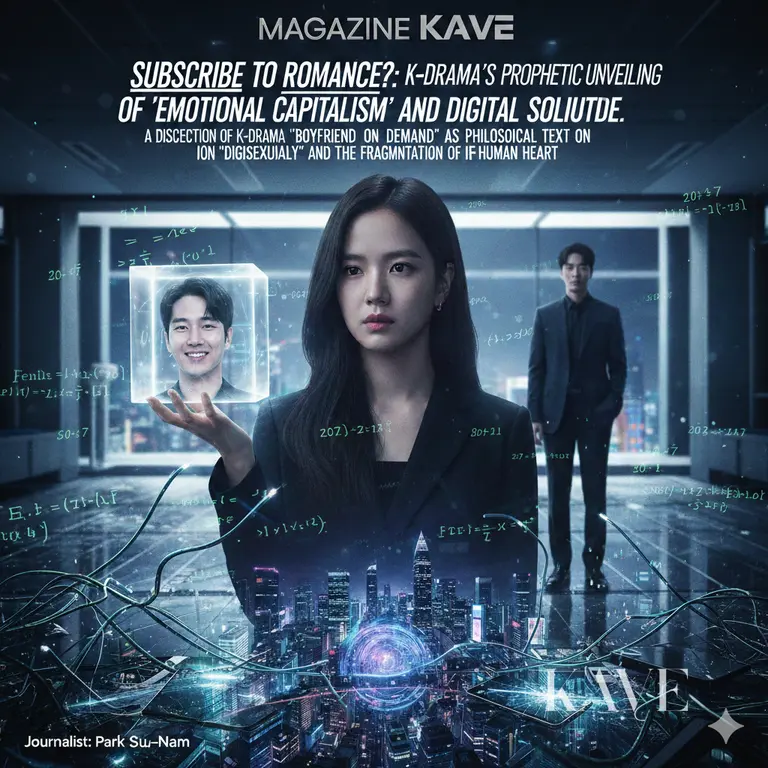
In January 2026, the drama 〈Boyfriend on Demand〉 was simultaneously released worldwide through Netflix, dominating global traffic immediately after its release and proving the power of K-content once again. The meeting of two massive icons, Jisoo from Blackpink and actor Seo In-guk, had explosive commercial potential in itself, but the perspective of most mainstream media on this phenomenon is extremely superficial. The media fixates on one-dimensional reviews such as 'Jisoo's successful acting transformation' or 'the sweet romantic chemistry between the two lead actors,' missing the chilling signs of the times that this work embodies.
This article starts from the hypothesis that 〈Boyfriend on Demand〉 is not just a romantic comedy or sci-fi fantasy, but a social documentary that empirically depicts the 'paradox of isolation' and 'complete commodification of emotions' faced by the hyper-connected society of the 21st century. The drama's premise—where a webtoon producer suffering from excessive work and burnout finds emotional solace through a virtual dating subscription service—suggests that modern individuals are abandoning the complex and painful process of coordinating with others and instead choosing the comfortable painkiller of 'subscription-based emotions.'
I aim to dissect this drama by thoroughly excluding the reporting methods of existing domestic media and borrowing perspectives from overseas sociological papers led by Eva Illouz and global economic reports. This is to answer fundamental questions about how the economic limitations faced by Korea's 'Sampo Generation' have given birth to the bizarre product of 'safe love' and why the world reacts so enthusiastically to this Korean specificity. K-dramas now function as a 'psychological infrastructure' that comforts or anesthetizes humanity damaged by capitalism.
The protagonist of 〈Boyfriend on Demand〉, Seo Mi-rae (played by Jisoo), is depicted as a capable webtoon PD but is exhausted of energy to maintain real-life relationships. The 'monthly boyfriend' device she accidentally acquires provides unconditional acceptance and perfect emotional optimization that real men cannot offer. This setup shows that the discourse surrounding Korea's 'Sampo Generation' (a generation that has given up on dating, marriage, and childbirth) has solidified into a massive market logic beyond a simple social phenomenon.
In Korean society, dating is no longer a natural outpouring of emotions. It is an 'investment' that requires time, capital, and emotional energy, and is simultaneously considered a 'high-risk risk' that can threaten an individual's career and survival. Between 2024 and 2025, Korea's marriage rate showed a temporary rebound, but this is closer to an illusion created by the fear of loneliness and the class stratification of marriage rather than a qualitative recovery of relationships.
The increase in marriage numbers paradoxically proves the 'stratification of marriage,' where only a 'small number' that has entered a stable orbit can participate in the marriage market. For the economically vulnerable lower classes or the youth who must focus on their careers, real dating is an act with diminishing returns. The virtual dating proposed by 〈Boyfriend on Demand〉 is precisely at this point, minimizing 'costs' while maximizing 'satisfaction' through algorithms, a product of economic rationality.
As Byung-Chul Han diagnosed in 『The Burnout Society』, modern individuals have degenerated into performance subjects who exploit themselves. The burnout experienced by Seo Mi-rae is not a reflection of her personal vulnerability but a structural product of a Korean society that imposes a 24/7 connected digital labor environment and constant self-improvement. In such an environment, encounters with others are exhausting in themselves. Others disappoint me, take my time, and make unpredictable demands.
Therefore, the 'monthly boyfriend' service is not just a romance but a technical solution that provides 'smooth communication' by eliminating the negativity of others. The devotion shown by virtual lovers in the drama is at a level that real humans cannot possibly imitate, paradoxically awakening viewers to how 'flawed' real dating is. This is not an evolution of romance but merely a packaging of the end of relationships under the name of romance.
Sociologist Eva Illouz has persistently traced how intimacy in modern society has been reconstructed by capitalist market logic. Through 『Cold Intimacies』 and 『The End of Love』, she argues that modern individuals consume dating as if shopping, pursuing efficiency of self-satisfaction rather than the authenticity of relationships.
According to Illouz, emotions now function like a currency. The subscription system of 〈Boyfriend on Demand〉 shows the commodification of emotions in its most extreme form. Users subscribe to emotional resources such as 'excitement' and 'comfort' by paying a fixed amount each month. This signifies that relationships have completely shifted from the realm of 'fate' or 'chance' to the realm of 'contracts' and 'services.'
A key concept to note here is what Illouz refers to as 'Negative Sociality' and 'Negative Bonds.' This refers to loose and instrumental relationships that can be canceled at any time and do not carry deep emotional responsibilities towards each other. The satisfaction the drama's protagonist feels in her relationship with her virtual boyfriend stems from the 'right to cancel,' which means that the relationship does not bind me and can be terminated whenever I want.
The role of Jisoo, the visual icon of Blackpink, in the global success of this drama is absolute. Illouz sees modern consumer capitalism as walking the stage of 'scopic capitalism,' which assigns value to visual images and controls desire through them. The perfect lovers in virtual reality (VR) are the result of projecting the aesthetic standards that the public yearns for to an extreme degree.
In the drama, Seo Mi-rae cannot endure the discomfort and tension arising from her relationship with her real rival Park Kyung-nam (played by Seo In-guk) and escapes to the smooth and perfect virtual boyfriend. This aligns precisely with the signs of the 'end of love' that Illouz warned about. Modern individuals prefer to consume only the fantasies they have programmed rather than face the unique inner world of others.
The virtual world presented by 〈Boyfriend on Demand〉 goes beyond merely pleasing the eyes; it shows the prelude to 'digisexuality,' which aims to completely replace human emotional and physical desires with technology. Digisexuality refers to the phenomenon of forming primary sexual/emotional identities through technology, fundamentally reshaping the paradigm of human relationships in the 21st century.
Whereas past technologies were 'tools' connecting humans, technology now acquires the status of a 'partner' in itself. The 'powerful dopamine' that Seo Mi-rae experiences in the drama does not come from interactions with humans but arises because the device analyzes the user's brainwaves and heart rate to provide optimal responses in real-time. This is the 'engineering design' of intimacy.
Byung-Chul Han defined eros in 『The End of Eros』 as 'entering the world of the other.' However, there is no other in digital dating. Only a sophisticated algorithm that reflects my desires exists. In the drama, Park Kyung-nam (played by Seo In-guk) appears rude and secretive, making Seo Mi-rae uncomfortable, but paradoxically, that 'discomfort' is the only signal that proves he is a living human.
However, modern individuals accustomed to the subscription economy do not want to endure this discomfort. They ask, "Why should I pay and endure discomfort?" 〈Boyfriend on Demand〉 is capitalism's kind answer to this question. This drama appears to show romance, but in reality, it declares the impossibility of romance.
The explosive global response to this drama is not solely due to the appearance of K-Pop stars. The 'Epidemic of Loneliness' that has deepened globally after the pandemic is the backdrop. The phenomenon of social isolation commonly found among young people in developed countries such as the United States, the United Kingdom, and Japan makes the setting of 〈Boyfriend on Demand〉 accepted as 'urgent reality' rather than 'fantasy.'
The U.S. Surgeon General declared loneliness a national health crisis in 2023. Loneliness is a deadly factor that increases the incidence of heart disease, stroke, and dementia, raising the risk of early death by 26-32% beyond just an emotional issue.
These figures suggest that the virtual dating service depicted in 〈Boyfriend on Demand〉 has a potential market worth trillions of dollars worldwide. Global viewers deeply empathize with Seo Mi-rae's emotional exhaustion and project her choice of 'safe comfort' as their alternative.
A decisive factor that has deepened the epidemic of loneliness is the disappearance of 'third places.' Physical spaces where people used to meet and communicate by chance, such as cafes, squares, and libraries, were closed or replaced by digital platforms during the pandemic. According to a 2023 survey, more than 60% of American adults have reduced outdoor activities compared to before the pandemic, fundamentally blocking opportunities for 'chance encounters.'
What has filled this spatial void is digital platforms like Netflix. The platform tempts us by saying, "The outside is dangerous and uncomfortable, so enjoy the perfect world we provide inside." 〈Boyfriend on Demand〉 draws in the logic of such platforms into the drama's setting (the virtual dating app), making the act of watching the drama synonymous with the protagonist's actions. This is not healing loneliness but rather a sophisticated marketing that 'commodifies' loneliness to perpetuate it.
K-dramas have now transcended mere entertainment, functioning as a 'psychological infrastructure' that supports the spirits of the global population exhausted or defeated in neoliberal competition.
〈Boyfriend on Demand〉 anesthetizes viewers on two levels. First, by showing the process through which the protagonist Seo Mi-rae heals her wounds through her virtual boyfriend, it allows viewers to fill their emotional hunger with the 'virtual boyfriend' of the drama. Second, by burying the structural problems of reality (overwork, housing insecurity, class disparity) in romantic fantasies, it substitutes social anger with emotional comfort.
Here, the unique 'Cinderella narrative' and 'savior narrative' of K-dramas are revived in the clothing of the digital age. The one who saves Seo Mi-rae is not a prince on a white horse but a highly developed 'dating algorithm' and 'affordable subscription fee.' This subtly conveys the message that salvation in a capitalist society is only possible through 'purchase.'
Byung-Chul Han criticizes the culture of 'likes' in 『The Transparent Society』 and 『The End of Eros』. In a society where only smooth positivity devoid of conflict and negativity circulates, humans no longer have the opportunity to mature. The global fandom's reaction to 〈Boyfriend on Demand〉 shows this obsession with positivity. Fans cheer for Jisoo's pretty looks and sweet romance while ignoring the chilling warning about the 'artificiality of relationships' that this work presents.
Ultimately, K-dramas have become a 'soft control mechanism' that manages the mental panic caused by capitalism. Instead of being angry about the unfairness and loneliness of reality, people turn on the Netflix app and 'subscribe' to romance, momentarily forgetting their pain. This is not true comfort but rather an 'emotional opiate' that prevents them from seeing the source of their suffering.
"Would you like to subscribe to romance?" is the most existential question posed to us living in 2026. 〈Boyfriend on Demand〉 shows how rational, safe, and sweet it is to answer "Yes" to that question through captivating visuals. Jisoo's dazzling appearance and Seo In-guk's charming narrative make it hard to refuse that answer.
However, what we must read between the lines of this drama is the longing for things that cannot be 'subscribed' to. Love is originally the courage to be hurt, a painful process of embracing the rudeness and imperfections of others. As Eva Illouz warned, the moment we leave emotions to the market and eliminate the risks of relationships through technology, the deepest part of our inner selves—the realm called humanity—slowly evaporates.
K-dramas are a mirror standing at the forefront of modern civilization. The future reflected by 〈Boyfriend on Demand〉 may not be a paradise where technology saves us, but a quiet hell where we no longer 'need' each other. True romance does not exist in the subscription list. It exists only in that fleeting moment when we turn off the screen, face the uncomfortable gaze of others, and start unpredictable conversations.
When capitalism tries to sell us 'safe love,' can we willingly choose 'risky love'? The success of 〈Boyfriend on Demand〉 is paradoxically a sad cry of humanity that has lost the power of choice. What we need in 2026 is not a better algorithm but the rough courage to face each other's wounds as they are. This heavy question posed by K-dramas is now left to the viewers. Would you like to subscribe to romance, or would you like to become human again?