
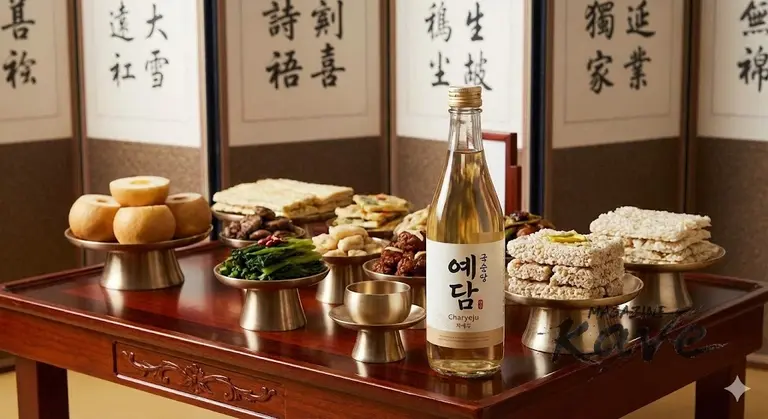
The world of Joseon was a 'village where every household brewed alcohol.' According to records, during the Joseon Dynasty, a culture of brewing alcohol with unique secret recipes flourished in each family and region. This went beyond the mere production of a luxury food item. It was considered unimaginable disrespect to buy ritual alcohol (祭酒) with someone else's hands or money. The act of washing rice, steaming it, and mixing it with homemade nuruk was the very beginning of the ritual, and that sincerity (Jeongseong) was the core of Confucian rituals.
However, after the Eulsa Treaty in 1905, the Japanese began to colonize all systems in Korea, and the brewing industry was no exception. The implementation of the Liquor Tax Act in 1909 and the announcement of the Liquor Tax Ordinance in 1916 strangled the culture of home brewing. The Governor-General of Korea completely banned home brewing for the purpose of securing tax revenue and controlling rice, forcing alcohol to be brewed only in licensed breweries. More critically, there was the 'control of microorganisms.' The Japanese replaced Korea's diverse and rough nuruk with the Japanese-style koji method. This method was easy to manage and had a high yield, but it produced a uniform taste. The microbial ecosystem of the Korean Peninsula, which had been maintained for thousands of years, was destroyed by the logic of imperialist efficiency.
The Grain Management Act of 1965
Even after liberation, the tragedy of traditional alcohol continued. To overcome the food crisis immediately after the Korean War, the Park Chung-hee regime enacted the 'Grain Management Act' in 1965, completely prohibiting the use of rice for brewing alcohol. This period was the 'dark age' of Korean traditional alcohol. Instead of rice, imported flour, corn, and sweet potato starch became the ingredients for alcohol, and diluted soju, which mixed ethanol with water and sweeteners, became the national drink.
From 1965 until the early 1990s when rice makgeolli was allowed again, more than a generation of Koreans forgot the taste of 'alcohol brewed with real rice.' They grew up misunderstanding industrial soju in green bottles and Japanese-style sake, 'Jeongjong,' as tradition. Kooksoondang's ritual wine class is like a clinical laboratory healing this 'taste amnesia.'
Why 'Sindoju' Now?
The alcohol that Kooksoondang teaches participants to make in this Seollal class is 'Sindoju.' Literally meaning 'new alcohol brewed with fresh rice,' it goes beyond a mere material definition of alcohol made from rice. Sindoju is the purest form of alcohol brewed to inform ancestors that the year's harvest has been safely completed, made from the first harvest. It symbolizes the act of returning the alcohol that had been replaced with 'imported flour' and 'diluted alcohol' back to 'fresh rice from our land.' This is a symbolic act of reconnecting the lost link between agriculture and rituals. The participation of 30 participants at a low cost of 20,000 won is also a process of restoring their status as 'producers' rather than capitalist consumers.
The Conflict of Nuruk and Koji, Chaos and Order
The first mountain that global readers must overcome to understand Korean traditional alcohol is to grasp the difference between 'nuruk' and Japanese 'koji.' This is not just a difference in fermentation agents but shows the philosophical differences in how the two cultures approach nature.
The koji used in Japanese sake brewing is the product of thorough 'separation' and 'purity.' Japanese breweries polish rice to remove protein and fat, inoculating only a single strain of mold (Aspergillus oryzae) cultivated in a laboratory into the pure starch core. This process occurs in a strictly controlled environment to prevent external contaminants. The result is crystal clear, with a beautiful fruity aroma (Ginjo-ka), and a clean taste without off-flavors. This is the epitome of an aesthetic that seeks to perfectly control nature according to human intent.
In contrast, the nuruk that participants crush by hand in Kooksoondang's class is 'wild' itself. Whole wheat is roughly crushed, mixed with water, and left in a natural state. During this process, numerous molds (Rhizopus, Mucor, Aspergillus, etc.), yeasts (wild yeasts including Saccharomyces), and lactic acid bacteria settle into the nuruk mass.
Nuruk is a 'microbial universe.' It contains molds that break down starch into sugar, yeasts that convert sugar into alcohol, and lactic acid bacteria that prevent the proliferation of contaminants and add acidity. The alcohol they produce is not uniform. It is a blend of earthy smells, grassy scents, the aroma of ripe pears, and a heavy body with acidity. While Japanese sake embodies the aesthetics of 'line,' Korean traditional alcohol embodies the aesthetics of 'plane' and 'volume.'
Comparative Tasting at the Beautiful Place... Awakening of the Senses
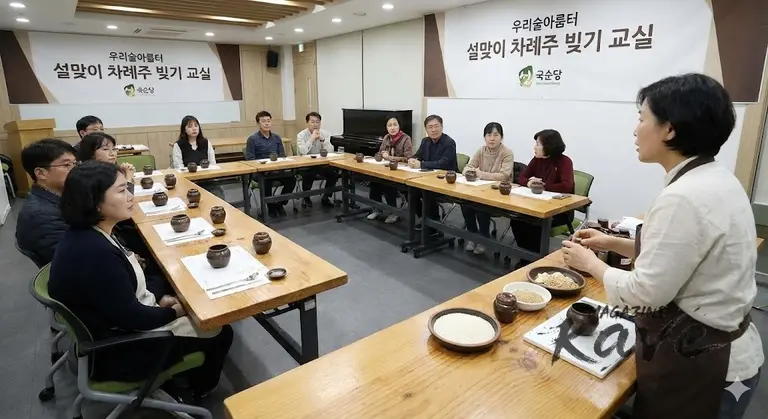
The highlight of Kooksoondang's 'Our Alcohol Beautiful Place' education is the time spent comparing these two types of alcohol. Participants alternate between drinking Japanese-style sake (or general commercial sake) and Kooksoondang's traditional ritual wine 'Yedam.' The participants' reactions are clear. Japanese-style sake has a lightness that brushes the tip of the tongue and disappears, while 'Yedam' brewed with nuruk fills the mouth with weight and leaves a lingering aftertaste even after swallowing. In this moment, participants realize with their tongues, not their heads, what the 'taste' that was erased by the Japanese occupation and industrialization was.
Another point to note in this lecture is the method of brewing alcohol, specifically using 'Baekseolgi' instead of 'Godubap' or 'steamed rice.' This is not just a difference in recipe but a scientific choice that embodies the wisdom of our ancestors who had to fight against time.
Why Baekseolgi Instead of Godubap?
The most common method for brewing makgeolli or yakju is the 'Godubap' method, where rice is soaked in water and steamed in a sieve. The rice grains remain alive, making it favorable for obtaining clear alcohol. However, for 'Seollal Ritual Wine,' time is of the essence. There are about two weeks left until Seollal. To perfectly saccharify the starch in rice and convert it into alcohol within this short time, a form that allows microorganisms to easily penetrate the rice is needed.
Contact with Son-mat Bacteria
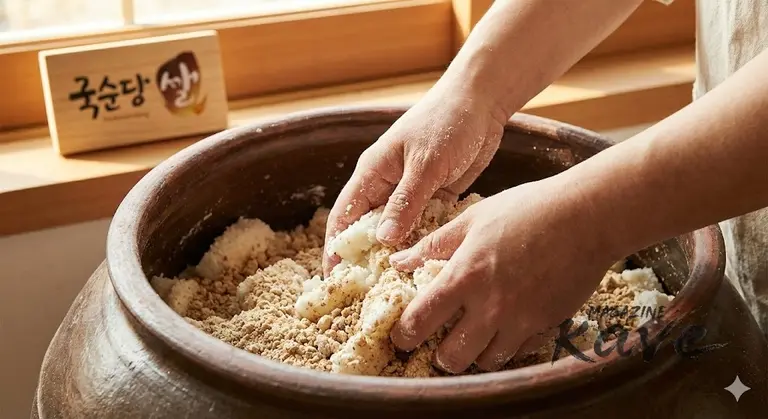
At the lecture site, 30 participants crush the freshly steamed Baekseolgi by hand (Punging) and mix it with cold water and nuruk to make a dough (Mash mixing). This process is painful but essential. During the process of handling the hot rice cake, the temperature of the rice naturally adjusts to around 25 degrees, which is ideal for yeast activity.
More importantly, it is the 'hand.' In Korean food culture, 'Son-mat' is not a metaphor. The beneficial bacteria residing on human hands mix into the brewing vessel. Participants experience a 'contact' that is absolutely not allowed in industrial breweries, kneading rice and nuruk with their own hands. This is a human resistance to the modern alcohol production method that moves from sterile rooms to stainless steel tanks.
Drinking Blessings: Resonance Between the Living and the Dead
The purpose of all these processes—raising nuruk, crushing rice, steaming Baekseolgi, and brewing alcohol—has only one destination: the ritual table. To global readers, Korean Charye culture may seem like simple ancestral worship. However, its essence lies in 'communication' and 'sharing.'
Fragrance to the Sky, Alcohol to the Earth
In Confucian rituals, burning incense is an act of calling upon the spirits of ancestors with the rising smoke. In contrast, pouring alcohol onto the ground (or sacrificial vessel) is an act of calling upon the bodies of ancestors that have returned to the earth. In other words, alcohol is a medium that connects heaven and earth, the living and the dead.
This is where Kooksoondang's 'Yedam' differentiates itself from Japanese-style sake. 'Yedam' is brewed with 100% pure fermentation without mixing in distilled alcohol to increase quantity, and it has been recognized for its authenticity to be used as a dedicated ritual alcohol for the Jongmyo Ritual designated by UNESCO. Presenting 'Yedam' as a gift to participants is not merely a product promotion but a message that says, "This alcohol is the standard you should brew."
Drinking Blessings... Drinking Fortune
The 'Eumbok' that takes place after the ritual is the completion and climax of the ceremony. It is a ritual where the ancestral spirits enjoy the fragrance and the remaining alcohol and food are shared among the family. While Western rituals involve the concept of sacrifice, where offerings are presented to the gods and burned away, Korean rituals embody the concept of communion, where meals are shared with the gods.
Drinking Sindoju is the act of physically consuming the virtue of ancestors. When participants place the Sindoju they brewed themselves on the ritual table on Seollal morning two weeks later, and the whole family sits around to drink that alcohol, the taste of that alcohol has a depth that cannot be compared to commercial soju. It is the taste of pride in "we brewed this," and it is the taste of evidence that the interrupted family history has begun to flow again.
The participation fee for Kooksoondang's class is 20,000 won (10,000 won for university students). Brewing over 1.5 liters of alcohol, receiving high-quality ritual wine 'Yedam' as a gift, and receiving education from professional instructors is absurdly cheap. This suggests that Kooksoondang views this event not as a profit-making venture but as part of a 'cultural struggle.'
Kooksoondang, which led the modernization of traditional alcohol with the Bekseju syndrome in the 1990s, has now moved to the stage of 'educating' consumers. If consumers do not brew alcohol themselves, they cannot understand why traditional nuruk is precious and why 100% fermented alcohol is expensive.
K-Sool in Global Trends
The trend in the global alcohol market can be summarized as 'Natural Wine' and 'Craft.' It is a movement that rejects artificial additives, uses wild yeasts, and minimizes filtering to pursue the original taste of the ingredients. Korean traditional alcohol, especially makgeolli and yakju made with nuruk, perfectly aligns with this global trend.
On January 24, the 30 people gathering at the Beautiful Place will pause their time, accustomed to the speed of smartphones, for two hours as they wash, steam, and mix rice.
In the jars they take home, an invisible revolution will occur. Yeasts will consume sugars, emitting alcohol and carbon dioxide, and the rice will sublime from a hard solid into a fragrant liquid. This two-week fermentation period gifts modern people with 'the uncontrollable time of nature.'
What we have lost is not merely the technique of brewing alcohol. It is the communal heart that offered the most precious thing made by our own hands to our roots (ancestors) and shared it with neighbors to confirm each other's well-being.