

[magazine kave=Choi Jae-hyuk Reporter]
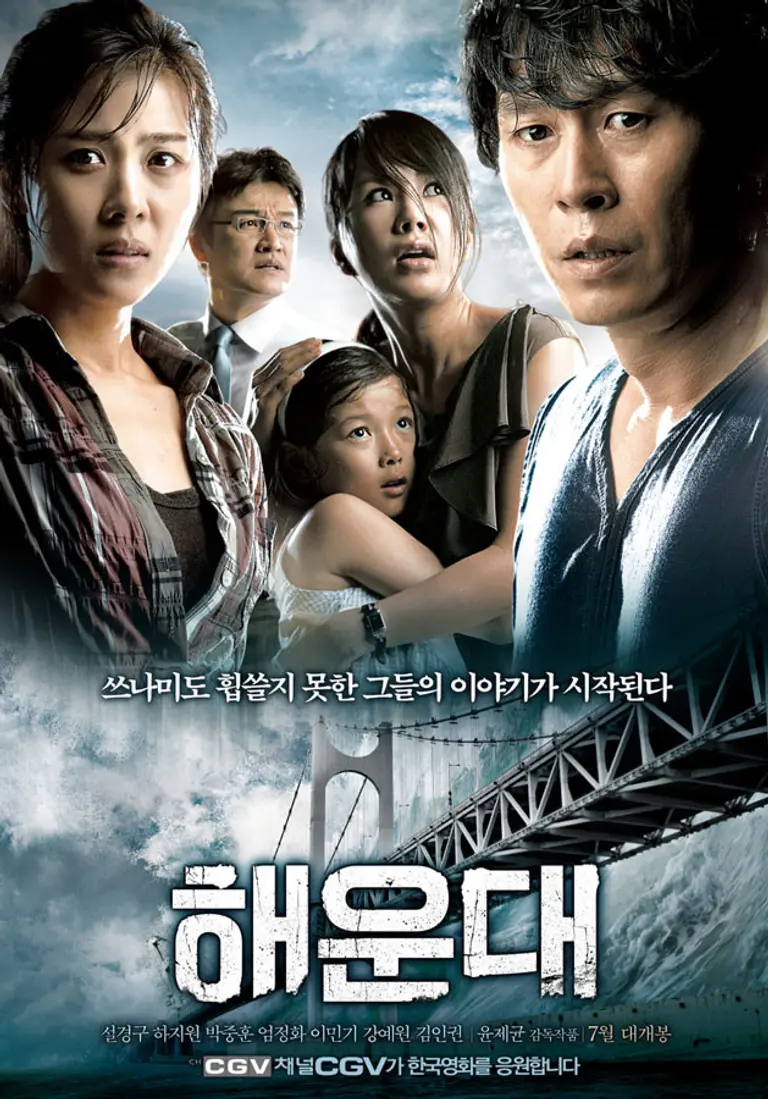
In the height of summer, the sun heats the sand and tubes and parasols are tightly packed on Busan Haeundae Beach. Amidst the loud hawking of merchants, children jumping into the waves, and drunken tourists, Choi Man-sik (Seol Kyung-gu) gazes at the sea with heavy eyes. After returning with the guilt of having lost his father in a tsunami that occurred in Thailand, he lingers around the diver Kang Yeon-hee (Ha Ji-won), deliberately laughing louder and making lighter jokes. Unable to utter the word 'sorry' until the end, he helps serve soup at a street stall, hails taxis for others, and assists with household repairs, continuing his own form of atonement. Yeon-hee, while pushing Man-sik away as if he were someone she had known for a long time, cannot hide the strange expression that suggests she has already accepted him long ago.
In Seoul, time flows at a completely different temperature. Geologist Kim Hwi (Park Joong-hoon) examines rock structures and seabed data, confirming ominous figures. Subtle signs of anomalies detected on the East Sea seabed accumulate, and the numbers and graphs on the monitor converge towards one conclusion. The possibility of a massive tsunami occurring in Haeundae, a densely populated resort area, is by no means low. His past experience at a tsunami disaster site haunts him, and the pull between his conscience as a scholar and his responsibility as a father tugs at him. His ex-wife Lee Yoo-jin (Um Jung-hwa) works as a news anchor and struggles to accept this disaster scenario that feels unrealistic. In Kim Hwi's eyes, as he looks at his daughter, a sense of anxiety builds that cannot be explained by the sentences of a research report.
There is also the perspective of those who face the sea most closely. Coast Guard rescue team member Choi Hyung-sik (Lee Min-ki) spends his day running between drunken tourists causing trouble and beachgoers ignoring safety rules. He is more familiar with the sea than afraid of it. He senses the moment the water flow changes and knows from experience the patterns of when the waves suddenly intensify. One day, while rescuing the fainted Hee-mi (Kang Ye-won), who is causing a ruckus with curses, a strange romance begins between the two. One has returned from a life-threatening rescue, while the other, feeling wronged, starts shouting, and this mismatched first meeting injects both light laughter and tenderness into the film.
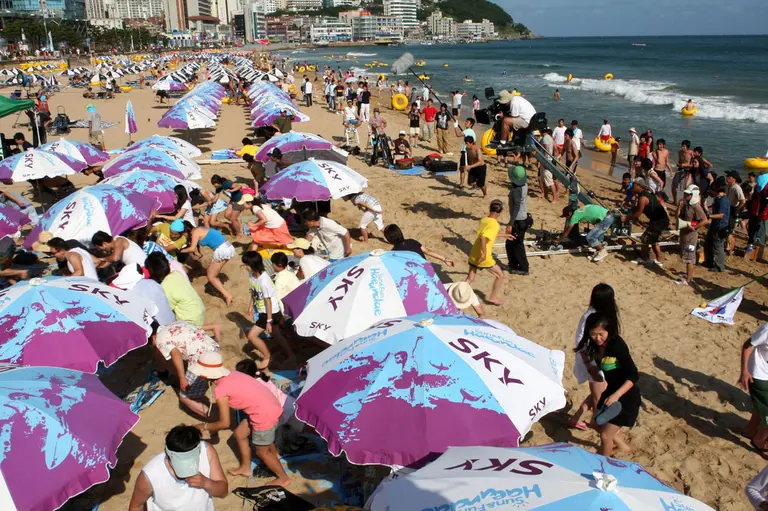
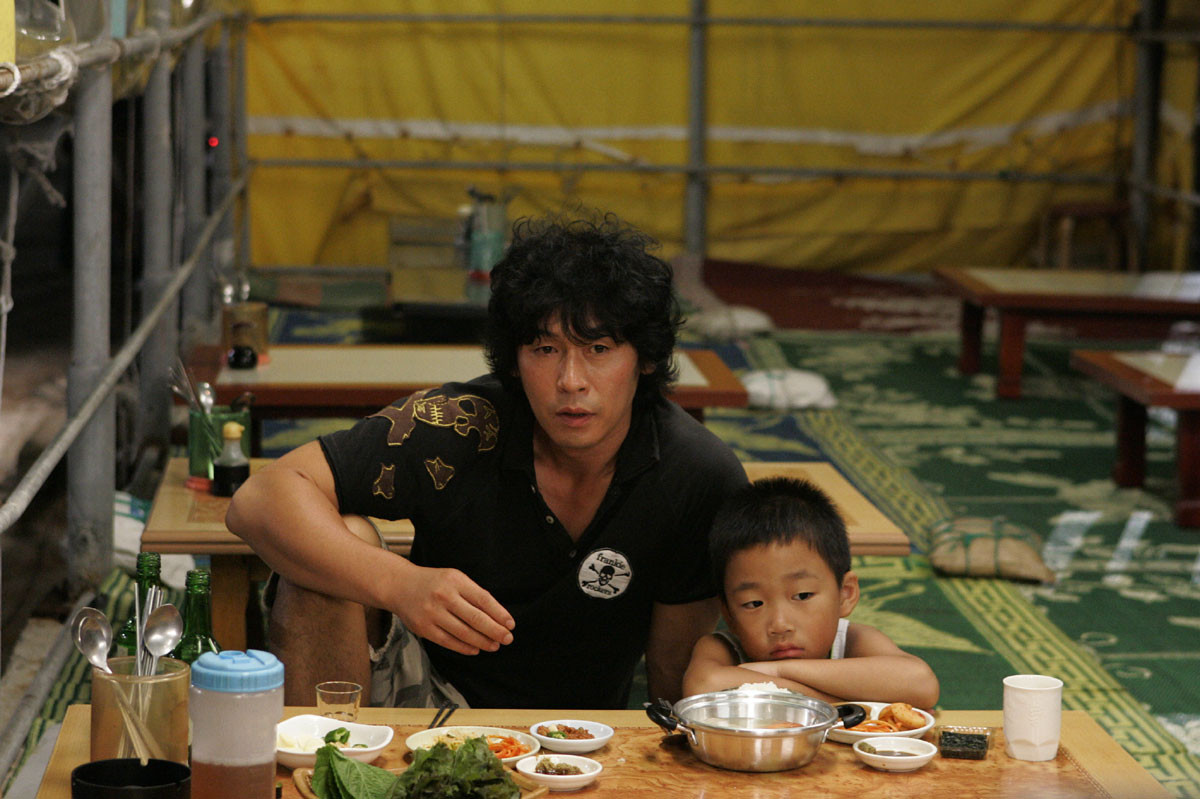
In the early part of the film, Haeundae appears more like a summer vacation movie than a disaster film. Man-sik and Yeon-hee clink glasses at a beach stall, Yeon-hee is busy preparing to open her restaurant, and Hyung-sik exchanges jokes with his fellow rescue team members, while Kim Hwi juggles between the broadcasting station and the lab, balancing reality and theory. The director shows these ordinary scenes for a sufficient length of time. The audience gradually becomes attached to their laughter, grumbling, and minor conflicts. The longer this ordinariness accumulates, the more brutally the impending disaster will feel, even as they wish to forget that fact for a moment.
However, cracks begin to appear in the corners of the screen. Dead fish washed up on the beach, strange wave patterns caught far out at sea, meetings of bureaucrats who do not take Kim Hwi's report seriously, and discussions about delaying warnings simply because they cannot reduce the number of tourists are all laid out. These scenes, familiar to the point of being realistic, remind us that disaster is not a bolt from the blue but rather the result of various signs that were previously visible and ignored warnings.
They say sorrow comes after joy...
On the fateful day, Haeundae is busier than ever this year. With school vacations and holidays coinciding with local festivals, the sandy beach is filled with people. Yeon-hee is excitedly preparing to welcome guests with dreams of officially opening her restaurant, while Man-sik circles nearby, determined to make a proper confession. Hyung-sik pretends to focus on rescue work, moving between the sea and the sandy beach, but finds excuses to contact Hee-mi whenever he can. Kim Hwi struggles to persuade the bureaucrats with his final report, but the responses he receives are only vague smiles and evasive words. The scenes where their paths intersect and overlap within the space of Haeundae make the entire city feel like a living organism.
And then suddenly, the sea goes quiet. The rhythm of the waves breaks, and the water drains abnormally, revealing a wide tidal flat in front of the beach. People approach the sea, intrigued by this strange sight. Moving fish can be seen within reach, and everyone raises their mobile phone cameras. At this moment, the audience already knows. This retreat is a sign that a massive tsunami is about to come. The difference in perception maximizes the tension between the outside and inside of the screen.
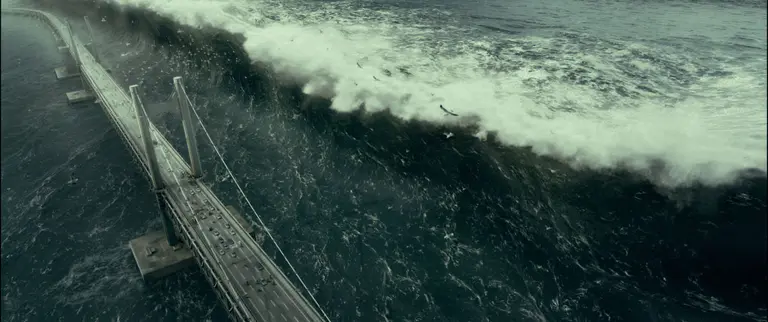
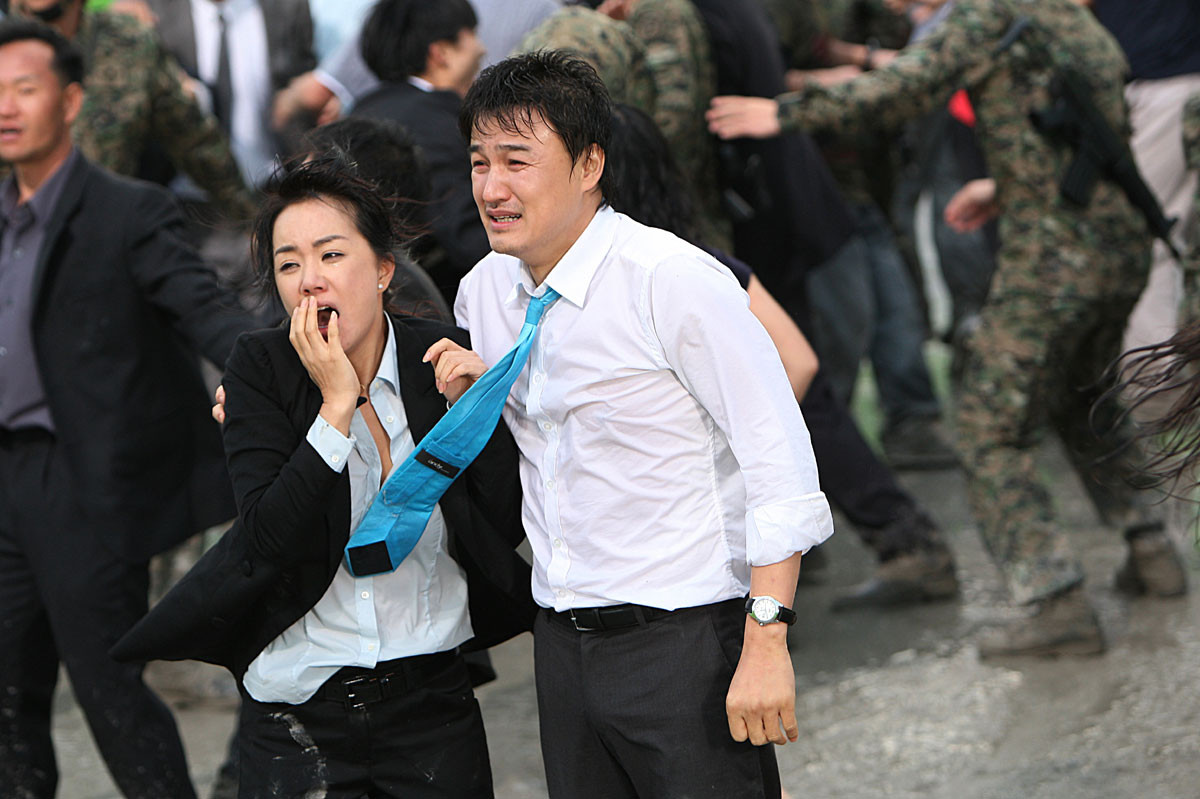
Kim Hwi and the authorities, along with the Coast Guard, belatedly realize the seriousness of the situation and hurriedly issue warnings and evacuation broadcasts, but there are still many people left on the beach and in the city. In the following scenes, a wall of water dozens of meters high fills the horizon, and as it rushes towards the city, the film reveals its true nature as a disaster genre, crushing all the laughter and daily life it had built up earlier. Vehicles on the Gwangan Bridge are swept away by the waves, water rushes into the lobbies of high-rise buildings, and underground parking lots, subway stations, and tunnels are instantly submerged. Hyung-sik, as a rescue team member, clings to the line until the end, pulling people up, while Man-sik instinctively throws himself towards Yeon-hee and those around her. Each character must decide for themselves who to protect and what to sacrifice in their given position. The consequences of those choices become the greatest emotional wave in the latter half of the film, so it is better to witness it with your own eyes.
Adding K-Drama to Disaster Blockbusters
Looking at the completeness of the work, the first noticeable point is the combination of genres. 'Haeundae' borrows the narrative style of Hollywood disaster blockbusters but thickly overlays it with Korean-style family melodrama, romantic comedy, and slice-of-life comedy. The reason for showing the characters' small daily lives and emotions instead of the signs of disaster for a long time in the beginning lies here. It is to make the audience accept them as 'people they could see somewhere' rather than 'victims of the incident'. After sufficiently showcasing an ordinary day, the way that day is swallowed whole creates a sense of loss that surpasses the visual scale of the disaster scenes.
The character composition is somewhat typical. A responsible but inarticulate head of the family, a woman who endures with laughter while carrying wounds, an expert wavering between science and reality, a prickly yet pure young man, and a character who is annoying at first but becomes likable by the end. Familiar roles are established. However, this typicality is precisely the strength of 'Haeundae'. The relationship between Seol Kyung-gu and Ha Ji-won as Man-sik and Yeon-hee feels alive, like the emotions of a man and woman that could exist somewhere in Busan. The dialogue naturally shows that passing remarks can become wounds and that jokes thrown without meaning can linger in the heart for a long time. Lee Min-ki's Hyung-sik symbolizes the face of a young, rough but responsible man, while the relationship between Um Jung-hwa and Park Joong-hoon as Kim Hwi and Yoo-jin brings the realities of middle age and parental concerns into the disaster. As characters from various generations and positions come together in one story, the emotional spectrum of the film widens.
Expanding the Scale of Korean Commercial Cinema
From a directorial perspective, this work boldly pushed the upper limits of the disaster scale that Korean commercial cinema could achieve at the time. The collapse of the Gwangan Bridge, the flooding of high-rise buildings, and the scenes of the entire city submerged left a strong impact on Korean audiences. It was impressive not just because of the quality of the computer graphics, but because it brought scenes of specific urban spaces collapsing onto the screen. The Haeundae beach and Marine City, which had been consumed as tourist images in countless dramas, variety shows, and promotional videos, suddenly become vulnerable structures in this film. The shock of this recontextualization of space is significant.
The emotional line of this film follows the typical grammar of Korean melodrama. It builds up comedy, conflict, and tears in succession, then explodes all at once at the climax. When disaster strikes, the audience can naturally cry because they have already built up enough affection. In that process, there are times when it seems excessive. Especially in the latter half, laughter and tragedy almost appear in tandem, causing emotional turbulence. Characters who were just funny moments ago make tragic choices in the next scene, and immediately after touching scenes, jokes pop up again, which may feel somewhat distracting to some viewers. However, this uneven emotional amplitude is also a familiar rhythm for Korean audiences.
As a disaster film, a noteworthy point is how this work depicts society before the disaster. The warnings of the geologist lose power at the threshold of bureaucracy, and the administration, worried about holiday tourism revenue, postpones uncomfortable conclusions, appearing like a recurring landscape that transcends specific eras. Rather than pinpointing someone as a villain, the director naturally places the complacency and avoidance of responsibility that comes with the thought, 'Surely, nothing like that could happen.' The message that these familiar attitudes accumulate to increase the scale of disaster lingers long after the film ends.
It is also important to focus on individual choices. The choices surrounding who to save first in a disaster situation and at what point to give up are intertwined with the characters' narratives. The film does not present answers to those choices. Some characters' sacrifices are highlighted, while others' decisions pass by in just a few short cuts. The audience is led to imagine what they would have done in that situation by observing those differences. This process of contemplation elevates 'Haeundae' beyond mere spectacle.
Disliking people but drawn to them because they are human
This film serves as a good starting point for those unfamiliar with the disaster movie genre. By not foregrounding brutal scenes or horror direction, but instead building up the relationships and emotions of the characters before pushing in the disaster, it allows for an experience of genre tension that is not burdensome. For those with personal memories of Busan and Haeundae, there is also the fun of overlaying their own memories onto the landscapes seen in the film. The sea, which was only seen in postcards and photos, will appear as a space where someone's life and death intersect.
For those feeling vague anxiety and helplessness while observing the world today, this film can help sort through complex emotions. 'Haeundae' shows how small humans can become in the face of nature while also demonstrating what those small humans can decide for each other. Amidst explosive CGI and sound, what ultimately captures and holds the audience's heart is the back of someone who jumps in for another. If you want to experience a moment of being choked up while lightly laughing on a summer night, and if you want to reaffirm the archetype of Korean disaster melodrama, choosing to revisit 'Haeundae' now is certainly worthwhile.