
The Moment Despair Gives Birth to Innovation... The CEO's Reckless Gamble
In 2011, imagine you are managing the company that invented ramen in Korea for the first time in 1963. Your company, once a true pioneer in the food industry, has now fallen to the status of an inconsequential 'perennial second place'. Competitors have dominated the market, and the brand has not escaped the image of 'grandfather's food'. Financial difficulties are mounting, and a sense of defeat is pervasive in the office, leading employees to quietly start polishing their resumes.
This was the reality of Samyang Foods at the time. Once occupying the position of the nation's ramen, it had now barely secured a corner spot on the shelves of large supermarkets.
Then came the moment that would change everything. Not in a conference room, but in the alleys of Myeongdong in the heart of Seoul.
The Realization in Myeongdong... The Moment Pain Becomes Entertainment
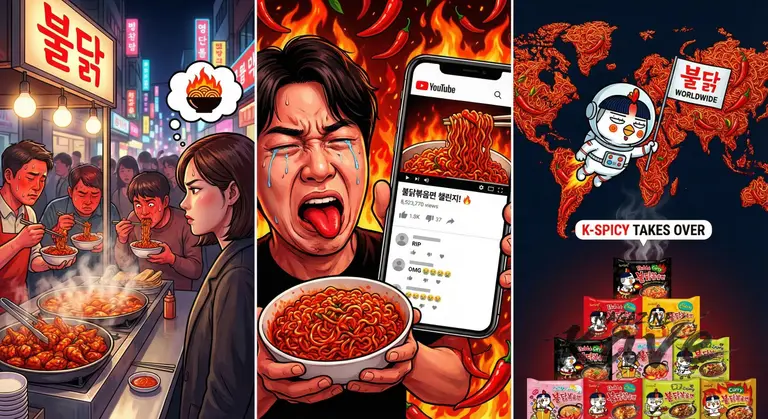
Kim Jeong-soo, then Vice President of Samyang Foods (daughter-in-law of the founder), went shopping in Myeongdong with her high school daughter and witnessed a strange sight. There was an absurdly long line in front of a small restaurant. Driven by curiosity, she went inside.
Inside, teenagers and young adults were eating spicy braised chicken. No, to be precise, they were 'suffering'. Their faces turned as red as tomatoes, and sweat poured down their foreheads like rain. They gasped for breath and gulped down water. Yet... they were laughing. They were having the time of their lives.
Vice President Kim frantically took notes. "Spicy food is not just a taste. It is stress relief. It is entertainment. It is a challenge."
In that cramped restaurant, witnessing Korean youth transforming pain into pleasure, she envisioned the future. What if we created the spiciest ramen in the world? What if we eliminated the broth and made a concentrated firebomb with dry noodles?
Her team thought she was crazy.
The Laboratory of Pain: 1,200 Chickens and 2 Tons of Sauce
Returning to headquarters, Vice President Kim issued a command that could only be described as culinary masochism as corporate policy. "Investigate all famous spicy restaurants across the country. Buy their sauces and reverse engineer them."
The research team scoured the country for fire chicken restaurants, spicy tripe houses, and volcano-like tteokbokki shops, collecting samples. They imported peppers from around the world. Vietnamese peppers, Mexican habaneros, Indian ghost peppers, and Tabasco sauce by the litre.
The goal? To precisely design a spiciness that is memorable enough but not so extreme that it sends people to the emergency room.
The cost was horrific. Over 1,200 chickens were sacrificed during the R&D process. 2 tons of spicy sauce were tested. The researchers developed chronic gastrointestinal disorders. Some begged for mercy. One researcher reportedly said, "Please, just kill me."
Vice President Kim refused to compromise. "If the taste is mediocre, it won't stick in consumers' minds."
After a year of culinary agony, they reached the magic number. 4,404 SHU on the Scoville scale—almost double that of Korea's best-selling Shin Ramyeon.
In April 2012, Fire Noodle was born.
A Product Everyone Detested (At First)
The initial reaction was... not encouraging.
"This is not food for humans."
"I almost went to the emergency room."
"Isn't this a chemical weapon?"
Even major retailers refused to stock it. "It's too spicy; it won't sell." Employees whispered that it would be discontinued within months.
But Vice President Kim was confident. She believed that a niche market of 'spice fanatics' would evangelise this product.
She was right. However, the evangelists appeared from completely unexpected places.
YouTube... Pain Becomes Viral Gold
Traditional TV advertising failed to save Fire Noodle. The internet saved it.
In the early 2010s, YouTube was explosively growing as a platform for viral challenges. Rumours spread. "There’s a ramen in Korea that’s insanely spicy." Overseas YouTubers began filming themselves eating it.
The most legendary moment was when British YouTuber Josh from Korean Englishman had his London friends try Fire Noodle. Their reactions—red faces, desperately searching for milk, existential crises about life—recorded millions of views.
Suddenly, eating Fire Noodle was no longer just a meal. It became a rite of passage. A test of courage. A badge of honour.
#FireNoodleChallenge was born and spread like wildfire across the continent. Teenagers in Texas, students in Stockholm, families in Jakarta—all filmed themselves in pain and ecstasy.
Samyang Foods spent almost no money on global marketing. Consumers did it for them. This was real viral marketing before it became a cliché.
The Spicy Spectrum... Building an Empire Through Pain Tolerance
They did not rest on their laurels. Samyang realised that everyone has a different pain threshold and created the Scoville Ladder.
Beginner Level:
Carbonara Fire Noodle (Creamy, for the faint-hearted)
Lovely Hot Fire Noodle (For those who think pepper is spicy)
Standard:
Original Fire Noodle (4,404 SHU - gateway drug)
Veteran:
Nuclear Fire Noodle (Double the spiciness)
Challenge! Fire Noodle Bibim (12,000 SHU)
Madness Level:
Nuclear Fire Noodle 3x Spiciness (13,000 SHU - the one banned in Denmark)
Yes. You read that right. The Danish Food Safety Authority issued a recall order, claiming it could cause acute poisoning. The internet's reaction? "Denmark can't handle us." Sales skyrocketed.
ModiConsumer... When Customers Become R&D
Here’s where it gets really interesting. The excessive spiciness of Fire Noodle became its greatest asset. It turned consumers into innovators.
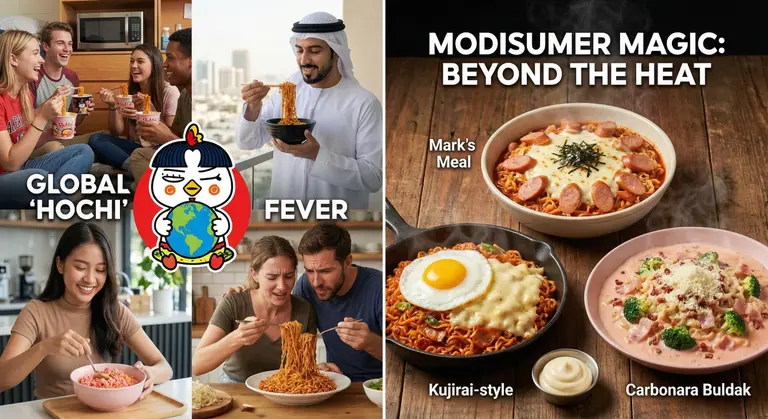
ModiConsumer (modify + consumer) emerged—people who ignore cooking methods and create their own recipes.
The Legendary 'Mark's Recipe': Named after GOT7's idol Mark, this recipe became a convenience store phenomenon.
Boil cup spaghetti noodles
Mix in giant tteokbokki
Add all the Fire Noodle sauce
Top with frankfurter sausages and mozzarella cheese
Microwave until the cheese melts
This combination—spicy, sweet, salty, creamy—was so addictive that it changed the sales patterns of convenience stores nationwide.
'Kujirai Style' Method (Inspired by Japanese manga):
Boil noodles in milk instead of water
Add a soft-boiled egg in the middle
Top with cheese and chives. Result: The spiciness becomes milder, making it accessible to 'spice wimps'.
Cream Carbonara Risotto: YouTubers transformed the leftover broth into Italian-style risotto by adding rice, bacon, milk, and parmesan cheese.
Samyang observed, learned, and based on customer experiments, officially launched Carbonara Fire Noodle. 11 million units sold in the first month.
This is C2B innovation—the consumer develops (Consumer), and the business commercialises (Business).
Numbers Don’t Lie... From Failure to 1 Trillion Won
Samyang's transformation is remarkable.
2023 Revenue: 1.728 trillion won
Operating Profit: 344.6 billion won (133% increase from the previous year)
Export Ratio: 77% of total sales—over 1 trillion won from overseas alone
A company that couldn't penetrate the domestic market became an export powerhouse. Fire Noodle is now sold in over 100 countries. It is a bestseller in Indonesia, Malaysia, the United States, and across Europe.
To enter the Islamic market, Samyang proactively obtained halal certification. Vice President Kim explained, "25% of the world's population is Muslim. If they can't eat it with peace of mind, we are not a true global company."
The Question of Leadership... Can Success Breed Greater Success?
According to research from Seoul National University, long-serving CEOs initially bring stability and trust, boosting performance. However, over time, they risk falling into the 'trap of success' and rejecting innovation.
Vice President Kim broke this pattern. Instead of resting on the glory of Fire Noodle:
Complete group rebranding (changed to Samyang Round Square)
Expansion into healthcare and biotech
Cultivating the third-generation successor Jeon Byeong-woo (promoting personalized nutrition and plant-based protein)
The question is not whether Samyang can maintain Fire Noodle. Can they create the next Fire Noodle?
Legacy... Wildness as Corporate Philosophy
The success of Fire Noodle is not just a business case. It is a cultural phenomenon. A story of a company on the brink of extinction finding salvation not through a safe path but by embracing madness.
Three lessons remain.
1. Scarcity breeds courage. When there is nothing to lose, all rules can be broken.
2. Co-create with customers. Don’t just sell products; create a playground where consumers become collaborators.
3. Conviction beats consensus. Vice President Kim ignored skeptics, retailers, and even his own employees. He believed in the vision when no one else did.
Today, somewhere in the world, a teenager is sweating through the Fire Noodle challenge, posting it on TikTok, becoming part of a global community connected by voluntary pain.
What was created from 1,200 chickens and countless stomachaches is not just a product but a cultural icon—a symbol of Korea's boldness, a rejection of boredom, and a will to make the world sweat.
Will there be a "second Fire Noodle"? No one knows.
But as long as Samyang has the DNA of innovation born from desperation, the fire will continue to burn.
And the world? The world will keep searching for milk.