
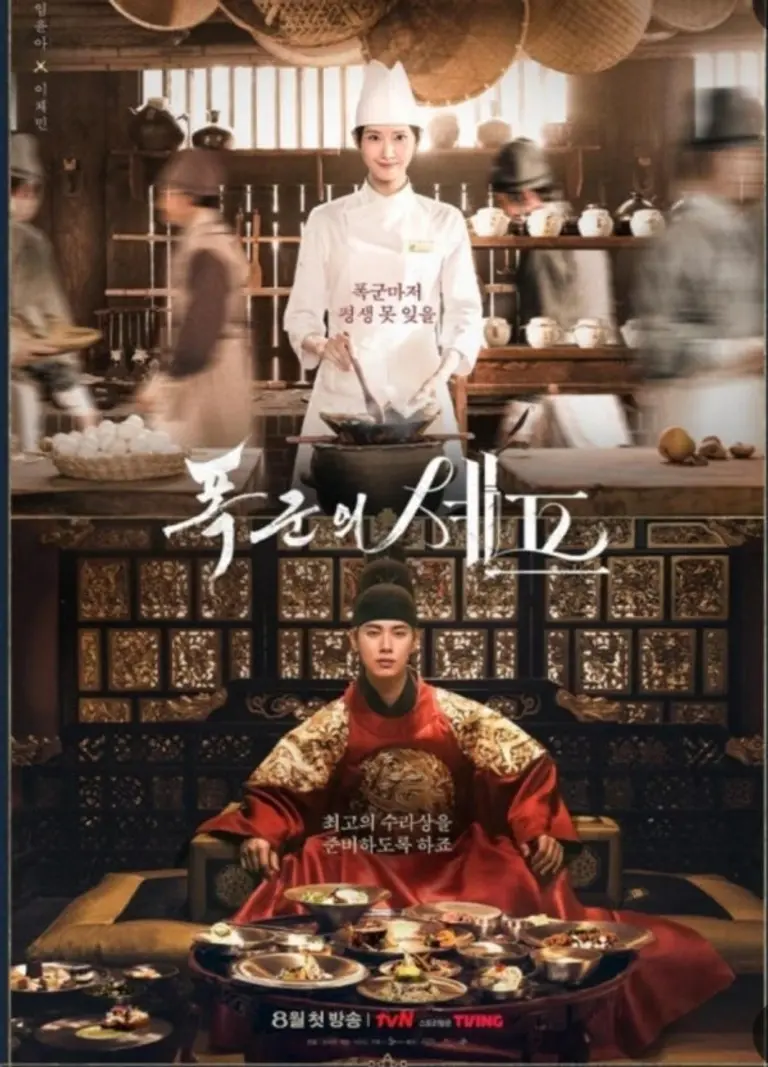
In a multi-cultural space in Seoul, a chef raises the championship trophy on a stage flooded with flashlights. The first Korean to win first place in the most prestigious competition in the French fine dining world, Michelin 3-star chef Yeon Ji-young (Im Yoon-a). Even amidst the cheers, champagne, and waves of congratulatory crowds, she is still a person more accustomed to the roaring flames of the kitchen and the sizzling sound of pans. Before the moment of glory can even cool, Ji-young is caught up in a sudden accident, and a strange darkness seeps into the place where the dazzling lights have gone out. The place she opens her eyes to is not a stainless steel kitchen, but the royal kitchen of Joseon, filled with the smell of wood, earth, and charcoal.
The drama 'The Tyrant's Chef' begins like this. A top modern chef time slips back to the Joseon era, where she meets the notorious king Lee Heon (Lee Chae-min), known as the greatest gourmet and the worst tyrant. At first, Yeon Ji-young believes it is a dream and wishes for 'this crazy situation to end quickly'. However, when the king, whose eyes are turned upside down by a plate of chicken she made, appoints her as the royal chef, the situation flips in an instant. With the terrifying declaration that "if you serve bad food, you will be executed immediately", Ji-young's day transforms into a menu development war for survival.
The royal kitchen of Joseon is completely different from a French kitchen. There are no measuring spoons, ovens, or refrigerators. Instead, there are jars, charcoal, cauldrons, and the skilled hands of artisans preparing food. At first, Ji-young despairs, saying, "How can I cook with this?", but soon she begins to take out the things she brought one by one. Modern hygiene concepts, flow design, combinations of sauces and ingredients, and the revolutionary concept of 'service'. She creates new flavours by mixing Western sauces with traditional sauces and prepares a royal meal that approaches the concept of a course meal using leftover ingredients. In this process, she clashes with the royal kitchen staff, who are of different ages, genders, and backgrounds, and gradually wins their hearts.
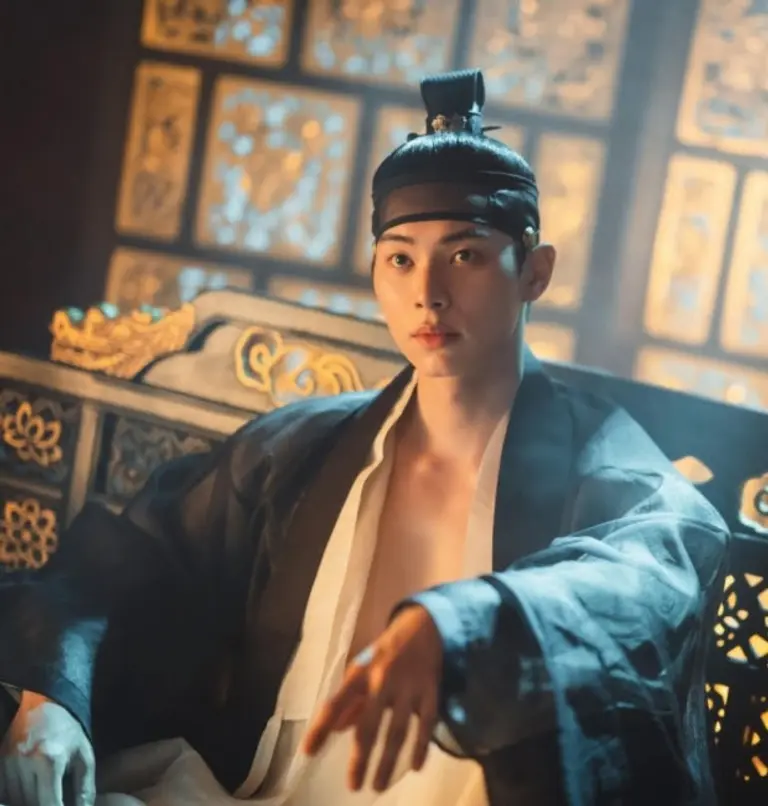
On the opposite side is the tyrant Lee Heon. Outside the palace, he is the object of resentment and fear for the people, but the camera penetrates into his private space. He possesses an absolute sense of taste. Just one spoonful allows him to perfectly decode the thickness of the broth, the heat of the fire, and the freshness of the ingredients in his mouth. This makes him more picky and more cruel. In front of the king, who believes that "bad food is a crime", Ji-young's plate is always placed on the knife's edge of life and death. At first, Lee Heon also throws a contemptuous gaze, asking, "Where did this woman come from?", but in front of the unfamiliar flavours filling his mouth, his expression unconsciously softens. The tyrant, whose heart opens first through taste, and the chef, who cleverly exploits that gap, begin their fierce competition.
From Simple Episodes to a Huge Turmoil
As the episodes accumulate, the narrative expands from simple royal kitchen episodes to the realms of politics and diplomacy. A Ming envoy proposes a cooking competition as a condition for tribute, and the royal kitchen quickly transforms into a battlefield where the face of Joseon and Ming is at stake. The Ming chefs pressure Joseon with the latest cooking methods and extravagant plating, resembling a banquet at the Palace of Versailles, while Lee Heon, without changing his expression, burdens Ji-young with a single phrase, "Do not lose." In a situation where gochujang and gochugaru have disappeared, Ji-young must create a dish that transcends that era using Joseon's ingredients and her own senses. On that one plate rests not only her survival but also the pride of the palace and the nation.
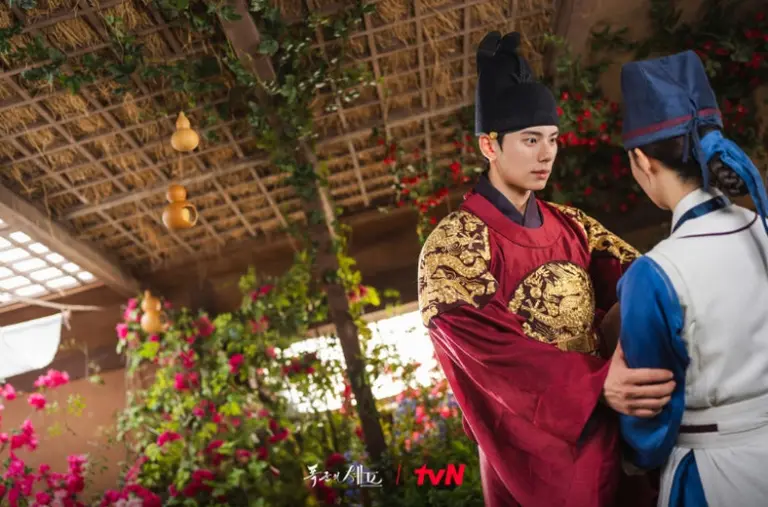
The internal enemies are also formidable. The power-hungry Je San Daegun, the vested interests trying to seize the royal kitchen, and the palace conspiracies entangled with the deposed queen's incident intertwine, making Lee Heon's throne increasingly precarious. Ji-young, before she knows it, becomes not just a simple 'chef', but a companion who stands by the king's side and a witness struggling to avoid history. As she learns about the inner self of the king, whom she only knew as a tyrant, her feelings of seeing him as a man also begin to waver. Meanwhile, Lee Heon gradually comes to see Ji-young, who was initially just a 'tool to please his palate', as an equal partner. The tongue that evaluated someone else's life learns for the first time what it feels like to be evaluated.
As the latter half progresses, the narrative tightens even more. On the timeline, the shadow of a major political upheaval and a coup already looms over the palace, and Lee Heon's surroundings are surrounded by betrayal and conspiracy. Ji-young finds herself torn between the 'tyrant' Yeonsangun from the history books and the Lee Heon in front of her. Should she save this man, or should she leave history as it is? Her choice becomes not just a matter of love, but a huge question that shakes hundreds of years of time. From this point, the drama shifts into a full-fledged time-slip fantasy. The mysterious book 'Mangunrok', the cracks in time, the reopening of doors... what choices are made and what reunions occur in the conclusion are best confirmed by watching the drama directly. The ending, where the sweetness of romantic comedy and the tragedy of historical drama subtly intersect, cannot be fully captured in a few lines of spoilers.
Is the Familiar Taste the Newest Taste?
'The Tyrant's Chef' may seem like a familiar recipe at first glance. A modern professional falls into the past, a romance set in the Joseon palace, a character who melts the heart of a tyrant. However, this drama intricately weaves these familiar ingredients through the medium of "taste". Cooking is not just a background setting, but a narrative device that reveals changes in relationships between characters and power dynamics simultaneously. The king's dining table is the centre of politics, and the small conflicts occurring in the royal kitchen directly translate into power struggles. A single dish can save someone's life or undermine another's prestige. Therefore, each dish that appears in every episode operates as a key event in the story rather than mere culinary pornography.
The direction excellently brings food, people, and space to life. The surface of the soup captured in close-up, the contrast of steaming white rice and red seasoning, and the sound of chicken frying stimulate the salivary glands through visuals and sounds alone. However, the depiction of 'taste' in this drama does not merely remain a physiological reaction. The greasy food that is hard for the poor to eat even once, the contradiction of a king enjoying the best royal meal while executing people, and the bowls of leftover royal meals that satisfy the hunger of court ladies and eunuchs all align perfectly with the social structure of how different classes consume food. In an era when even a drop of oil was precious, the chicken made by pouring oil liberally is a symbol of power and a breaking of taboos. Just as Marie Antoinette said, "Let them eat cake if they have no bread", Ji-young's chicken is a revolutionary taste that transcends class and a dangerous provocation at the same time.
Character development is also solid. Yeon Ji-young does not simply fit into the mold of a 'cheerful female protagonist'. She is a three-dimensional character with pride as a professional, survival instincts, and emotional turmoil coexisting. When cooking, she focuses like a laser, but she is more unstable than anyone when it comes to her feelings and future. Lee Heon is also portrayed differently from the textbook image of a tyrant. He is undoubtedly violent, capricious, and easily swayed by anger, but beneath that lies an endless fear of self-censorship. The fear that "everyone will leave me" makes him more cruel, while simultaneously yearning for someone's sincerity. As these complex aspects come to life, viewers naturally empathise with their relationship. It feels as if 'Beauty and the Beast' has been transported to the Joseon palace, but the beast is reinterpreted not just as a cursed prince but as a character burdened with historical trauma.
The supporting characters also play their parts well. The scheming Je San Daegun and the Grand Queen Dowager, who reigns at the centre of palace intrigue, do not remain trapped in the 'villain' mold often seen in historical dramas. Their beliefs and desires gradually reveal themselves in the cooking competition and political struggles, adding layers to the character relationships. The royal kitchen staff are literally the 'seasoning' of this drama. Without their humour, camaraderie, and relationships where they tease yet care for each other, the romance between the king and the chef would have been much drier and less engaging. They move like a kitchen brigade, each in their position, creating a complete dish, that is, the narrative.
The combination of genres in 'The Tyrant's Chef' is exquisite. It layers historical drama, romance, comedy, fantasy, and culinary elements without being excessive, centering around cooking. Like a perfectly balanced sauce, each genre harmoniously blends without overwhelming the others. The image and roles of the lead actors are also a perfect match. An actor who has been loved for their 'mukbang' and bright energy in advertisements and variety shows appears as a chef, naturally overlaying a familiar image onto a new narrative. It provides a catharsis that even 'imagination rewriting the typical tyrant' offers. The process of a king, once pointed at in history books, gaining a slightly different face through food and love precisely touches on the pleasure of 'reinterpretation' that today's viewers enjoy. Just as the musical 'Wicked' rewrites the story of the wicked witch, 'The Tyrant's Chef' breathes new narrative life into the historical figure of Yeonsangun.
Of course, there are also shortcomings. In the latter half, as time slips, the coup, and the secret of the Mangunrok all converge at once, a somewhat dissonant weight emerges from the initially light cooking and romantic comedy tone. For some viewers, this may feel like "the story volume suddenly became too large". It feels like enjoying a light appetizer only to suddenly be served a full-course dinner. Additionally, since it draws on historical figures, there are perspectives that feel discomfort from the discrepancies with actual history. However, considering that this work clearly established itself as a 'virtual historical drama' from the beginning, the acceptance ultimately comes down to individual sensibilities and genre tolerance.
If the Meeting of Joseon and the Chef is Joyful
If you enjoy time-slip romances but are tired of 'the same old settings', this is worth a watch. Here, time slip is not just a romantic device connecting the fates of the male and female protagonists, but a serious narrative tool that shakes cooking, history, and power. Secondly, for viewers who enjoy cooking variety shows and gourmet content, the royal kitchen in 'The Tyrant's Chef' can be enjoyed as a sort of historical drama version of a kitchen studio. The fun of waiting to see what menu will come out in each episode is quite delightful.
Finally, I would like to hand this drama to anyone who has pondered, 'Is my ability useful in this era?'. Yeon Ji-young, despite being a highly competent chef, feels that her skills are completely useless when she first falls into Joseon. However, she slowly realizes that although the tools and environment have changed, what ultimately moves people and opens hearts is the skills she has honed throughout her life. Following this process, you may find yourself thinking, "Could this job I am holding onto now have meaning in a completely different time and place someday?" If you need such imagination and comfort on a night like this, 'The Tyrant's Chef' will provide a much warmer and more reassuring meal than you might expect.