

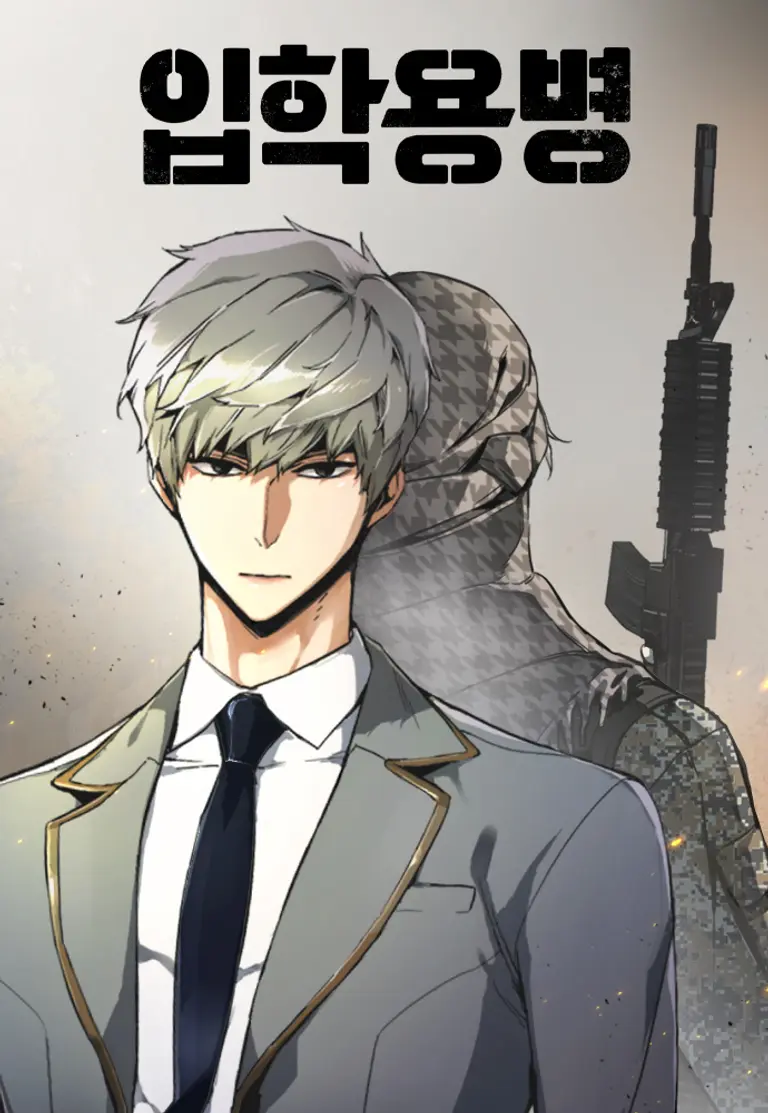
In the midst of a dark jungle, the sounds of gunfire and explosions mix in the battlefield. As soldiers held captive under the watch of armed groups sink into despair, a boy slips in like a shadow. With a youthful face that doesn’t even wear a helmet properly, his gaze is colder than any veteran. "The only one being deployed is me." With this single line, the boy quickly checks his equipment and sweeps through the military camp, rescuing all the captives in an instant.
The title of the webtoon 'Enrolment Mercenary' is already half explained in this scene. Before he is a high school student, he is a 'mercenary' who is deployed whenever a request comes in from anywhere in the world. And this boy, who fought in such a distant place, is the protagonist Yu I-jin, who will later enter an ordinary school wearing a school uniform. It’s as if Rambo suddenly found himself sitting in a self-study room; this setup is already a comedy and a tragedy in itself.
The Boy Made by the Battlefield, the Monster Welcomed by the Classroom
Yu I-jin, the sole survivor of a plane crash in his childhood, entrusts himself to a secret mercenary organisation called 'Camp' to survive in a foreign land. What he learns there is not calculus but ballistics, and not Korean grammar but operational briefings. As he traverses numerous battlefields, he keenly absorbs the harsh reality of a world where the value of a person is calculated in numbers. Names, nationalities, and emotions are luxuries. Only the success of the mission is the reason for his existence.
One day, I-jin receives an unexpected offer. He learns that he no longer needs to go to the battlefield, and that his younger sister Yu Da-yeon, who was thought to be missing since the accident ten years ago, and his grandfather are still alive in Korea. The gaze that had never wavered even in the war zone trembles for the first time. Thus, I-jin returns to his homeland.
Life in Korea is more unfamiliar and quiet than any battlefield he has known. Warm meals, clean rooms, and dinner tables shared with family. I-jin awkwardly smiles and says, "I want to live normally now." But as everyone knows, such lines in dramas are flags. It means that the ordinary life is about to be shattered.
Everyday life in Korea also has its own 'survival front'. The high school I-jin has just enrolled in is another battlefield where students in uniforms divide ranks and establish hierarchies. The playground, hallways, stairs, and rooftops have become spaces where fights are waged not with guns but with fists, money, family backgrounds, and power dynamics. A few powerful students in the class exert violence against weaker kids, while the homeroom teacher and school turn a blind eye.
At first, I-jin tries to quietly observe. "This isn’t a battlefield." But as he watches a classmate get kicked, wallets and phones stolen, and someone laughing while crying, the senses he had buried within him react. He has seen countless times in the battlefield that the structure of preying on the weak remains the same wherever one goes.
Ultimately, I-jin decides to resolve the issue not as a 'student' but as a 'mercenary'. He analyses the opponent, understands their movements, and acts at the best timing to overturn the situation in an irreversible way. It’s as if a chess grandmaster has invaded a local board game; the game itself is instantly restructured. From that day on, the hierarchy within the school is completely rewritten.
Peace is Short, Shadows are Long
Once the fights within the school are settled, I-jin’s daily life seems to regain a moment of peace. He makes friends, and his relationship with Da-yeon gradually becomes more natural. However, the scent of the battlefield does not easily let him go. Suspicious movements are detected throughout Korea, and old colleagues and organisations who know I-jin’s identity, as well as forces trying to eliminate him, begin to reveal themselves one by one.
Especially as I-jin steps into the world of security and protection surrounding the chaebols, the scale of the fights rapidly expands from school violence to corporate power and international crime organisations. While he is known as the 'nice transfer student' at school, in the shadows, mercenaries with unknown identities move around a target with a high-paying request. Sometimes with guns, sometimes bare-handed, and sometimes through mental battles, the fights continue.
Throughout this process, I-jin always adheres to one principle. He will never allow harm to come to his family and friends under any circumstances. Even when the moment comes where he has no choice but to return to the logic of the battlefield, he is determined to clearly define the direction of that violence. The various episodes of 'Enrolment Mercenary' can ultimately be seen as stories where this principle is put to the test. School violence, organised crime, power struggles among chaebols, and overseas mercenary organisations; every time a stronger enemy appears, I-jin’s desire to "live quietly" clashes with his anger of "but this is intolerable".
The webtoon repeats this structure while not simply being a one-to-many action. Between episodes, I-jin’s past gradually unfolds, and the organisations 'Camp' and 'Numbers', along with the tangled human relationships and connections with soldiers, are built up more three-dimensionally. Readers may see I-jin living happily at school, but in a single frame, they witness the 'mercenary mode' switch on, realising the depth of the trauma this boy carries. As memories from the battlefield and the scenery of the classroom continue to intersect, the work expands into a narrative that touches on how war can forever change an individual’s life, beyond ordinary school action.

Characters as Weapons: A Munchkin, but Not a Monster
The first pillar supporting the firepower of 'Enrolment Mercenary' is undoubtedly the characters, especially the design of the protagonist Yu I-jin. I-jin appears to be the archetype of a 'munchkin' protagonist in modern terms. He can overpower most opponents in just a few moves, excelling in firearms, knives, hand-to-hand combat, and tactics. If it were an RPG, he would be a level 99 character from the start. However, the author portrays this strength not as a display but as a 'trace of trauma'.
I-jin’s expressionless face and taciturn nature, along with his ability to quickly analyse opponents and find weaknesses, are essentially defence mechanisms ingrained in him since childhood for survival. Just as a wolf raised in the wild remains vigilant in the city, I-jin scans for exits and threats even in a peaceful classroom. Thus, while readers feel a simple catharsis from I-jin’s overwhelming combat power, they also experience a strange sense of pity and chill.
Especially poignant are his awkward smiles when with family and his hesitation to express emotions while joking with friends at school. He is closer to a 'survivor who has just returned to people' than a 'hero with the power to protect someone'. He is not a superhero but rather akin to a war veteran. This tension makes I-jin a memorable character among many action webtoon protagonists.
The supporting characters are also well-structured. His younger sister Da-yeon is not just a simple object of protection. Unaware of her brother’s past, she dreams of a "normal family" while being the first to notice I-jin’s strange presence. She is an ordinary high school student shaken by friends and school violence, yet shows strength by believing in her brother and holding on in times of crisis.
Characters like Cha Du-sik occupy the 'strong bully' position essential in school action stories, but through meeting I-jin, he gradually changes and grows, providing another layer of enjoyment. Like a local thug suddenly meeting a martial arts master and becoming a disciple, his transformation is predictable but all the more satisfying. The heirs of chaebols, security teams, and former soldiers are depicted not merely as genre decorations but as forces with their own interests and beliefs.
Alchemy of Genres: Military + School = Global Hit
The action direction is one of the greatest strengths of this work. First of all, it is 'visible'. In narrow alleys, staircases, school hallways, and inside vehicles, the brawls that take place in limited spaces have clearly defined movements. The points of impact, composition, and camera angles are designed to fit the vertical scroll structure of the webtoon, allowing readers to naturally replay a scene in their minds just by scrolling down.
This is more challenging than it seems. Many action webtoons focus on flashy effects, making it difficult to understand 'who hit whom and how'. In contrast, 'Enrolment Mercenary' covers gunfights, bare-knuckle fights, knife fights, and group brawls without becoming repetitive or boring. The moments where the tension is maintained by briefly slowing down during battles and capturing the instant when the opponent engages in psychological warfare are also notable. It has the rhythm of a well-made action film.
The genre balance is also intriguing. 'Enrolment Mercenary' is fundamentally a work that combines military action and school stories. It is a structure that is new to Korean readers and familiar to the overseas market. In fact, this work has long dominated the upper ranks of popularity on Naver Webtoon in Korea, and has also achieved great popularity in Japan, recording consecutive number one rankings and surpassing 300 million views. The fact that it is serviced in ten languages worldwide and has exceeded 1.8 billion cumulative views is evidence that the narrative and action of this work resonate across borders.
The reasons for this popularity can be explained in multiple layers. Firstly, the choice of 'a genre that is precisely known and loved' is significant. The structure where a super-strong protagonist trained in the battlefield enters school, cleans up bullies, and then takes down greater evils is a kind of 'authentic power fantasy'. Everyone has at least once imagined, "I wish a guy like that was in our school", so this genre always has a certain level of demand.
However, while many works stop here, 'Enrolment Mercenary' naturally expands into family narratives, trauma, and international incidents, enhancing reader immersion. Like a good TV series, when one season ends, the next season unfolds on a larger scale.
The way it addresses school violence is also quite direct. In this work, school violence is never consumed as 'material for episodes'. It vividly depicts violent scenes occurring in familiar places like corners of classrooms, under stairs, and in gym storage, along with the fear and intimidation felt by victims and the bystanders’ indifference.
The scenes where the situation is turned upside down by I-jin’s intervention are undoubtedly fantasy. In reality, things do not resolve this neatly. However, the reality that this fantasy leans on is quite heavy. Therefore, some readers may feel that "it’s too much like a soda, lacking realism", while for others, it serves as a form of "vicarious satisfaction for justice that cannot be achieved in reality". It is a kind of collective catharsis.
The way the narrative unfolds regarding soldiers and mercenaries is also neat. The war and operation scenes are not armed with flashy jargon but are composed mainly of simple briefings, mission objectives, and movements. The basic structure of "understanding the structure of the building with the target → understanding the security patterns → determining entry and exit routes → variables arise → make judgments on-site" is repeated, allowing readers to naturally follow the flow of operations.
Without complex political or diplomatic settings, each episode maintains a clear purpose and tension as a unit of mission, creating an effect where each episode feels like a small movie. Like the Mission Impossible series, each episode unfolds a complete operation.
If You Want to Experience the Thrilling Munchkin Genre!
For readers who enjoy school action and munchkin protagonist narratives, 'Enrolment Mercenary' is almost a must-read. Starting on the narrow stage of high school, the structure expands to chaebols, the military, and mercenary organisations, providing great pleasure. You will feel like, "At first, I thought it was just a school violence cleanup story, but at some point, I found myself watching an international thriller." It’s like suddenly transitioning from reading Harry Potter to watching a series.
For those who are concerned about the real issue of school violence, it is hard to ignore the catharsis this webtoon provides. Of course, everyone knows that reality does not resolve this neatly. Nevertheless, if you want to experience the intense desire for "someone to step in for me", the character Yu I-jin will serve as a pretty cool 'agent'. He acts as an emotional safety net.
For those curious about why Korean webtoons resonate globally, 'Enrolment Mercenary' serves as a good reference. It combines genre familiarity, fast-paced direction, and emotional narrative threads, intertwining war, school, family, and violence. Following this work, you will find yourself unexpectedly waiting for the next episode every week. And you might suddenly think,
"Of course, there are no mercenaries like Yu I-jin in reality. Still, at least in my surroundings, I hope the weak are not trampled too easily."
The power to evoke such wishes is the true strength of 'Enrolment Mercenary'. The action is flashy, but at its core beats an unexpectedly warm heart. It is the story of a boy trying to protect the warmth of the classroom with the coldness learned from the battlefield. That is the secret of this webtoon, which has recorded 1.8 billion views.