

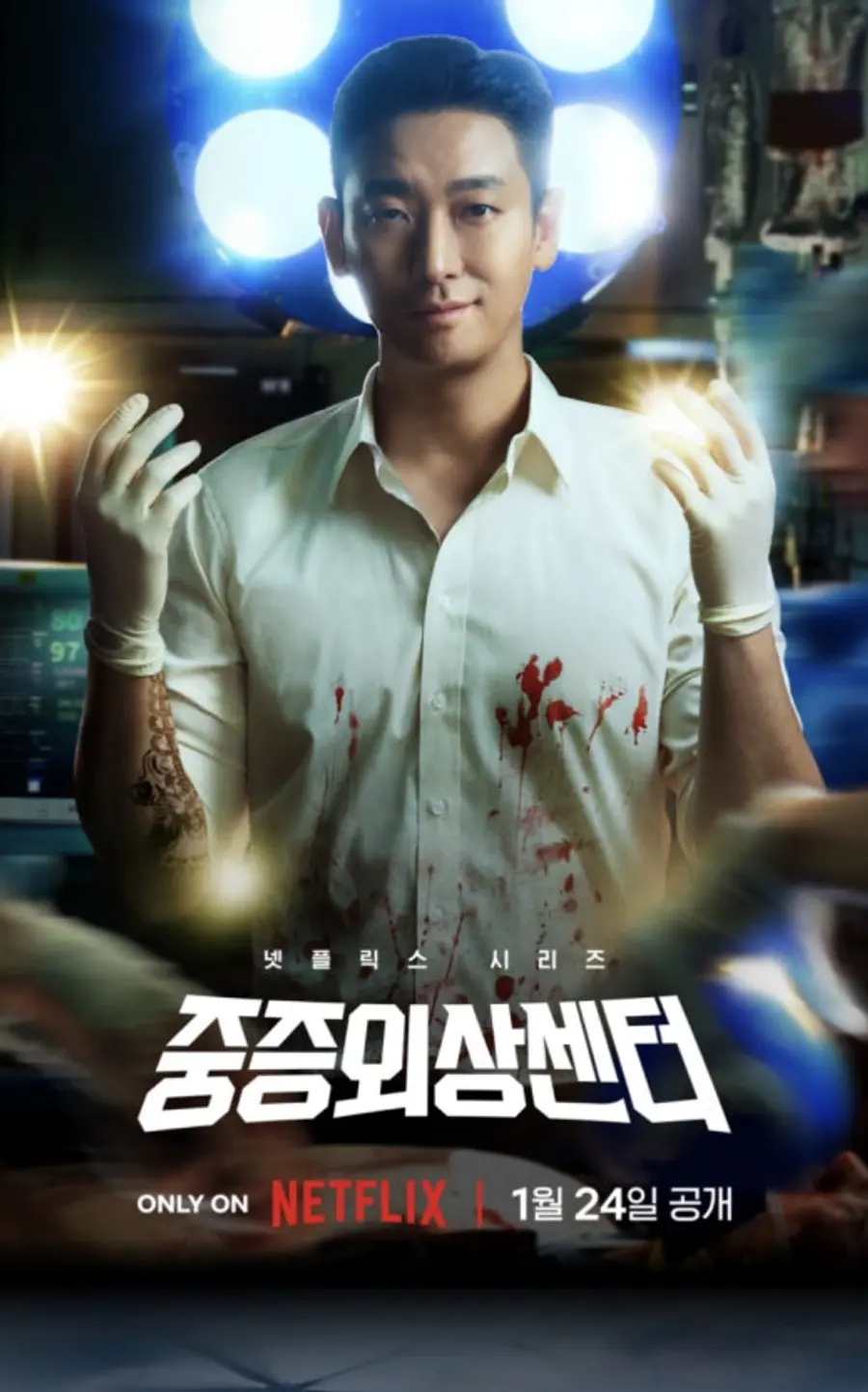
[KAVE=Lee Tae-rim Reporter] Every time the emergency room door opens, the smell of blood, dirt, and oil rushes in all at once. When the paramedics push in the stretcher, doctors, nurses, and technicians get tangled together like 'The Avengers' to barely grasp the golden time. The Netflix drama 'Trauma Centre' takes these chaotic few minutes as the basic rhythm of each episode. It tells the story of the reconstruction project that unfolds as trauma surgeon Baek Kang-hyeok (Ju Ji-hoon) is assigned to the Trauma Centre at Korea University Hospital, and the people who endure within it.
While 'Grey's Anatomy' focuses on the romance of doctors and 'The Good Doctor' deals with the growth of a doctor on the autism spectrum, 'Trauma Centre' is an action-oriented medical drama that feels like 'Mad Max: Fury Road' relocated to a hospital. The only difference is that instead of a fire-breathing guitar, there is a defibrillator, and instead of a war fanatic, there is a life-obsessed fanatic.
A War Hero in a Failed Organisation
The Trauma Centre at Korea University is closer to a failed organisation than Dunder Mifflin from 'The Office' from the very beginning. Although it received hundreds of billions in support under the pretext of opening, its performance is at rock bottom, and personnel have long since escaped like lifeboats from the Titanic. It is a department that is merely named a centre, but in reality, it is a 'chicken rib' left abandoned next to the emergency room. To the hospital's upper management, it is a headache that drains the budget, and among the on-site medical staff, there are rumours that "if you stay here long, your life will be ruined," circulating like 'Voldemort's name'.
At a point where no one believes this department should be saved, suddenly a strange name is summoned. Baek Kang-hyeok, a suspicious surgeon from Doctors Without Borders, who has stitched up all kinds of gunshot wounds in conflict zones like Syria and South Sudan. Like 'Rambo' returning from the jungle, he too has returned from the battlefield. However, while Rambo wields a knife, Kang-hyeok wields a scalpel.
From the very first scene, his character is as clearly depicted as Tony Stark escaping from a cave in 'Iron Man'. A man jumps out of a taxi and runs into the helipad, already wearing surgical scrubs and opening a patient's abdomen at a time when he should be standing in a suit at the inauguration ceremony. The grand introduction prepared by the hospital director flies into the air like Scarlett's dress in 'Gone with the Wind', and the camera goes straight to a blood-splattered surgery scene.
His straightforward attitude of "I was late because I was saving lives, does it make sense to apologise for that?" shows the tone that runs through the entire drama. For Kang-hyeok, the hospital system is not a set of rules to be followed, but rather an obstacle that causes patients to die. If Batman in 'The Dark Knight' believed that "there is justice above the law", Kang-hyeok believes that "there is life above the regulations".
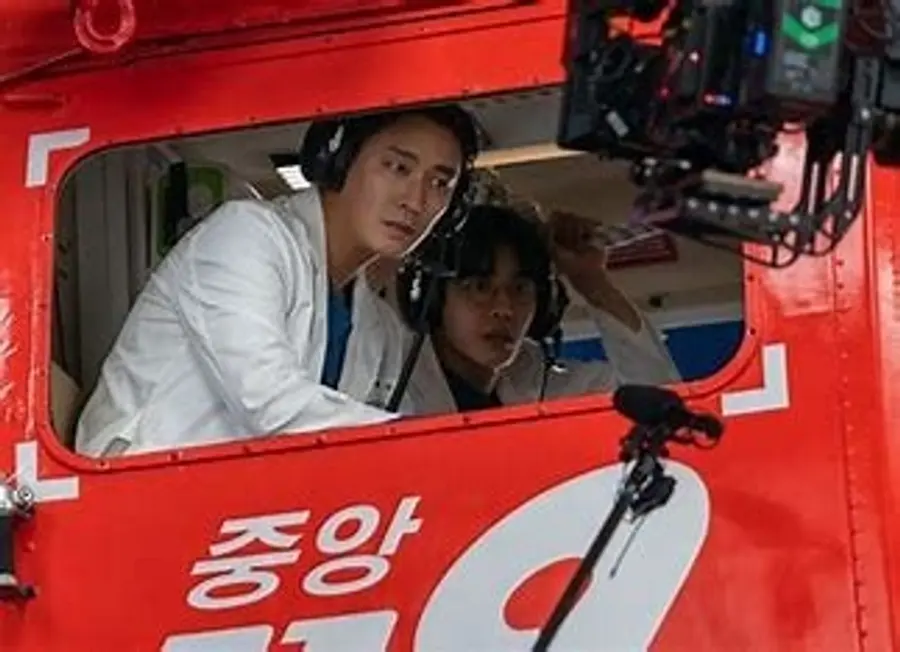
The Odd Assembly of the ‘Avengers Trauma Team’
The trauma team he leads is truly an odd assembly. If 'The Avengers' is a gathering of heroes with their own superpowers, the trauma team is a gathering of doctors with their own traumas. Fellow Yang Jae-won (Choo Young-woo), who dreamt of trauma surgery only in an idealistic way but has become cynical due to reality, and Cheon Jang-mi (Ha Young), a fifth-year nurse who jumps into the field before anyone else but is always blocked by the walls of the system.
Like gathering at the Central Perk coffee shop in 'Friends', they gather in the trauma centre's operating room. Doctors from general surgery, anaesthesiology, and emergency medicine, who had been hesitant to step forward due to the high risks of trauma, are gradually drawn in like the Straw Hat Pirates from 'One Piece'. At first, everyone keeps their distance, saying, "I shouldn't get entangled with that weirdo", but as a series of trauma patients arrive, facing disasters like bus rollovers, factory collapses, and military accidents, they are forced to make a choice: to run away or to jump in together.
Each episode begins almost like a documentary reenacting '911 Terror' or 'Titanic Sinking'. Situations that push physical limits, such as climbers falling from mountains, highway pile-ups, construction crane collapses, and military base explosions, constantly appear like in the 'Final Destination' series. Each time, the golden time, that is, whether they can get the patient onto the operating table within one hour after the accident, determines the outcome.
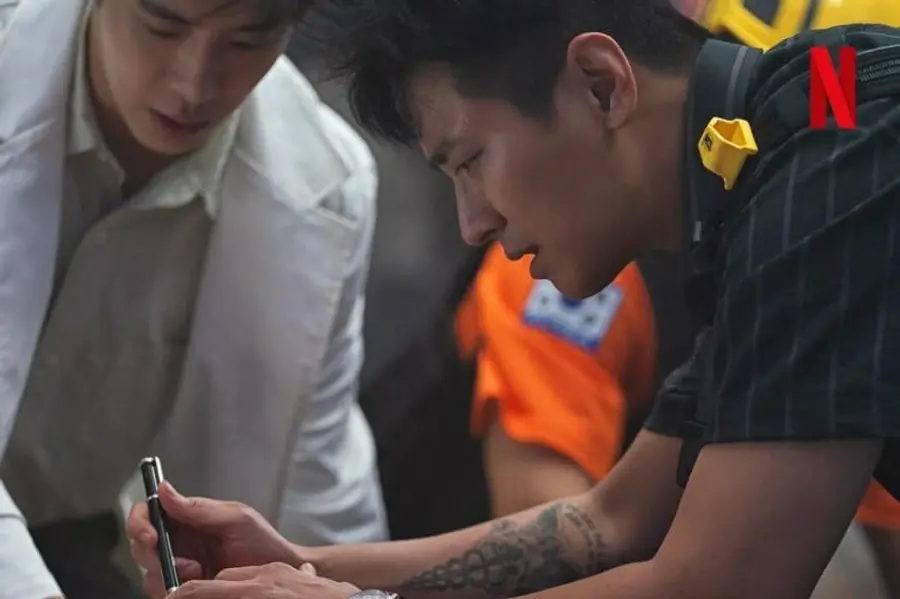
In the ambulance, in the helicopter, and at the entrance of the emergency room, a few minutes are drawn as the boundary between life and death. If Jack Bauer from '24' had to stop a terrorist attack within 24 hours, Kang-hyeok must save lives within one hour. The camera follows the patient's shattered ribs, burnt skin, and protruding organs as obsessively as the zombies in 'The Walking Dead', but it does not cruelly consume it, instead drawing the reality of 'fighting against time'.
Once inside the trauma centre, another war awaits. Kang-hyeok adopts a style of 'changing the rules if necessary' as he learned on the battlefield. To fill the lack of personnel, he forcibly recruits residents from other departments like Doctor Strange using the Time Stone, unilaterally changes operating room assignments, and confronts the hospital management head-on over helicopter placements.
His greatest enemies are not bullets, but the planning and coordination director Hong Jae-hoon (Kim Won-hae), who prioritises budget over doctors, the hospital director who shakes the centre according to political calculations, and the ministers and bureaucrats. While Frank Underwood from 'House of Cards' fought with power, Kang-hyeok fights with the value of life. In scenes where he confronts these figures, he is portrayed almost like a superhero protagonist, akin to Captain America facing off against Shield headquarters. He casually tosses a helmet into the meeting room and declares, "Even at this moment, someone is dying".
However, the drama does not depict Kang-hyeok as a one-sided hero like 'Superman'. The trauma he experienced in conflict zones, the guilt over patients he could have saved but missed, and his experiences of being pushed out in the hospital's political battles are revealed bit by bit, like Bruce Wayne's childhood. For him, the trauma centre is not just another job, but rather the last belief he clings to in order to keep enduring.
As if infected by this belief like a 'zombie virus', Yang Jae-won and Cheon Jang-mi, as well as doctors like Han Yu-rim (Yoon Kyung-ho), who initially saw the trauma team as a 'disadvantageous position', gradually change their attitudes. The process of each finding their own "reason not to give up" forms the emotional arc of the latter half. Just as Frodo in 'The Lord of the Rings' gained companions on his journey to destroy the ring, Kang-hyeok also gains companions on his journey to save the trauma centre.

Meanwhile, outside the hospital, the walls of reality are always ready to bring down the centre. The social background that has shaken the entire medical community after the medical staff strike and conflicts over medical school quotas means that viewers perceive this drama as more than just a genre piece. As the poor environment and personnel shortages of actual regional trauma centres have been repeatedly covered in the media, analyses have emerged stating that "'Trauma Centre' has once again shed light on reality".
Of course, the world within the drama is much more extreme and much more 'hero-friendly' than reality. This is where the critique lies. Just as 'Mad Men' dealt with the advertising industry of the 1960s, but actual advertisers would say, "It's not that cool", actual trauma surgeons also say, "It's not that heroic".
The Perfect Form of Korean Medical Drama
In terms of artistic quality, 'Trauma Centre' has organised the formula of Korean medical dramas as well as the lightsaber from 'Star Wars'. It follows a typical structure but strips away as much excess as possible. Since it had to contain patient episodes, team growth, hospital politics, and the protagonist's personal narrative within a short format of eight episodes, the depth of the sub-characters is somewhat sacrificed, but the rhythm of the main axis is as fast and linear as 'Bullet Train'.
Spending most of the runtime in the field and operating room, it opts to push forward with 'action' rather than 'words'. Just as 'Mad Max: Fury Road' minimised dialogue and relied on action, 'Trauma Centre' minimises meetings and relies on surgery.
The direction is closer to understanding the pace suited for the OTT era as well as the Netflix autoplay button. Thanks to filming in actual hospital spaces like Ewha Womans University Medical Center and Bestian Hospital, the artificial feel of a set is lessened. The wide lobby, corridors, and helipad come directly into the screen, and the wind and noise created when the helicopter lands are captured with texture, much like the fighter scenes in 'Top Gun: Maverick'.
The camera work in the emergency room and operating room scenes is also impressive. By mixing shaky handheld shots and close-ups, it places the audience right next to the medical staff. Just as '1917' placed the audience in the trenches of World War I, 'Trauma Centre' places the audience in the operating room. This makes it fit well with Netflix's unique binge-watching format. After finishing one episode, it is hard not to press the "next episode" button. It has an addictive rhythm like 'Stranger Things' or 'Squid Game'.
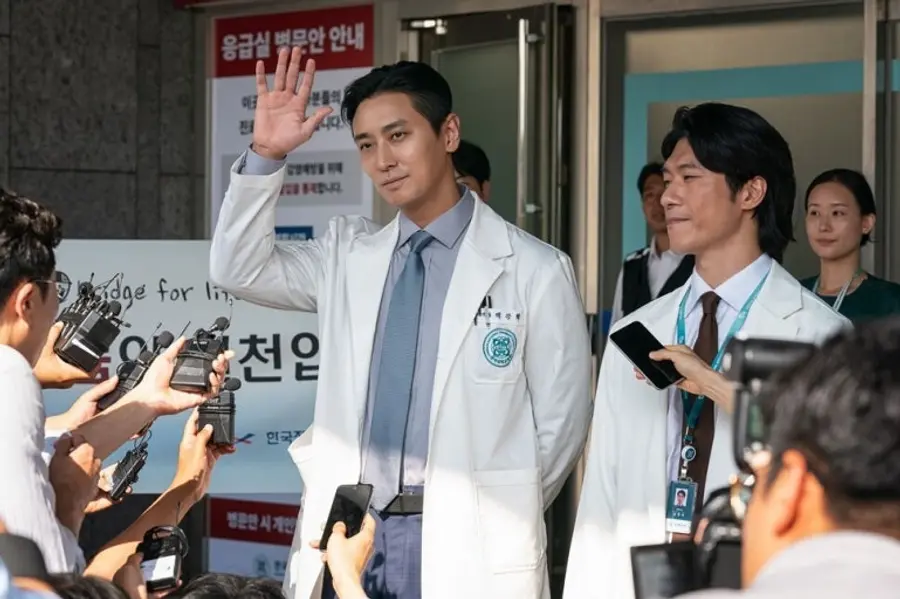
Ju Ji-hoon's Baek Kang-hyeok: ‘Iron Man in Scrubs’
Above all, the core of this drama is the character Baek Kang-hyeok created by Ju Ji-hoon. Having already played strong characters in various works such as the crown prince in 'Kingdom' and a psychopath in 'The Man from Nowhere', here he stands at the point where the profession of a trauma surgeon and the hero narrative intersect most effectively.
It is true that current trauma surgeons have pointed out that some medical details are inaccurate, calling it "a superhero story like Iron Man". Nevertheless, the public's enthusiasm for this character stems from the fact that it most delightfully embodies the archetype of the 'mission-driven weirdo' character that Korean dramas have accumulated over a long time. Just like Kim Sa-bu from 'Romantic Doctor, Teacher Kim', Baek Seung-soo from 'Stove League', and Oh Sang-sik from 'Misaeng'.
The reason why every line and action of Kang-hyeok is consumed as a meme is also here. Lines like "Protect the golden time", "Patients come first", and "Regulations can wait" are as frequently quoted as "Avengers Assemble" from 'The Avengers'.
Of course, the limitations of this hero narrative are clear. The fantasy of overcoming structural problems with overwhelming abilities, the premise that 'one good doctor can change the entire system' can sometimes feel uncomfortable to viewers who know the realities of the medical field. It is as unrealistic as Batman single-handedly protecting Gotham City.
In reviews from actual trauma surgeons, there are also criticisms that despite receiving much consultation for accuracy, there are many scenes that are far removed from reality. As the work defines itself as a 'fantasy medical action drama', some degree of distance from reality must be tolerated. However, this distance seems to widen more in the latter half, leaving a sense of disappointment that the critique of the medical system is consumed as decoration for the hero narrative.
Just as 'Silicon Valley' dealt with the IT industry but actual developers would say, "It doesn't work like that", 'Trauma Centre' also has doctors saying, "It doesn't work like that". But does that matter? No physicist watches 'Star Wars' and says, "That kind of hyperspace travel is impossible". This is fantasy.
Universal Appeal of the Medical Genre
Nevertheless, it is interesting that 'Trauma Centre' resonated with viewers worldwide. Achieving global number one in the non-English TV category on Netflix within ten days of release and entering the top 10 in 63 countries proves the universality of the medical genre once again. Just as 'ER', 'Grey's Anatomy', and 'House' have been loved worldwide, 'Trauma Centre' continues that lineage.
Scenes of human bodies being torn apart and bleeding evoke primal tension and empathy in audiences from any country. When combined with the clear timer of 'golden time' and the intense ethical proposition of "That person must not die", the borders of the drama surprisingly crumble easily. In that respect, this work is a case that skillfully finds the intersection of Korean sentiment and global genre grammar, much like 'Parasite' or 'Squid Game'.
For viewers who enjoyed medical dramas like 'Romantic Doctor, Teacher Kim' or 'ER' and want to see a version with bolder action and OTT scale, this is almost a must-watch. If you are looking for a work where the hospital space feels like a real battlefield of 'D-Day' rather than just a melodramatic stage, 'Trauma Centre' will sufficiently raise your heart rate.
Conversely, if you are a viewer who prioritises thorough realism and structural considerations like in 'House' or 'The Good Doctor', you may find yourself tilting your head several times while watching this work. The difficulty of patient cases, the details of surgical scenes, and the scope of authority used by doctors within the organisation may feel alien compared to reality. In that case, it is more comfortable to premise this drama as "a superhero story set against the backdrop of Korean medical reality" rather than a documentary. Just as no one says, "That kind of suit can't be made" while watching 'Iron Man'.
And above all, for those who feel vague anxiety and anger from recent news about medical strikes, medical school quotas, and the poor reality of regional trauma centres, 'Trauma Centre' may provide an emotional outlet. The scenes where a superhuman trauma surgeon curses at the system and fights to protect golden time, even if only on screen, provide a sense of vicarious satisfaction.
Just as one might wish for Batman to be in Gotham City while watching 'The Dark Knight', one might wish for Baek Kang-hyeok to be in our hospital while watching 'Trauma Centre'. However, after the ending credits roll, if you take a moment to look for articles or interviews that address the reality of actual trauma centres, this drama will take on a meaning beyond mere pleasure.
A work that naturally follows the thrill of superhero stories with the question, "How do we protect this golden time in reality?" If you are willing to take on such questions, 'Trauma Centre' is a quite meaningful choice at this point in time. Watching Baek Kang-hyeok run down from the helipad, we ask ourselves, "Is there a system in our society to protect golden time?" And if you have the courage to answer that question, this drama will function as a mirror of the times, transcending being just a Netflix Korean drama.