


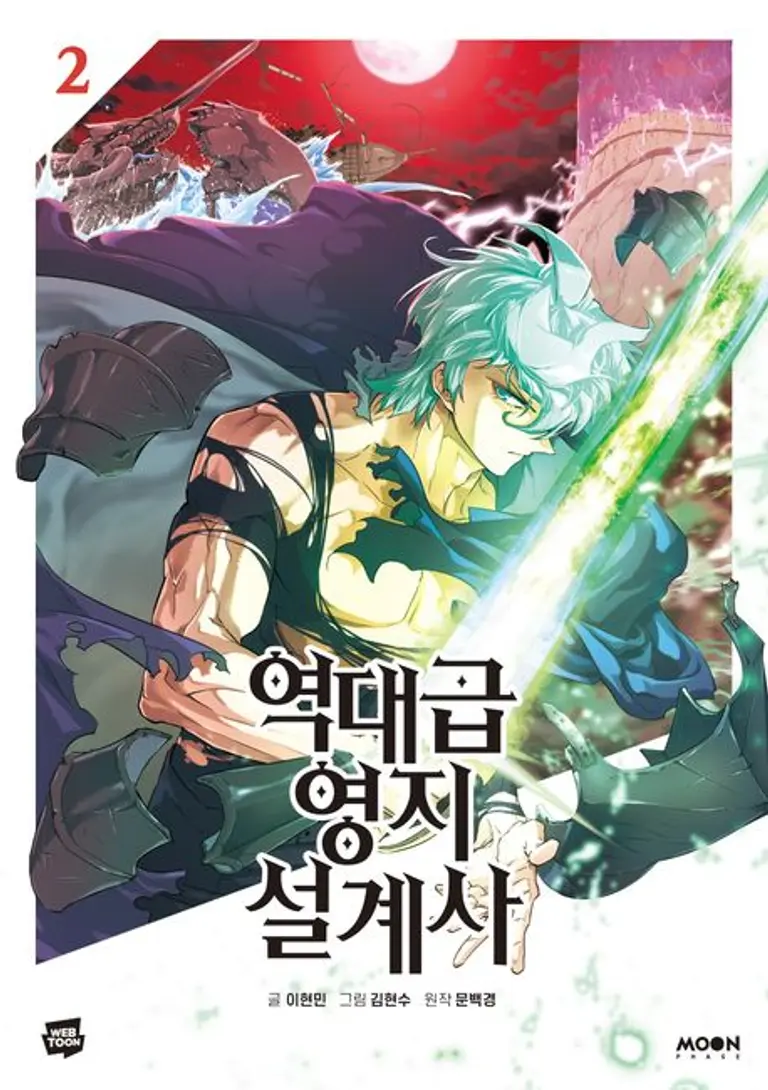
[KAVE=Lee Tae-rim Reporter] Under a sky completely different from Seoul, a hole-ridden castle wall and a broken tower stand in the middle of an endless plain. The name alone is already unsettling: the Baronial Territory of Frontiera. Naver Webtoon 'Ultimate Territory Designer' depicts the struggles of a person armed with a shovel and blueprints to revive this failing territory. The protagonist, Kim Soo-ho, is originally a job-seeking student majoring in civil engineering in South Korea. Chased by debt and barely surviving day by day with part-time jobs, he one night disappears as if sucked into a fantasy novel he was reading until dawn. Like the protagonists of Japanese light novels who are hit by trucks and transported to another world, but instead of a truck, he is overwhelmed by fatigue just before dying from overwork. When he opens his eyes, he finds himself resurrected in the continent that serves as the backdrop of the novel, and his identity is that of 'Lloyd Frontiera', the problem child of a baron family on the brink of destruction.
Lloyd was originally a supporting villain who bore the responsibility for the territory's downfall and disappeared gloriously. However, now inside him is Kim Soo-ho, equipped with knowledge of civil engineering and a trauma from the real estate market in Korea. He quickly assesses the situation. The territory is drowning in debt, the land is barren, there are no talented individuals, and external forces are bringing the threat of war and factional struggles among the nobility. According to the original story, this territory will soon go bankrupt, and Lloyd will die miserably. It’s like inheriting a small business on the verge of bankruptcy. Soo-ho resolves to change his mindset. "If it’s going to fail, let’s at least design it properly before it does." He soon changes his conclusion. "No, let’s make sure it doesn’t fail at all."
After this resolution, the webtoon flows from Lloyd's perspective as he views the territory as a 'development project'. He first surveys the entire area, checking the terrain and water resources. In areas at high risk of flooding, he designs embankments and waterways, and in lands with low agricultural productivity, he introduces irrigation facilities and fertiliser systems. The scenes where he transfers the basics of modern civil engineering—drainage, transportation, and sewage design—onto the map of another world feel like a comic strip unfolding a city-building simulation akin to SimCity or Cities: Skylines. In scenes where he briefs the future structure of the territory, saying things like, "Here’s the road, here’s the water and sewage, and over there’s the market and school," readers naturally draw a 3D map in their minds. Like Google Earth, but in a medieval fantasy version.
People are the Infrastructure: The Birth of a Fantasy Construction Site
The key to territory design is people. Lloyd first gathers the residents of the territory for consultations. He adjusts the tax system to relieve the farmers burdened by debt and taxes, and promises a new workshop street to the artisans who have lost hope. It’s like a startup CEO recruiting early members. At the same time, he brings in the abandoned knight from the country, Habiel, who is also the protagonist of the original novel, as his bodyguard and business partner. This combination is intriguing. Habiel, who was originally the protagonist of the story, now becomes a supporting character and labour force in the 'spin-off' of territory design. The comedy created by the temperature difference between the stoic knight and the territory designer who spills capitalist mindset whenever he opens his mouth is also a major aspect of the work. It’s like the relationship between Nathan Drake and Sully from 'Uncharted', but instead of seeking treasure, they are looking for sewage systems.
Fantasy elements are also added to this. Lloyd summons a being called 'fantasy species' that can only be handled by noble families, instead of using civil engineering equipment. There’s the ‘Hamster Fantasy Species’ that digs and compacts the ground (like a bulldozer), the ‘Snake’ that eats dirt and spits out rebar (the fantasy version of a 3D printer), the ‘Hippo’ that drinks water and acts as a large dam (a living reservoir), and the gigantic ‘Bird’ that provides an overview of the construction site (the medieval fantasy version of a drone). The scenes depicting the construction site give a strange thrill, as if translating a modern construction site with bulldozers, dump trucks, and concrete mixers into fantasy. The process of fantasy species and territory residents building bridges, managing rivers, and even creating ondol-style houses and public toilets, and even jjimjilbangs, is a representative spectacle of this webtoon. It feels like playing the survival mode of 'Minecraft' collectively.
Of course, the story doesn’t end with just designing the territory and building structures. The Baronial Territory of Frontiera is also a tasty morsel in the eyes of surrounding countries and nobles. Lloyd must internally deal with corrupt officials and the noble relatives, while externally engaging in diplomatic battles with those who invade, attracted by the territory's value. To avoid war, he opens pathways, shares commercial rights, and sometimes introduces the concept of "allocation rights" to turn the greed of the nobility into real estate products, which evokes a strange sense of catharsis while reminding one of Korean-style development projects. It’s like applying the logic of reconstruction in Gangnam to medieval nobles.
As the story progresses, Lloyd's goals gradually change. Initially, his dream was to become a 'laid-back nobleman living off easy money'. A fantasy version of the 'Fire Tribe'. So he had to save the territory. However, while practically saving people and building a city, he unknowingly takes on responsibility. Every time he hears reports that the lives of the territory residents have improved, or sees children playing in the schoolyard, a heavy sense of relief crosses his face behind his joking expression. Meanwhile, the scars of war and ancient secrets left throughout the territory, as well as crises shaking the continent, gradually reveal themselves, and the Frontiera Project expands from simple local development to a venture that changes the nation and the world. How far and how it expands is something to follow until the conclusion, so it’s best to stop the plot explanation here. In summary, 'Ultimate Territory Designer' is a story that, through the struggles of a civil engineering student trying to properly revive a failed territory, lays a new foundation for the structure of the fantasy world itself.
An Idealist and a Businessman... The Protagonist is Lovable Because He is a Supporting Character!
'Ultimate Territory Designer' wears the guise of a typical isekai reincarnation story while providing a completely different thrill. In short, this story is closer to 'fighting with blueprints instead of fists in fantasy'. Instead of leveling up by defeating monsters, he strengthens the territory by straightening rivers, building bridges, and designing water and sewage systems and security and school districts. Instead of combat power, infrastructure becomes the tool that changes the world, with shovels and figures replacing magic swords. It’s like Gandhi winning through city planning instead of nuclear weapons in the Civilization series.

In this process, the author remarkably simplifies somewhat rigid subjects like civil engineering, real estate, administration, and politics. The scenes where Lloyd spreads out blueprints and explains terrain, waterways, and road networks feel like a tutorial for a city-building game. Just gathering the cuts that explain where traffic congestion occurs, where flood risks are, and how to arrange markets, residential areas, and public facilities to improve the quality of life for residents could form an introductory book on urban planning. However, the lengthy explanations are not boring. Scenes where fantasy species run around like heavy machinery and nobles believe the promotional phrases for allocations literally while lining up are interspersed, naturally transforming professional content into comedy and catharsis. It’s like turning a TED talk into a comedy show.
The protagonist Lloyd's character is also interesting. He is neither a righteous idealist nor an outright villain. Having lost his family to real estate fraud in reality, he understands the violence of structure better than anyone. Therefore, while he strongly believes that he must guarantee safe housing and jobs for the territory residents, he transforms into a cold businessman when dealing with external forces. When he brings up exchange conditions at the negotiation table, saying, "Do you want allocation rights or passage rights?", readers marvel at how intricate his calculations are while faintly sensing the anger and trauma underlying them. It’s as if Bruce Wayne became a real estate developer instead of Batman. This complex emotion makes Lloyd appear not as a simple munchkin or a good hero, but as a real person.
Supporting characters also take on roles beyond their functions. Habiel, who was the protagonist of the original novel, is reallocated in this webtoon as a "young knight who is strong but lacks social experience". He doesn’t understand Lloyd's urban planning at all, but he believes in him and endures physically. Their relationship is closer to that of a technician responsible for the site and a site manager protecting him, rather than 'protagonist and bodyguard'. It’s like the relationship between Sherlock Holmes and Watson, but applied to civil engineering instead of deduction. Adding to this are merchants, artisans, and immigrants gathering in Frontiera, each with their own stories, creating a sociological landscape that shows "what kind of people a well-designed city attracts". Just like Silicon Valley attracts talent from around the world.
Translating Korean Real Estate Trauma into Fantasy
The artwork and direction also align well with the story's direction. Aerial shots overlooking the scenery of Frontiera, wide cuts showing dams, bridges, markets, and residential areas at a glance are symbols of this work. In scenes comparing the desolate landscape before development with the transformed city after infrastructure is laid, readers can visually confirm "how efficient this design is". It’s like a before-and-after remodeling show, but instead of houses, it’s the entire city. The character's expressive acting is exaggerated yet detailed, with the sly smile shown to the noble bringing the contract, the gentle face reassuring the territory residents, and the crazed gaze revealed only to enemies clearly distinguished.
Above all, the reason this webtoon is beloved is that it translates the everyday experiences of Korean readers into fantasy. Phrases like ‘perfect traffic, top-notch school districts, forest access, premium life’ feel familiar as if taken directly from real apartment advertisements. The difference is that here, those words are not mere false or exaggerated advertisements but are actually implemented. Lloyd lures the nobility's funds with allocation rights as bait, but reinvests that money into improving the lives of the territory residents. Readers, who have always remained in the consumer position in reality, experience for the first time the perspective of "the one planning" in the webtoon, feeling a strange vicarious satisfaction. It’s like having a god's perspective in The Sims or RollerCoaster Tycoon.
A Growth Story for Adults: The Narrative of Recovery
Another point to note is that this work is closer to a 'growth story for adults'. While growth narratives often evoke stories of teenagers or those in their early twenties, 'Ultimate Territory Designer' depicts an adult who has failed multiple times designing his life once again. Knowledge of civil engineering, social experience, and memories of failure become Lloyd's weapons. The process of providing jobs for the territory residents, persuading long-term infrastructure investments, and dealing with political forces reflects the experiences of adult readers who have faced challenges in companies and society. Therefore, the catharsis this work provides comes not from "the protagonist becoming strong and winning", but from "changing the results through planning, design, and consistent execution". Just as 'Moneyball' transformed baseball through statistics, this webtoon transforms fantasy into engineering.

Of course, it is not a perfect work. As the story progresses into the latter half, the worldview expands, and there are sections where the focus shifts from the details of territory design to war, politics, and transcendent threats. Some readers may feel that the fun of the early 'city development simulation' diminishes in this part. It’s like suddenly changing genres from SimCity to StarCraft. Additionally, since Lloyd possesses exceptional design abilities and simulation skills, there is an impression that crises are resolved relatively easily after the midpoint. Nevertheless, overall, the messages and structure this work presents remain consistent. The statement, "Ultimately, it is design and execution that change the world", is pushed through from the small unit of a territory to the entire continent.
If readers enjoy city-building games or simulation genres, they will feel as if they are 'personally handing over the blueprints' while watching this work. Following the process of roads, bridges, markets, and schools being completed one cut at a time, they will find themselves picturing the future map of Frontiera in their minds, eagerly awaiting the next episode. If you enjoyed SimCity, Cities: Skylines, or Animal Crossing, this is a must-read.
It will be a refreshing antidote for readers tired of typical sword and magic fantasy. Instead of defeating dragons, digging drainage ditches, instead of defeating the demon king, laying down sewage systems, and instead of leveling up, raising GDP in fantasy. If you find this subversion enjoyable, this work is for you.
Finally, for readers who have ever thought, 'I want to completely overhaul my life because it feels suffocating right now', Lloyd's struggles will provide heavy comfort. The sight of him drawing blueprints and gathering people to carve out paths even under the worst conditions feels like a story set in fantasy while simultaneously being a realistic self-development tale for adults. After finishing this work, even if you can’t design a territory right away, the desire to at least redesign the structure of your life will quietly rise.
And you will fall into the joy of thinking, 'Maybe I can also rebuild my own Frontiera?' This absurd yet convincing fantasy that one shovel can change the world will make your Monday morning a little different.