

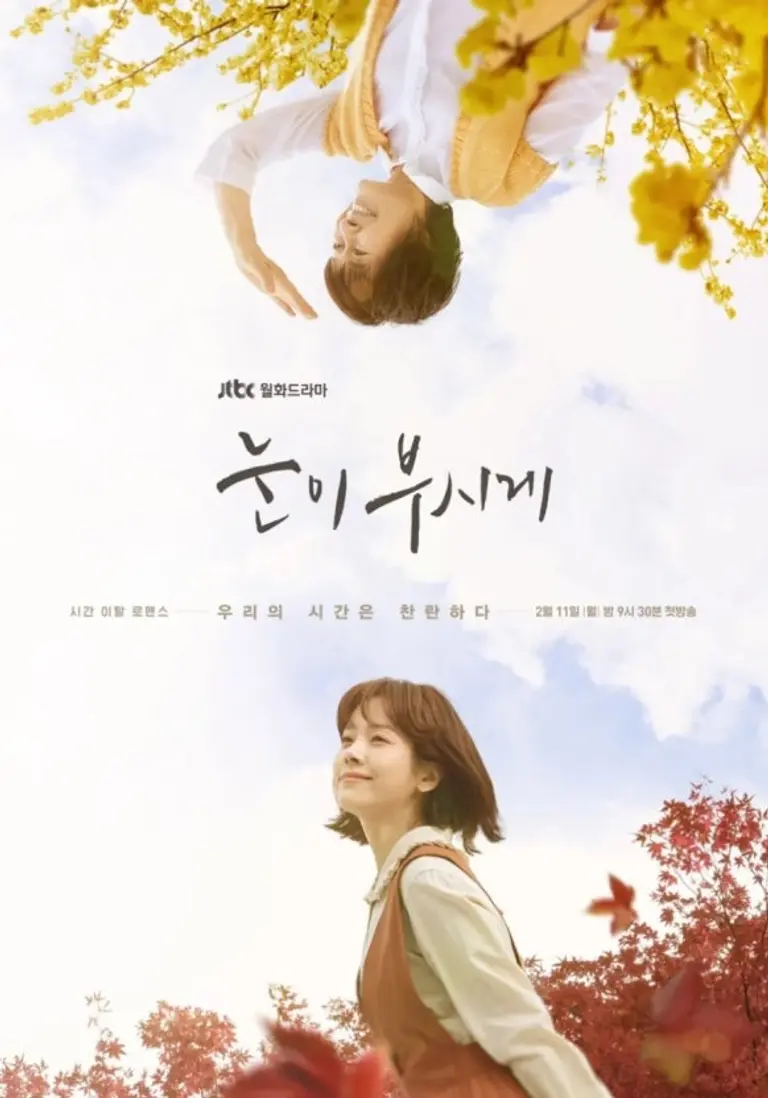
[KAVE=Lee Tae-rim Reporter] JTBC drama 'The Light in Your Eyes' is anything but ordinary from the first scene. When the grandmother Kim Hye-ja (Kim Hye-ja), who suffers from dementia, tells her granddaughter Hye-ji (Han Ji-min), "I am twenty-five years old," time instantly reverses from 2019 to the 1970s. As if passing through a black hole in 'Interstellar', we are sucked into the world of the grandmother's memories. However, instead of a spaceship, we ride the time-distorting device of dementia.
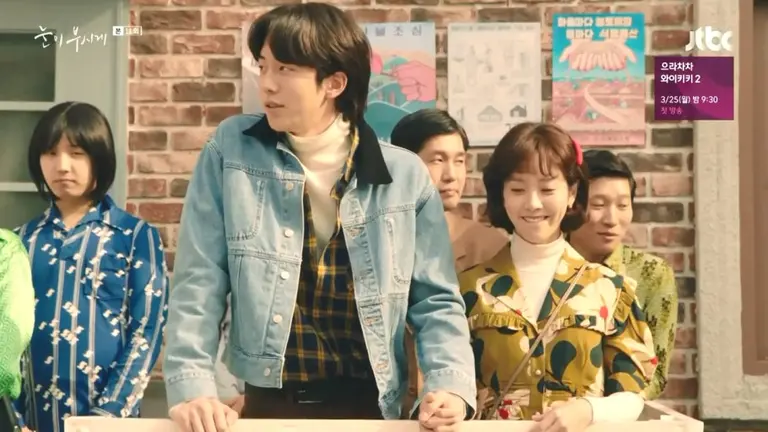
What we encounter there is twenty-five-year-old Kim Hye-ja (Han Ji-min playing two roles). In a rural village in the 1970s, she begins an ordinary newlywed life after marrying a local youth Nam Woo-cheol (Nam Joo-hyuk). It is not the cliché of "poor but happy" often seen in TV dramas. In reality, they are truly poor, worrying about meals, the husband fails in business, and the mother-in-law mistreats the daughter-in-law. It is closer to the hard survival period of 'Ode to My Father' than the nostalgic alleyways of 'Reply 1988'.
But Hye-ja does not crumble. Even on the day her husband comes home drunk after failing in business, and on the day her mother-in-law snaps at her, "Can't you even give birth to a son?", she endures steadfastly. Some days she makes a living from running a shop, some days from sewing, and some days she sets up a restaurant in a one-room apartment to make ends meet. Her husband Woo-cheol, while feeling sorry for her, brings another business idea and says, "This time it will be different." If Gatsby in 'The Great Gatsby' tried to catch the past Daisy, Woo-cheol runs his whole life to catch future success.
As time passes, the couple has children, those children grow up and go to school, and the family gradually increases. The 1970s become the 1980s, and the 1980s become the 1990s. Wrinkles appear on Hye-ja's face, and Woo-cheol's hair turns grey. However, the drama does not wrap this passage of time in historical events like 'Forrest Gump'. Instead, it measures time by personal milestones such as "the day the daughter took her first steps", "the day the son got into college", and "the day the grandson was born".
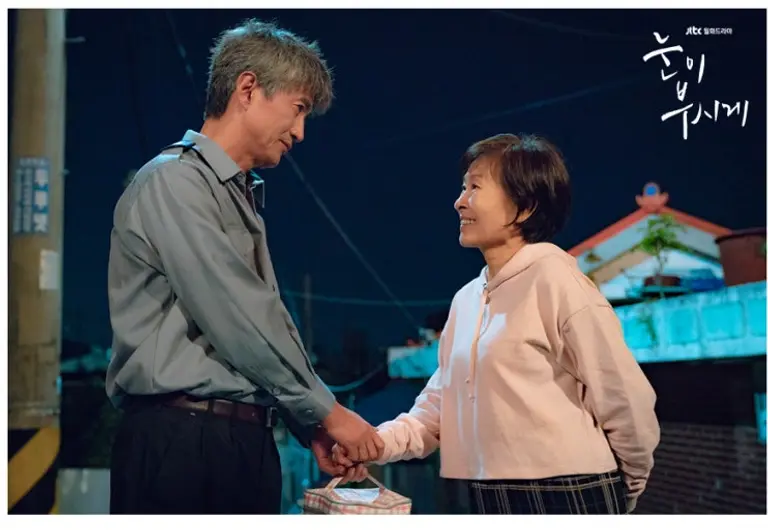
Then, at some point, the screen returns to 2019. Grandmother Hye-ja's dementia symptoms worsen, and she can no longer recognize her family's faces. Granddaughter Hye-ji explores her grandmother's memories and discovers a young version of her grandmother that she never knew. And she realizes that the elderly woman sitting in front of her was once the same age as her, a woman who loved, hated, dreamed, and was frustrated. Just as the protagonist in 'Midnight in Paris' gains enlightenment through time travel, Hye-ji also sees the present anew through her grandmother's past.
The structure of the drama alternates between the present of the grandmother suffering from dementia and the past in her memories. After a scene where the grandmother asks, "Where has Woo-cheol gone?", a scene follows where young Hye-ja and Woo-cheol go on their first date. After a scene where the grandmother looks at her granddaughter and asks, "Who are you?", a scene follows where young Hye-ja smiles while holding her newborn daughter. This editing is not just a simple flashback but visualizes the confusion of time experienced by dementia patients. While 'Memento' expressed short-term memory loss through reverse editing, 'The Light in Your Eyes' expresses dementia as a random replay of time.
A Journey into the Grandmother's Memories
The artistic quality of 'The Light in Your Eyes' shines above all in its attitude towards 'ordinary life'. This drama has no chaebol heirs, genius doctors, or secret agents. Hye-ja and Woo-cheol are just an ordinary couple. They neither achieve great success nor completely fail. Sometimes they are happy, often they struggle, and mostly they just live. While 'Parasite' showed the extremes of class, 'The Light in Your Eyes' tells the story of people who have spent their lives somewhere in the middle.
However, this ordinariness creates a more universal resonance. Most viewers' parents and grandparents lived just such a life. They may not have achieved grand dreams, but they raised children and saw grandchildren. It took a lifetime to secure a house, but still, the whole family gathered during holidays. Unlike Sebastian and Mia in 'La La Land', who had to choose between dreams and love, they could not give up on dreams, love, livelihood, and family, so they embraced everything and endured.
Kim Hye-ja's performance gives dignity to this ordinariness. The grandmother Hye-ja she portrays is neither as dignified as the elderly in 'Dear My Friends' nor as cheerful as Oh Mal-soon in 'The Queen's Umbrella'. She simply ages, suffers, and loses her memory. She feels sorry for being a burden to her family, yet at the same time, she feels resentful. She needs help to go to the bathroom, spills food while eating, and forgets her son's name. This brutal realism makes the drama even more painful.
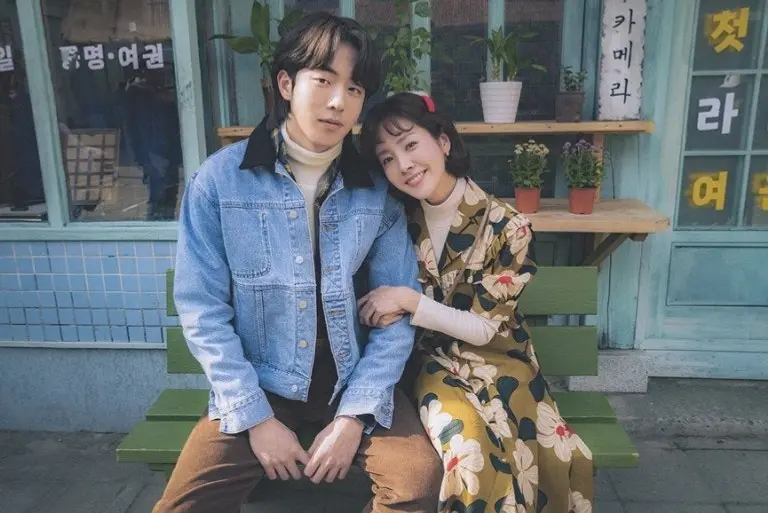
Han Ji-min's dual role is another pillar of this drama. The twenty-five-year-old young Hye-ja is not as spirited as the twenty-somethings in 'Age of Youth'. She is already married, worries about making a living, and is mindful of her in-laws. But within her, there are still dreams, ambitions, and pride. Han Ji-min delicately portrays this complex layer. As the same actress is cross-edited with Kim Hye-ja, who plays the grandmother, viewers naturally feel the passage of time, realizing that "that young woman becomes that grandmother".
Nam Joo-hyuk's Woo-cheol breaks away from the typical 'incompetent husband' cliché. He continues to fail in business, but at the same time, he genuinely loves his wife. While feeling sorry for not being able to earn money, he cannot give up on his dreams. Born in a patriarchal era, he does not take his wife's sacrifices for granted. This complex character is neither a 'villain' nor a 'hero', but simply a 'person'. Just like our fathers and grandfathers.
The Moment You Lost Yourself, the Magic Arrived
The drama is also honest in its approach to dementia. It does not romanticize it like 'A Moment to Remember'. Dementia is not beautiful. It is hard for both the patient and the family. Love alone cannot solve it. Economic burdens, physical fatigue, and emotional exhaustion are all realistically portrayed. While 'Still Alice' intellectually explored the inner world of early dementia patients, 'The Light in Your Eyes' emotionally captures the reality of families caring for late-stage dementia patients.
Watching 'The Light in Your Eyes', you come to realize that the elderly person sitting in front of you, nagging, was once the same age as you, a person who felt the same anxieties and dreams as you. And you also come to accept that one day you too will age, lose your memory, and become a burden to someone. This is not comfort but awakening. Just as Cooper in 'Interstellar' realized the nature of time in his daughter's room, we simultaneously understand the cruelty and preciousness of time within the grandmother's memories.
Moreover, for those in their twenties and thirties who are pondering, "Is my life okay as it is?", this drama delivers a heavy message. Hye-ja's life is not a successful one. But it is not a failed life either. It is simply a life lived. It does not say, like 'Whiplash' or 'La La Land', "If you don't achieve your dreams, it is meaningless." Instead, it says, "Even if you don't achieve your dreams, life goes on." And it whispers that within that 'continuing life', there are shining moments, there are dazzlingly beautiful scenes. This affectionate perspective on ordinariness comforts all of us who live ordinarily today.