

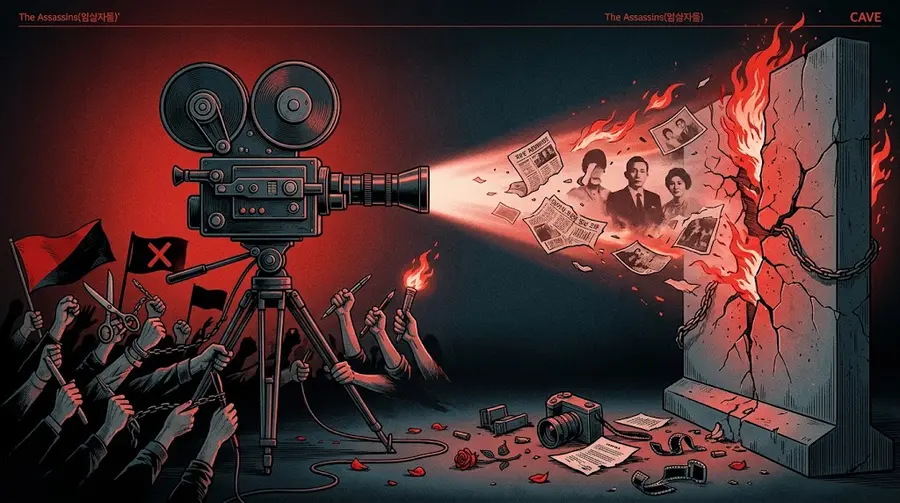
A bullet fired on screen 52 years ago has struck the asphalt of Seoul in 2026. The uproar now surrounding 〈The Assassins〉, directed by Hur Jin-ho and starring Yoo Hae-jin, Park Hae-il and Lee Min-ho, is a dramatic example of how a commercial film can touch a nation’s most intimate historical trauma and ignite a social civil war.
Having passed 2 million admissions soon after its release and topped the box office, the film is now fighting two very different battles inside and outside cinemas. Inside, audiences are captivated by a painstaking thriller investigating the mystery of the attempted assassination of former president Park Chung-hee on 15 August 1974, in which his wife Yuk Young-soo was shot. Outside, complaints and legal action by conservative groups, protests outside lead actor Yoo Hae-jin’s home, and even the cancellation of parts of the Busan International Film Festival’s (BIFF) official programme and an appearance by actor Lee Min-ho following terrorist threats have produced an unprecedented physical confrontation.
The reason global communities, including Reddit, and overseas film critics are paying attention to this strange phenomenon is clear: how can an event from more than half a century ago retain enough volatility to disrupt daily life in a cutting-edge 21st-century democracy?
K-cinema’s battle over the archives against a ‘monopoly on memory’
To Western eyes, the narrative strategy of 〈The Assassins〉 follows in the footsteps of Oliver Stone’s 1991 film 〈JFK〉 and David Fincher’s 〈Zodiac〉. It puts the archival record of a historical event officially closed and sealed by the state under a microscope, filling the logical gaps between its lines with cinematic imagination. Through a journalist and an investigator who doggedly probe who was behind the incident and the contradictions at the scene, the film presses questions that official history has yet to answer.
The problem is that, in South Korean society, the 1970s are not simply the ‘past’ but a ‘sanctuary’ bound up with present-day political legitimacy. At the point where two grand narratives collide — the myth of rapid growth and the shadow of authoritarian rule — the cinematic questions posed by 〈The Assassins〉 have been received in some quarters not as ‘artistic expression’ but as ‘an insult to the system and to memory’.
To borrow French historian Pierre Nora’s concept of ‘sites of memory’ (lieux de mémoire), the defining turning points of South Korea’s modern history have not yet settled into ‘history’ through social consensus. Instead, they remain contested ground over which opposing camps claim exclusive ownership. Just as 〈12.12: The Day〉 revisited the military rebellion of 1979 and shook historical perceptions across generations, 〈The Assassins〉 has brought the tragedy of 1974 back into public debate, reigniting a fundamental struggle over who has the right to remember and recount history.
The boundary between fiction and journalism — and the paradox of ‘physical censorship’
What will strike overseas readers most is not the intensity of the ideological argument but the way it is expressed. Surrounding the private home of an actor who played a fictional character to protest against the content of a commercial film shaped by fictional imagination, and threatening the safety of Asia’s largest film festival, the Busan International Film Festival, so that actors cannot appear, are scenes rarely seen in Western democracies.
In place of formal prior censorship by the state, an era of so-called ‘privatised censorship’ has arrived, in which ideologically driven interest groups and fandoms bring physical force to bear. Ironically, the extreme backlash and demands to ban screenings have served as publicity for the film, becoming a catalyst that has drawn people in their twenties and thirties to cinemas.
Global media scholars have noted the distinctive position of South Korean period dramas. While Hollywood becomes absorbed in franchise superhero films and safe recycling of intellectual property, losing its voice on social issues, South Korean commercial film capital is confronting the most sensitive and dangerous flashpoints of modern history head-on, achieving popular success while creating a forum for public debate. Film is doing more than entertaining: it is serving as ‘proxy journalism’, seeking to settle historical debts that institutional politics and the press have failed to address.
Only questions that spare no sacred cows can move history forward
Of course, the cinematic leaps and conspiratorial perspective adopted by 〈The Assassins〉 deserve rigorous academic and critical debate over how closely they accord with historical truth. The criticism that it uses a historical tragedy as a device for commercial suspense is also something its creators must answer for.
What is clear, however, is that trying to suppress the questions themselves can never protect the truth. Just as Germany after Auschwitz and the United States after the Vietnam War and Watergate worked through national trauma by repeatedly representing it on film and engaging in painful self-examination, a society’s cultural maturity depends on how freely it can speak about its most painful failings.
The strange commotion now surrounding 〈The Assassins〉 is a belated growing pain for South Korean society and, paradoxically, evidence of K-cinema’s most untamed vitality. The shots rang out in 1974, but South Korea’s cultural war in 2026 over how to record and interpret their echoes is still posing the weightiest of questions to audiences around the world. How far may art go in questioning history? And are we ready to face those uncomfortable questions?