
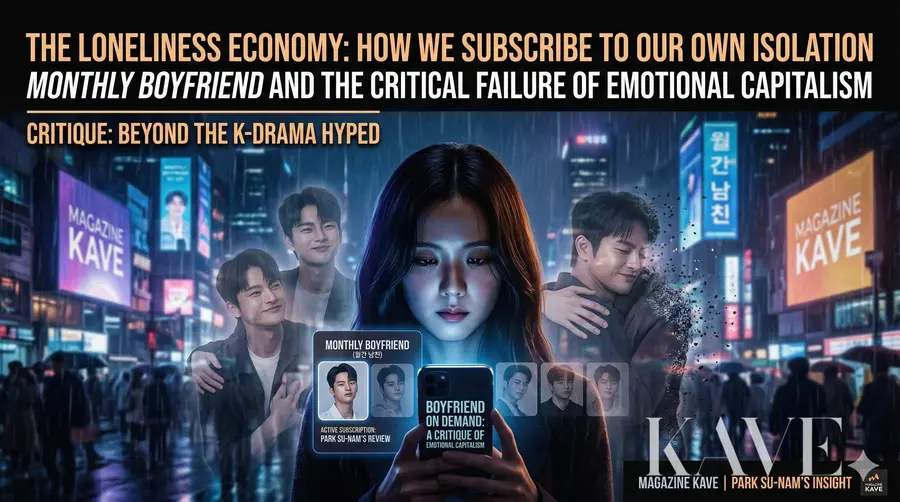
[Magazine Kave=Reporter Park Sunam] In modern society, popular culture is more than entertainment: it functions as a vast psychological infrastructure reflecting the collective anxieties and unmet needs of its age. Released worldwide on Netflix on 6 March 2026, the 10-part K-drama ‘Boyfriend on Demand’ appears, on the surface, to be a light, sweet romantic comedy about virtual reality (VR) and artificial intelligence (AI). Global audiences and mainstream media have embraced the natural, playful chemistry between BLACKPINK’s Jisoo (as Seo Mi-rae) and Seo In-guk (as Park Kyeong-nam), along with the visual feast offered by its varied cast of cameos.
But consuming the series merely as ‘2026’s cutest virtual romance’ is a one-dimensional reading that misses the chilling social symptoms lurking beneath its surface. ‘Boyfriend on Demand’ is both a social documentary that closely dissects the isolated inner lives of people shaped by an uncompromising capitalist logic and a dystopian fable warning of how technology commodifies and controls human emotion.
The end of eros, swallowed by the subscription economy: the fantasy of returns without risk
The protagonist, Seo Mi-rae, is a webtoon producer suffering from severe burnout. Emotionally exhausted by pressure at work, relentless deadlines and the expectations of modern society, she pays a monthly subscription fee to enter a perfectly controllable virtual dating simulation rather than face the unpredictability of a real relationship. Significantly, Mi-rae’s job is to plan and produce ‘fictional romance’. A worker who sells fantasies to others has so little capacity for emotional connection in her own life that she relies on another, more sophisticated technological fantasy — a VR subscription service. The premise symbolises the extreme alienation of labour under modern capitalism.
As sociologist Eva Illouz has observed, emotion has become entangled with the logic of capitalism to form an enormous market. ‘Boyfriend on Demand’ depicts a world in which this ‘emotional capitalism’ has reached its fullest expression. Where romance once involved chance, fate and inevitable hurt, intimacy for humanity in 2026 has been reduced to a monthly ‘subscription’ service. For people who must survive and sustain a career in an intensely competitive society, forming a relationship and negotiating conflict with someone else is an excessively costly ‘high-risk investment’. For the so-called ‘Sampo generation’, who have given up dating, marriage and having children, virtual romance becomes an economically rational choice: it minimises the cost of emotional labour while using algorithms to maximise psychological satisfaction.
Director Kim Jung-sik has said the series began with a simple question: ‘What if you could subscribe to love?’ Screenwriter Namgung Do-young’s carefully chosen episode titles clearly reinforce that premise. The following analysis considers the sociological implications of the titles of episodes in the latter part of the series. The title of episode four, ‘No Risk, High Return’, captures the drama’s central theme. Subscription-based virtual dating transplants capitalism’s rational pursuit of maximum returns directly into the most intimate realm of human emotion. Users eliminate the ‘risk’ of being hurt while collecting only the ‘return’ of perfectly calibrated excitement supplied by an algorithm. But, drawing on the insights of philosopher Byung-Chul Han, a relationship in which the other person’s unpredictability — their negativity — has been erased, leaving only a smooth reflection of one’s own desires, is not love in any genuine sense. It is merely a variation on narcissism, an infatuation with one’s reflection, and a chilling vision of ‘the end of eros’: the loss of the capacity to expand one’s world through encounters with others. In a world stripped of the friction that arises when another person approaches as an unpredictable being, love becomes a comfortable consumer product.
Negative sociality and frictionless control: the loss of the other and the rise of digisexuality
The virtual-reality app in ‘Boyfriend on Demand’ offers around 900 different virtual boyfriend options. Within the simulation, men with the most desirable looks of the day — including Seo Kang-jun, Lee Soo-hyuk, Lee Jae-wook, Ong Seong-wu and even musician Jay Park — appear as idealised fantasy archetypes such as princes, doctors and secret agents. Mainstream coverage presents this varied parade of cameos as eye candy that adds to the show’s appeal. From a sociological perspective, however, they are a collection of perfectly controllable ‘others without otherness’.
Modern people live in a society of extreme exhaustion. To an exhausted self, another person is, at root, a burden and a source of fatigue. A real partner may become angry without warning, unload difficult feelings or announce a break-up. Episode three portrays the loss and pain that follow a separation with enough realism to move viewers to tears, offering a searching reflection on how we come to hate someone we once loved. Yet after undergoing this emotional strain in real life, the protagonist ultimately tries to process her feelings within the app’s ‘safe space’. By contrast, the 900 perfect boyfriends in virtual reality are products of ‘engineering design’: they analyse brainwaves and heart rate to generate optimal responses in real time. They never displease the user, whisper affection only to the extent requested and disappear neatly at the press of a log-out button when they are no longer needed.
This analysis focuses here on the concept of ‘negative sociality’. The reassurance users feel in virtual dating stems less from having a perfect partner than from their absolute power to ‘cancel’ or swipe away the relationship whenever they wish. A frictionless environment from which the ‘negativity’ of disagreement and conflict has been entirely removed erodes people’s ability to interact genuinely with others. Paradoxically, the algorithm chosen to avoid conflict makes each person an even more isolated island.
The arrival of ‘digisexuality’, in which technology ceases to be merely a tool for relationships and becomes the partner itself, maximises convenience while leaving an unsettling emptiness behind it. Retreating into an algorithmically designed matrix and putting real life on hold for fear of being hurt by others is not a cure for isolation, but another powerful form of psychological avoidance. Genuine attachment forms through shared vulnerability; in a relationship with AI, only the user exposes vulnerability, while the AI merely collects it as data. This is closer to an elaborate process of psychological anaesthesia disguised as love.
The hidden mastermind theory: Park Kyeong-nam’s identity and the romance of surveillance capitalism
While mainstream reviews focus on the quick-fire banter and comic chemistry between Jisoo and Seo In-guk, a plausible and startling theory that could overturn the foundations of the story has taken shape among international fans and in Reddit communities. It concerns the true identity of Seo In-guk’s character, Park Kyeong-nam, Mi-rae’s real-world colleague and rival. Even before the series aired, the production team repeatedly stressed that, beneath Kyeong-nam’s cynical exterior, he harbours ‘surprising secrets’ that will stir Mi-rae’s emotions. Seo In-guk himself also hinted at a ‘major plot twist’ involving his character near the end of the series at a press event.
Astute viewers have consequently advanced a compelling theory: Park Kyeong-nam is not simply a colleague but the actual creator, or mastermind, who planned and developed the virtual-reality dating programme ‘Boyfriend on Demand’ — or, at the very least, an administrator controlling the system behind the scenes. The theory draws logical connections between several apparent coincidences in the plot. Early on, someone inside the company where Mi-rae works singles her out as a beta-test reviewer for the app. In the fiercely competitive webtoon industry, her selection in particular may be more than chance. Moreover, previously leaked photographs from the set showed Seo In-guk, a real-world character, at the same beach resort location where Lee Soo-hyuk was filming as a virtual boyfriend. This suggests that Kyeong-nam is intervening in the virtual world either physically or through code. It is also considered highly likely that the virtual boyfriends’ personalities or conversational patterns were modelled on Mi-rae’s preferences as Kyeong-nam observed them in real life.
If this ‘mastermind theory’ proves true, ‘Boyfriend on Demand’ changes genre entirely: from a cosy, sweet romantic comedy into cyber-cosmic horror about what Shoshana Zuboff calls ‘surveillance capitalism’.
What if Kyeong-nam acts like Mi-rae’s adversary at work while secretly watching and analysing, from behind a database monitor, which men’s voices attract her in the virtual world and which forms of physical contact raise her heart rate? It would be a perfect metaphor for a modern surveillance society extending Jeremy Bentham’s Panopticon into the most intimate territory of romance and emotion. Some might dress it up as a tech geek’s awkward devotion or unrequited love. Fundamentally, however, it bears an unnerving resemblance to the data-extractive structure of modern capitalism: Big Tech companies collecting our most intimate search histories, the places our gaze lingers and our heartbeat data without permission, then manipulating our desires and pushing tailored products at us.
From this perspective, every moment of joy, excitement and sorrow Mi-rae experiences in virtual reality ceases to be the result of her own autonomous choices. Each becomes an input meticulously calculated and fed to her by an omniscient designer wielding algorithmic power. Viewers witness how love, among humanity’s most distinctive and precious emotions, can be hacked and conditioned through data monopolies and algorithms. This is not merely a twist; it is a pointed social indictment of the technology dominating 2026.
Visualising dystopia: cinematic Easter eggs and the legacy of ‘Black Mirror’
Critics overseas have placed the themes and narrative structure of ‘Boyfriend on Demand’ alongside Netflix’s flagship dystopian anthology, ‘Black Mirror’. It shares a particularly strong philosophical trajectory with ‘San Junipero’, which portrays an afterlife sustained in virtual reality; ‘Hang the DJ’, which exposes the flaws of a dating algorithm that controls even a couple’s compatibility and the duration of their relationship; and ‘The Entire History of You’, in which every memory of human relationships is stored as visual data and becomes an obsession. Both fictional worlds pose fundamental, existential questions about how increasingly sophisticated technology reduces human intimacy and emotion to scraps of data and, ultimately, erodes our humanity.
Rather than reveal this dystopian menace openly, director Kim Jung-sik and writer Namgung Do-young have concealed it in carefully placed Easter eggs throughout the visual storytelling and narrative. Decoding these hidden devices is another of the drama’s central pleasures.
First is the clever use of aspect ratio throughout the series. Kim Jung-sik deliberately chose different aspect ratios for scenes in Mi-rae’s bleak, stifling real world and those in the dreamlike, fantastical virtual world. More than a simple visual cue to her location, this is an effective directorial means of making viewers instinctively feel the cognitive rupture when the boundary between virtuality and reality collapses. As Mi-rae becomes increasingly detached from reality and dependent on the virtual world, the gulf between the two aspect ratios feels wider, intensifying the psychological pressure exerted by the frame of the real world.
Second is the double meaning of the scene at Shangri-La Mactan resort in Cebu, the Philippines, in episode one. On a hellish subway commute, Mi-rae recalls a glorious summer holiday on a Philippine beach. With a turquoise sea and a sign bearing the Philippine tourism slogan ‘Love the Philippines’ clearly in view, the scene appears to represent a beautiful past romance in contrast to her harsh present. Viewed more closely through a capitalist lens, however, even this ‘memory of the past’, which she treats as a refuge and escape, is not an experience of nature untouched. It takes place in a ‘luxury global resort’: a carefully constructed, controlled commercial setting created by big capital. Even modern people’s real-world romance and memories are already wholly subordinated to capitalist patterns of consumption. The scene thus sharply foreshadows the seemingly inevitable next step: her consumption of virtual-reality dating.
Third, the means of entering the virtual dating matrix is a physical ‘ring’, not a smartphone or glasses. Traditionally, a ring symbolises a promise, a bond and a constraint. This digital ring is more than a log-in device: it acts as an ‘electronic tag’ binding the user to the system, an invisible handcuff. Users firmly believe they can always choose to log out. Yet, gradually addicted to the dopamine and perfect emotional gratification dispensed by the algorithm, they eventually find themselves unable to take the ring off of their own accord. Mi-rae, a producer who once controlled the worlds of the webtoons she developed, steadily loses control inside the simulation and becomes passive, like ‘the protagonist of a webtoon written by someone else — the designer’. It is a chilling and tragic portrait of modern people losing their agency and becoming objects within a vast data system.
The market for isolation, measured in data: the explosive growth of the global AI companion industry
‘Boyfriend on Demand’ has resonated worldwide with so many viewers because its bleak dystopian vision of romance in 2026 is by no means confined to fiction on a screen. The global ‘epidemic of loneliness’ has already become a powerful, vast force in the real economy, not just the virtual world. Tinder’s arrival in 2013 revolutionised online dating through the simple mechanism of swiping left or right, helping create a market worth $6.18 billion by 2024. By 2026, however, the market has shifted its paradigm entirely towards intimacy with ‘synthetic personalities’, dispensing even with encounters between people.
According to a January 2026 report in Monitor on Psychology, published by the American Psychological Association (APA), ‘synthetic relationships’ designed to meet the fundamental human need for social connection are increasing explosively. Beyond general-purpose generative AI assistants that help with everyday tasks, such as ChatGPT and Claude, the number of AI companion apps specifically designed to initiate and sustain romantic relationships, including Replika and Character.AI, surged by as much as 700% between 2022 and mid-2025. These apps have evolved to the point where they share virtual meals with users, watch films with them, remember intimate secrets and flirt. Character.AI, in particular, has 20 million monthly active users, more than half of whom are aged 24 or under; the strange phenomenon of people holding virtual weddings with virtual avatars has already become a social ‘new normal’.
K-drama as psychological infrastructure and the soft control of emotion
Seen from this broader perspective, the social position of ‘Boyfriend on Demand’, distributed by the global platform Netflix, is deeply contradictory and deftly constructed.
On the surface, the drama appears to portray modern alienation, overwork and fractured relationships critically. As its story progresses, however, it packages Mi-rae’s temporary ‘healing’ and consolation in the arms of a virtual algorithm as something beautiful. Rather than prompting viewers to reflect on their own lives, this may encourage them to treat the drama itself as a virtual lover with which to satisfy their emotional hunger. As communal ‘third places’ such as cafés, libraries and public squares disappear after the pandemic, isolated individuals come to rely on the digital space of Netflix as their sole refuge.
Under neoliberal governmentality, society does not suppress individuals so much as gently soothe their feelings until they conform to the system. Large, tangible social problems — structural inequality, exploitation through long working hours, housing insecurity and excessive competition — disappear behind a screen of dazzling romantic fantasy. Instead of gathering in public squares to express anger or solidarity in pursuit of change, people drag their tired bodies to bed, pay a monthly subscription of 15,000 won and let Netflix administer its ‘emotional anaesthetic’ directly into their veins. Conflict evaporates; anger dissolves into sweetly seductive images. This is where the chilling critique emerges: K-drama operates as one of neoliberal capitalism’s most efficient and adaptable instruments of soft control, a modern opium of emotions.
Platforms sell isolation. Netflix does not offer lonely people real-world ways to overcome loneliness; it whispers, ‘Stay longer in this safe, risk-free digital world,’ and monopolises their time. ‘Boyfriend on Demand’ is simply the most sophisticated version of that sweet whisper.
Rejecting the comfortable matrix and finding the courage to be hurt
Even so, the glimmer of hope offered by the Netflix original ‘Boyfriend on Demand’ lies in the direction of its ending. After fierce conflict and the chaos of the simulation, the series gives Mi-rae a small but essential realisation. She chooses to leave behind the pleasure of perfect, painless virtual dating supplied by an algorithm and accept a real, unpredictable love with Park Kyeong-nam, whose feelings could change at any moment and with whom she could exchange deep wounds. Having been haunted by the fear that a man might leave her because of a painful break-up in her past, she acknowledges that love inevitably entails risk and willingly embraces it. That moment is the drama’s greatest achievement.
Although this ending may seem to follow the romantic comedy genre’s familiar convention of a happy ending, beneath it lies an important philosophical message for humanity in 2026. A perfectly controlled algorithmic matrix may offer comfort and a temporary rush of dopamine, but it cannot provide a genuine encounter with ‘the other’ or salvation for the soul. Conflict with another person, painful misunderstandings, rough collisions and, at times, wounds that scrape us to the bone: this whole process is the surest sensation of pain proving that we remain connected to the world as human beings. Only by passing through that pain can we break out of the narrow shell of the self, expand our world and approach the essence of eros.
To cure the terrible illnesses of our age — exhaustion and isolation — we must not outsource our most intimate feelings and vulnerabilities to the ‘subscription services’ of technology giants that exploit those very conditions ever more skilfully. The alluring comfort of virtual reality so seductively portrayed in ‘Boyfriend on Demand’ paradoxically proves how desperately we need to step away from the smooth screens of our smart devices and seek the messy, imperfect solidarity of living alongside real people.
Will we be tamed into docile acceptance of safe subscriptions and algorithmic control, or reach out towards another real person despite the risk of being hurt? In this advanced society of emotional capitalism, where AI calculates even the subtlest human feelings as data and creates a vast market worth $550 billion, choosing the courage to be hurt by another person may be the most powerful and noble way to resist mechanical perfection and defend human dignity.