

[magazine kave=Park Soo-nam Reporter] In 2023, the attention of the global popular culture industry was focused on one man's words. The person who brought the genre of K-POP to the global mainstream, HYBE's Bang Si-hyuk, threw out a somewhat shocking, perhaps self-destructive topic. "We need to remove the 'K' from K-POP." This statement was not just a simple rebranding declaration for brand marketing. It was an internal whistleblower indicating that 'K-POP', based on the geographical and cultural specificity of Korea, had reached a critical point of growth, and at the same time, it was a signal of a massive strategic shift to export the 'system' itself to break through its limitations.
Bang's sense of crisis is also proven by numbers. After the unprecedented success of BTS, the global export of K-POP reached an all-time high, but indicators of actual influence in the mainstream market, such as the number of entries on the Billboard Hot 100 chart, were stagnating or declining. The decline in indicators in the Southeast Asian market and the limitations of the 'fandom business' in the Western market were enough to evoke fears that "if this continues, K-POP could end as a temporary fad." Bang's warning that "if we rest on our current achievements, we will be eliminated in an instant" was not an exaggeration, but a cold reality based on data.
We are now witnessing the era of 'Hallyu 3.0'. Beyond the 1.0 era, which exported single content products like dramas and movies, and the 2.0 era, which exported music and performances through idol groups centered on Korean members, we have now entered the 3.0 era, where the 'production system' and 'nurturing know-how' that create K-POP are being implanted locally. This is the final stage of the 'Culture Technology' advocated early on by former SM Entertainment chief producer Lee Soo-man and is the core of HYBE's 'Multi-home, Multi-genre' strategy.
The group at the forefront of this strategy is 'KATSEYE'. This girl group, born from a collaboration between Universal Music Group (UMG) and HYBE, sings in English rather than Korean in Los Angeles, not Seoul, and has a multinational composition with only one Korean member. However, the 'method' that created them strictly followed the K-POP T&D (Training & Development) system. This is an ambitious attempt for Korea's soft power to go beyond simply selling 'Korean things' and establish itself as the standard production process in the global pop market.
The joint project between HYBE and Geffen Records, 'The Debut: Dream Academy', was not just a simple audition program. It was a massive laboratory to verify whether the 'T&D (Training & Development) system', which is the core competitiveness of K-POP, could operate effectively in the culturally different Western market.
Mitra Darab, the representative of HxG (HYBE x Geffen), stated that a system operating 20 hours a day was built for this project over the past year. The K-POP unique training lifestyle, vocal and dance training, personality education, styling, diet, and weight management were all applied to the local trainees in the United States. This fundamentally differs from the existing Western pop market's 'Artist Discovery (A&R)' approach. While the Western market focuses on discovering and marketing already established artists, the K-POP system focuses on discovering raw talent and 'processing' and 'nurturing' it into the form desired by the agency. In this process, trainees are reborn not just as singers but as perfectly planned 'idols'.
Inevitably, cultural friction occurred during the process of implanting this system. The Netflix documentary 'Pop Star Academy: KATSEYE' shows these conflicts without reservation, illuminating both the light and dark sides of the system.
Naisha's Elimination and the Weight of NDA: Participant Naisha was immediately expelled for posting an unreleased song on her private Instagram (Finsta) story. For Western teenagers, social media is an extension of daily life and a means of self-expression, but in the K-POP system, information security (NDA) and agency control are uncompromising absolute principles. Naisha's expulsion was a symbolic event that engraved the harsh discipline of K-POP, which states that "even with talent, you cannot survive if you break the rules," into the minds of Western participants.
Manon's Attitude Controversy and It Factor: Member Manon, who has visuals and star quality, constantly clashed with other participants due to her lack of participation and insincere attitude. From a Korean perspective, especially from the viewpoint of existing K-POP fandom, 'diligence' and 'painstaking effort' are essential virtues and moral obligations that idols must possess. However, Manon was ultimately selected as a debut member. This can be interpreted as a compromise that accepted some Western values that prioritize 'star quality (It Factor)' that can capture the public over 'diligence in the process' during HYBE and Geffen's adaptation to the U.S. market. Manon's selection shows that the K-POP system exhibited flexibility during the localization process while also demonstrating how far the principles of the existing system can be modified.
'Dream Academy' starkly exposed the chronic issue of trainees' mental health in K-POP on the global stage. The uncertain debut process over two years, constant competition, and disconnection from family brought unbearable stress to the participants in their late teens. Western critics raised ethical and legal questions about whether the Korean training model could coexist with Western perceptions of mental health and labor laws.
HYBE has tried to address this by deploying psychological counseling professionals and introducing mental care programs, but the tension between the K-POP system, which pursues 'extreme efficiency' and 'perfectionism', and Western values that emphasize 'individual autonomy' and 'well-being' remains a challenge to be resolved. This is a mountain that the K-POP system must overcome to establish itself as a global standard in the future.
The beginning of KATSEYE was by no means smooth. The debut single "Debut" announced their arrival, but the market's reaction fell short of expectations. Despite being a large-scale project with hundreds of billions of won invested, the initial streaming figures were lukewarm. Questions were raised among fans about the quality of the song and the planning, and some even mentioned the negative nickname "GIRLSET", fearing it might become another failed localization attempt.
However, the turnaround began with the second single "Touch". HYBE and Geffen focused on a short-form content challenge centered on TikTok rather than traditional radio promotions or TV broadcasts. The catchy melody and easy-to-follow key choreography of "Touch" exploded in response through the TikTok algorithm, starting to chart climb.
A deep analysis of data from Spotify and Chartmetric reveals that KATSEYE's success is not just a matter of luck. Contrary to initial concerns, KATSEYE is currently showing an explosive upward trend.
Notably, there is a streaming gap between the title track and the included tracks and the reversal phenomenon. The data as of the end of 2024 is as follows:
Gabriela: 513.7 million streams (despite being a B-side, ranked 1st)
Touch: 508.1 million streams (actual breakout hit)
Gnarly: 380.8 million streams
Debut: 226.8 million streams
M.I.A.: 89.1 million streams
While the debut single "Debut" remained at around 226 million, "Touch" and "Gabriela" surpassed 500 million. In particular, the fact that "Gabriela", despite not being an official promotional track, recorded the highest streams within the group solely through viral activity on social media like TikTok is significant. This proves that KATSEYE's consumption pattern is driven more by the public's voluntary short-form content consumption than traditional 'album listening' or 'fandom streaming'.
According to Chartmetric data, KATSEYE's monthly listeners reach about 28.4 million, with daily streaming exceeding 8.3 million. Even more encouraging is the speed of fandom influx. As of December 16, 2025, new Spotify followers surged by 117.1% compared to usual, accelerating fandom expansion.
The distribution of their fandom strongly suggests that the 'K-less K-POP' strategy was effective. With strong support from Southeast Asian markets like the Philippines and Indonesia due to member Sophia's influence, the influx from the U.S. mainland, Brazil, and European markets like the UK is also clearly evident through members with diverse backgrounds like Lara, Daniela, and Megan. This shows that the 'global pop mix' strategy proven by BTS is also applicable to KATSEYE, demonstrating that they are growing into a truly 'global girl group' that is not limited to specific countries.
The global localization group is not exclusive to HYBE. Leading K-POP companies representing South Korea, such as JYP and SM, are all diving into this market with their lives on the line. However, the report card so far shows a stark contrast. By comparing and analyzing the strategic differences and achievements of each group, we can gain a more comprehensive understanding of the success factors of KATSEYE.
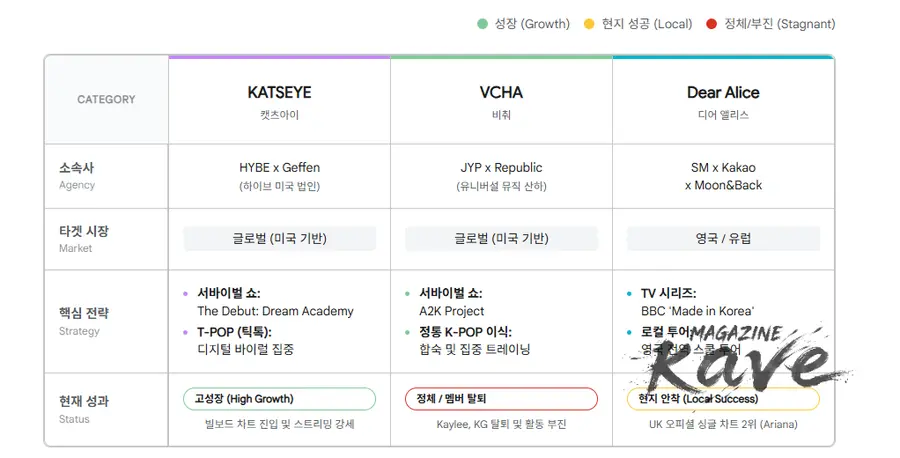
JYP Entertainment's 'VCHA', created in collaboration with Republic Records, debuted before KATSEYE but is relatively struggling. The music video for the debut song "Girls of the Year" has around 10.6 million views, significantly lower than KATSEYE's follow-up songs.
Analysis of Structural Causes of Underperformance
Ambiguity in Targeting and Lack of Authenticity: VCHA maintained the colors of existing K-POP too strongly in all aspects, including music, choreography, and styling. This gave the impression to the Western public that it was "K-POP (K-pop Cosplay) imitated by Americans," leading to authenticity controversies. It is difficult to avoid criticism that they were too focused on applying Korean styles rather than transforming to fit the local market.
Failure of Promotion Strategy: After a brief initial activity, they lost momentum due to a long period of radio silence. They adopted a strategy relying on existing K-POP fandom, such as performing at the opening stage of TWICE, but this became a hindrance to building an independent fandom.
Rigidity of the System: There are also criticisms that JYP's emphasis on 'character', 'diligence', and 'health' in training methods suppresses the appeal of local members who value individuality and freedom. The incident involving member Kaylee's suspension can be seen as an example of this systemic fatigue.
SM's Dear Alice: Thorough 'Localization' and Combination with 'Legacy Media'
SM Entertainment's British boy group 'Dear Alice', created in collaboration with Kakao and the UK’s Moon&Back Media, shows a very interesting approach different from KATSEYE. They exposed their formation process through the BBC broadcast 'Made in Korea: The K-Pop Experience', utilizing the impact of legacy media (TV) rather than digital.
Differentiated Success Strategy:
Thorough Britishness: All members are white British, and they applied K-POP's sharp choreography and performances based on British pop sensibilities. The debut single "Ariana" entered the upper ranks of the UK Official Singles Chart, achieving visible results. This shows that the strategy of positioning themselves as a thoroughly 'local' group by removing the 'K' was effective.
School Tour Strategy: They directly targeted teenage fandom by touring schools across the UK, similar to legendary boy bands like Westlife and Take That in the 90s. This contrasts with KATSEYE's focus on digital virality centered on TikTok, contributing to building a solid local fandom through 'offline contact' and 'grassroots marketing'.
XG, Blackswan, and the Lessons from EXP Edition
XG (all Japanese members) and Blackswan (multinational members) are cases where 'Korean planning companies did not create them (XG)' or 'there are no Korean members (Blackswan)'. They positioned themselves as K-POP (Blackswan) or defined themselves as 'X-POP' beyond K-POP (XG), standing at the center of identity debates.
Here, we need to recall the past case of 'EXP Edition'. This group, formed in New York without any Korean members and claiming to be K-POP, faced fierce criticism of "Cultural Appropriation" and was shunned by the K-POP fandom. Fans pointed out that even if they wrote Korean lyrics and appeared on Korean broadcasts, they lacked the unique 'trainee period' and 'growth narrative' of K-POP. This is an example showing that the essence of K-POP is not nationality but the system and process.
KATSEYE focused on the 'system' to avoid repeating the failures of EXP Edition. They are not Korean, but they proved through the documentary that they endured a K-POP system that is even harsher than that of Koreans. This is the key mechanism that allowed KATSEYE to overcome the 'fake K-POP' controversy.
KATSEYE's ultimate goal is not simply to enter the Billboard charts or break Spotify streaming records. Their eyes are fixed on the Grammy Awards, known as the Holy Grail of the music industry, particularly the 'Best New Artist' award, which can only be received once in a lifetime. This is an area that even BTS could only be nominated for and not achieve, and it would be a symbolic event indicating that the K-POP system has fully settled into the mainstream pop market.
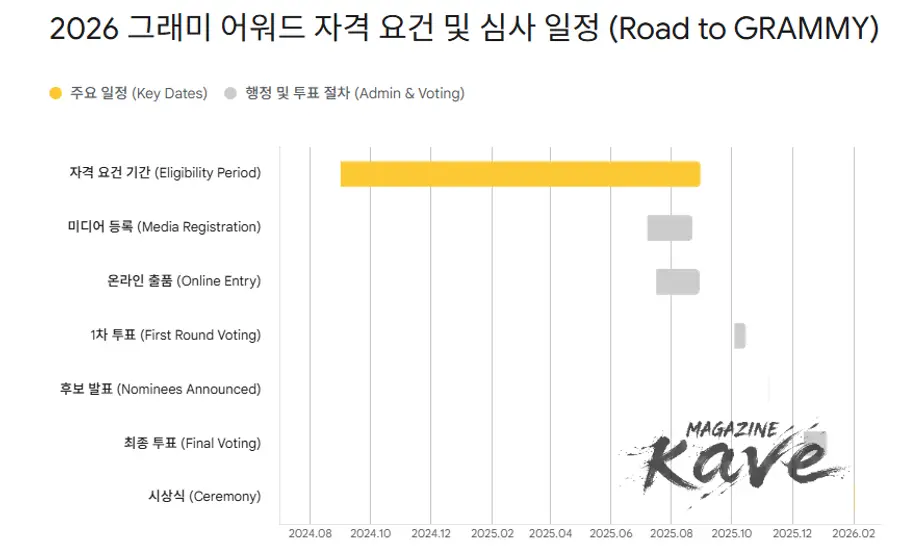
The eligibility period for the 68th Grammy Awards in 2026 is for music released from August 31, 2024, to August 30, 2025. After debuting in June 2024, KATSEYE is one of the new artists that will have the most active and impactful activities during this period with hits like "Touch" and "Gnarly". Analyzing the timeline of the 2026 awards ceremony, KATSEYE's activity cycle is optimized to leave a strong impression on the judges.
Major music media and communities such as Pitchfork and Variety are already mentioning KATSEYE as a candidate for the 2026 Grammy Best New Artist. Competitors include The Marías, Lola Young, and Sombr. While these competitors have strong indie sensibilities and singer-songwriter aspects, KATSEYE relies on overwhelming performance and commercial success.
KATSEYE's Grammy Appeal Points:
Diversity and Inclusivity: The Grammys have emphasized racial and cultural diversity in recent years. The member composition of KATSEYE, which mixes various races such as Asian, Black, Latin, and White, perfectly aligns with the values of 'political correctness (PC)' and diversity that the Grammys pursue. This is a powerful weapon to stimulate the voting body (Recording Academy).
Commercial Viability: Global virality through TikTok and streaming numbers reaching hundreds of millions prove that they are not just a 'planned product' but icons leading the flow of contemporary popular culture.
Industry Support: The lobbying power and promotional capabilities of massive capital from HYBE and Universal Music Group (Geffen) are undeniable factors. In particular, Geffen Records has the know-how that successfully launched Olivia Rodrigo.
Weaknesses to Overcome: On the other hand, there are clear weaknesses. The Grammys have traditionally been very stingy towards boy groups or girl groups, especially 'idol' bands. Additionally, there remains a conservative view on whether the artificial firepower led by K-POP fandom will be recognized as 'true artistic achievement'. While KATSEYE, a pop group, may benefit from the sluggishness of the hip-hop genre, they must also overcome the tendencies of voters who prefer 'authentic artists'.
The case of KATSEYE marks a historical turning point showing that the K-POP industry is transitioning from 'manufacturing (content production)' to 'service (nurturing system provision)'. This means that just as the semiconductor industry has differentiated between design (fabless) and production (foundry), the entertainment industry has also entered an advanced stage where 'IP planning' and 'artist nurturing' are separated or fused and exported.
KATSEYE's challenge for the 2026 Grammy, regardless of its success, is a signal that K-POP has evolved from a peripheral subculture to the 'production grammar' of mainstream pop. If they lift the Grammy trophy, we may no longer need to call them a 'K-POP group'. They would simply be a bona fide 'global pop group' created by the most advanced system in the world, the 'K-System'. This would be the true form of "K-less K-POP" that Bang Si-hyuk envisioned.