
[Magazine Kave = Editor-in-Chief Park Soo-nam] Saturday morning, February 28, 2026. In Minab, a small city in Hormozgan Province in southern Iran, 7-year-old girls were getting ready for math class. That ordinary morning at 10:45—sharpening pencils, opening notebooks, and exchanging good-morning greetings with giggles. The classroom ceiling of Shajareh Tayyebeh Girls’ Elementary School collapsed. It was a Tomahawk cruise missile, believed to have been launched by the U.S. Navy. 168 children died. Fourteen teachers were buried together. Between ages 7 and 12—some of the smallest and most innocent beings in the world—they shut their eyes under ash where pencils had been. Amnesty International concluded that the strike was a “targeting error based on outdated information,” caused by the U.S. military still treating a school that had been separated years earlier as part of a military facility. N.R. Jenzen-Jones, a weapons expert and head of ARES (Arms Research Service), told CNN: “This is probably a failure in the targeting process. Somewhere along the intelligence cycle, the information wasn’t updated—or the wrong target was selected.”
It’s simple, really. Let’s lay out the facts.
On February 28, 2026, the United States and Israel launched a large-scale joint airstrike campaign across Iran under the operation name “Operation Epic Fury.” Supreme Leader Ali Khamenei was killed in the strikes, the nuclear facility at Natanz was destroyed, and Iran’s naval forces of the Islamic Revolutionary Guard Corps were left in ruins. The justifications Trump’s administration put forward were as numerous as a buffet. Removing Iran’s “imminent threat,” stopping nuclear weapons development, destroying missile capabilities, securing oil resources, and—finally—regime change. So many justifications mean, paradoxically, there is not a single clear one. Before the war began, the then Iranian Foreign Minister, Badr al-Busaidi of Oman, was mediating U.S.-Iran nuclear talks. On the day of the airstrikes, he wrote on X (formerly Twitter): “I’m disappointed. Once again, active and serious negotiations have been undermined. I urge the United States: don’t get pulled in any further. This is not your war.” But what did Trump do? He ordered the attack from aboard Air Force One, en route to Corpus Christi, Texas. In the plane, while snacking, he had 168 children sign the documents authorizing the strike that killed them. And he declared “victory” again and again. He even lied: “Iranian forces have been destroyed.”
Let’s look at the scale of the damage. As of April 7, 2026, HRANA (Iran Human Rights Activists) recorded 3,636 deaths from the airstrikes in Iran, of which 1,701 were civilians. An additional 1,800 people in Lebanon, 23 in Iraq, and 11 in the UAE were killed—civilians, all of them. UNICEF said that within 10 days of the war’s start, more than 1,100 children across the entire Middle East had died or been injured. In Iran alone, 200 children died; in Lebanon, 91; in Israel, 4; and in Kuwait, 1. UNICEF described the situation as “catastrophic” for millions of children. At least 20 schools and 10 hospitals were destroyed within Iran.
What was the world’s reaction? Like driving nails into a coffin, international law scholars and world leaders—without exception—said the same thing.
Oona Hathaway, a law professor at Yale, called the U.S. airstrikes on Iran “blatantly illegal.” The Washington Post reported that he “represents a huge portion of the international legal academic community.” Experts from the Office of the High Commissioner for Human Rights (OHCHR) described the war as a “clear violation of international law and an act of aggression,” warning: “The United States and Israel must stop treating themselves as being above international legality while fighting and escalating the war.” U.N. Secretary-General António Guterres urged “an immediate cessation of hostilities and de-escalation of tensions.” President Emmanuel Macron of France warned that the war “opens a Pandora’s box that brings serious consequences.” In a joint statement, the leaders of France, Germany, and the United Kingdom called for “commitment to regional stability” and “the resumption of negotiations.”
Russia’s Ministry of Foreign Affairs described the attack as a “preplanned and unprovoked act of armed aggression.” China’s Xinhua News Agency, alongside a caricature of Uncle Sam, published the phrase “Hegemonism is the only language I know.” Geoffrey Sachs, a professor of economics at Columbia University, appeared on Democracy Now! and called the war “the most blatant and shameless attack on the United Nations Charter and international law since 1945.” He went further: “This is the most blatant fascism we’ve seen since the fascist era of World War II... Two malignant narcissists—Netanyahu and Trump—are leading us to disaster.”
In 1946, the International Military Tribunal at Nuremberg held that “the initiation of a war of aggression is the supreme international crime,” because it “contains in itself the accumulated evil of the whole.” War crimes, crimes against humanity, and all those incidental crimes flow from this fundamental crime—the illegal initiation of war. Trump’s Defense Secretary Pete Hegses declared there are “no such thing as stupid rules of engagement” in this war. Trump himself also said: “The only limit on my global power is my own morality. That’s the one in my head... I don’t need international law.”
Statements as worthless as an orange peel. But in the end, the world doesn’t ask about the thread that moved the hand that threw that peel.
What’s interesting is that even U.S. citizens don’t all agree with this war.
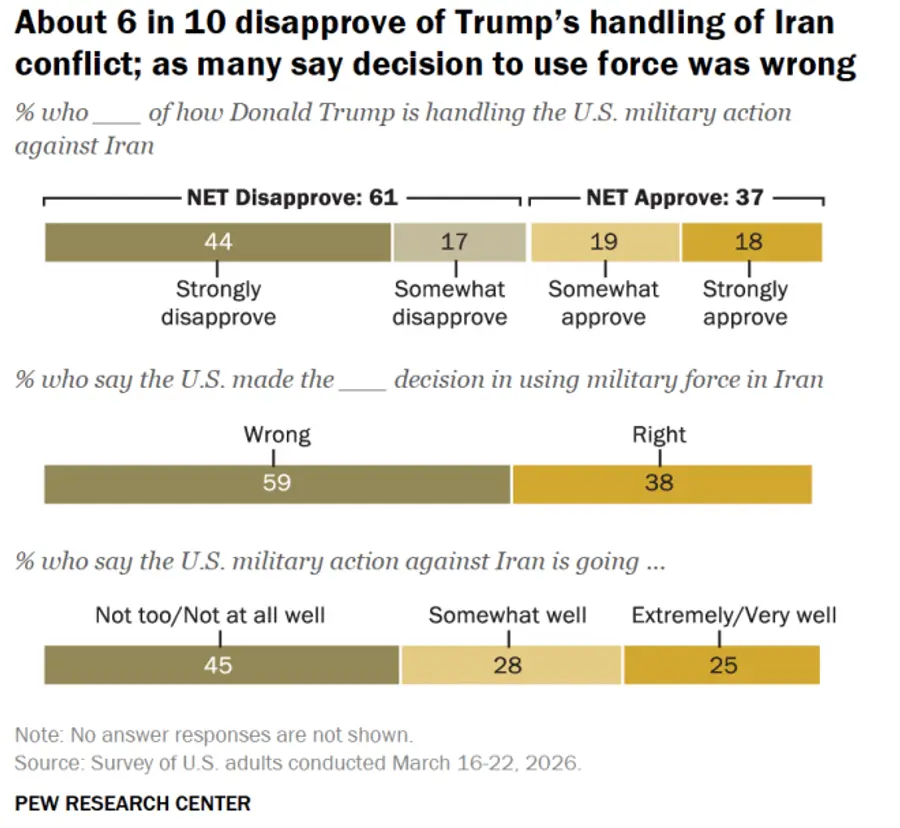
According to a March 25, 2026 survey by the Pew Research Center, 61% of Americans disapproved of Trump’s handling of the Iran war, and 59% said using military force was “a wrong decision.” 40% of Americans believed the war would make the United States “less safe in the long run,” while only 22% said it would make it “more safe.”
Even in a Quinnipiac University poll, 54% of voters opposed the war, and even in Fox News’ own poll, 58% of Americans said they were against it.
However—there’s one number that really makes your stomach turn.
Seventy-five percent of Republican supporters backed the airstrikes on Iran. Among them, 90% of self-identified MAGA (Make America Great Again) supporters supported the war. Non-MAGA Republicans had a support rate of 52%.
Read it again. Ninety percent of MAGA supporters.
This isn’t a problem with a single person called Trump. This is a problem of ideology. Not Trump—rather, the soil that makes Trump possible.
Now we need to step back a bit and ask a question that’s terribly uncomfortable.
Where did Trump come from?
Most media criticize Trump. Social media mocks him, and political commentators analyze his ignorance and narcissism. But like a deer running dangerously down the road, these analyses miss the point. Trump is not the cause; he is the result. Trump is not the arrow; he’s just the flint that pops from the bowstring.
The name of that bowstring is “America First.”
According to analysis by the Council on Foreign Relations (CFR), Trump’s “America First” foreign policy appears, on the surface, to endorse neo-isolationism, but in reality it is a hegemony project wearing the mask of neo-imperialism. Trump declared he would annex Canada, demanded ownership of Greenland, and threatened to control the Panama Canal. He used military force in Venezuela, Iran, Iraq, Nigeria, Somalia, Syria, Yemen, and the Caribbean region.
Is this isolationism? Put a world map in front of a kindergartner and even they would say, “No.”
The academic paper “America First, Humanity Second” in E-International Relations analyzes this phenomenon more sharply. It defines Trump’s America First as a direct descendant of 19th-century “Manifest Destiny”—the expansionist ideology that the United States was granted a sacred mission to dominate the entire North American continent. The paper argues: “This is the imperialism unique to Trump and MAGA, an extension of the tradition of expansionism that has continued since the era of ‘Manifest Destiny.’” The core argument is this: “If America is always the ‘first,’ then the rest of humanity automatically becomes the ‘second.’” America First is not a mere political slogan. It is an ontological declaration that demotes 95.8% of the world’s population to “lesser beings.”
If you trace America First further down to its roots, you reach a foundation of stone called “American Exceptionalism.” James W. Ceaser’s 2012 paper, “The Origins and Character of American Exceptionalism”, analyzes how this idea has existed since the founding of the United States as a “fated mission,” and notes that “when there is usable power, that mission is often expressed in imperialistic or unilateral forms.”
The 2009 paper by Nayak and Malone, “American Orientalism and American Exceptionalism” (published in International Studies Review), argues that American exceptionalism forms the basis of American identity, foreign policy, and hegemony. And, on the premise that ordinary people in the Middle East want what Americans want, it justifies an “elimination of the enemy and an aggressive militaristic approach.”
Noam Chomsky put it bluntly: “Exceptionalism is a concept held by every great power, and it’s always wrong.” He pointed out that under the illusion that American intervention abroad is altruistic, it actually “benefits only the most powerful Americans.”
Geoffrey Sachs, a professor of economics at Columbia University, systematically analyzes in his book “A New Foreign Policy: Beyond American Exceptionalism” (2018) how American militarism and exceptionalism have distorted Middle East policy, describing a pattern that has resulted in “hundreds of thousands of Iraqi civilian casualties, thousands of American casualties, and costs in the trillions of dollars.”
If you map out the genealogy of American exceptionalism, it goes like this:
Manifest Destiny (1840s) → the revival of the Monroe Doctrine (1823) → exceptionalist foreign policy → MAGA/America First → the invasion of Iran (2026)
This isn’t the madness of one person. It’s the fermentation product of an ideology that has matured over 200 years.
Here, I’ll make my central claim. It’s academic, and I’m sorry for that—but I’ll dress it up in flowery language so smart readers won’t feel offended, and ask one question.
If Trump disappears, does the problem get solved?
The answer is tragically simple. No.
As Fox News polling shows, 90% of MAGA supporters back this war. Seventy-seven percent of Republicans support military action, and 79% believe this war will “make the world safer.”
What these numbers mean is clear. Trump didn’t create this fervor; he simply rode on it. It’s not the surfboard that creates the waves. It’s the waves that lift the surfboard.
An analysis by the Foundation for American International Policy (FPIF) pinpoints this precisely: even though Congress couldn’t secure votes to pass a War Powers Resolution to prevent the war—despite not even consulting the president before the war began—both parties, under different presidents, “allowed the initiation and continuation of large-scale military force without even pretending to claim the authority to declare war.”
This isn’t only Trump’s problem. The 2003 invasion of Iraq wasn’t just a Bush problem. The 1953 coup in Iran (the overthrow of Mossadegh) wasn’t just an individual Eisenhower problem. The Vietnam War wasn’t just a problem of Johnson or Nixon as individuals.
UN human rights experts said this: “Decades of coups, military interventions, and interference through unilateral sanctions by the United States across Iran and the entire Middle East have caused chaos in this region, and that must end.”
They said decades. Trump’s term is only a fraction of those decades.
The paper “Whither the ‘City Upon a Hill’? Donald Trump, America First, and American Exceptionalism”, published in the Texas National Security Review, argues that to understand Trump’s America First, we must analyze the master narrative beneath it—American exceptionalism. Trump isn’t a new version of exceptionalism; exceptionalism has finally been revealed in its stripped-down form.
Let’s return to Minab again.
On March 3, 2026, thousands of Iranians gathered in the streets and buried the children’s bodies. Row after row of small coffins wrapped in white cloth stretched on endlessly. In Tokyo, Japan, the Iranian group “My Iran” held a “memorial service for 168 children killed in the bombing of Minab Elementary School in Iran.” Iranian residents in Japan and Japanese citizens gathered and lit candles. Amnesty International analyzed that the weapons used in the attack were highly likely U.S.-made Tomahawk missiles. The school had been physically separated from an IRGC base years earlier, and even had separate entrances built. Satellite photos from December 2025 captured the children playing ball in the playground. Yet the U.S. military recognized the school as part of a military facility and attacked it.
U.N. High Commissioner for Human Rights Volker Türk said the airstrikes raised “serious concerns” about whether they complied with international humanitarian law. U.N. spokesperson Ravina Shamdasani said: “This attack must not become another horrific incident that disappears from headlines and no longer becomes a priority. There must be accountability.”
The American Friends Service Committee (AFSC) of the U.S. calculated the cost of this war: about $65 billion in total war costs, $220 million per day. That amount is enough to pay one year’s salary to 3,300 teachers every single day. The 168 children in Minab could have received a lifetime of education for a sum equal to only a few percent of what the U.S. spends on war every day.
The world’s media and citizens criticize Trump. Of course they should. He is the commander-in-chief who ordered the war, and he bears direct responsibility for the deaths of 168 children.
But if we place Trump only at the very tip of the cone, we’ll miss the cone’s base—the massive foundation that supports him.
Geoffrey Sachs warned: “The United States still has an imperial mindset, and that is preventing adaptation to the new reality.” He analyzed that the Iran war has dismantled America’s alliance system, emphasizing that the roots of this war lie not in an individual but in structural imperialism. Monthly Review’s analysis, “The Trump Doctrine and the New MAGA Imperialism”, is even more direct: “Trump’s nation-imperialist strategy aligns perfectly with the reactionary worldview of his MAGA followers. They are not opposed to imperialism and militarism.”
Read this sentence again. MAGA followers are not opposed to imperialism. They want imperialism. They just want that imperialism to be “for America.” This is the identity of America First—the democratization of imperialism. The most cunning form of hegemony ideology in human history: when ordinary people wave the empire’s flag themselves.
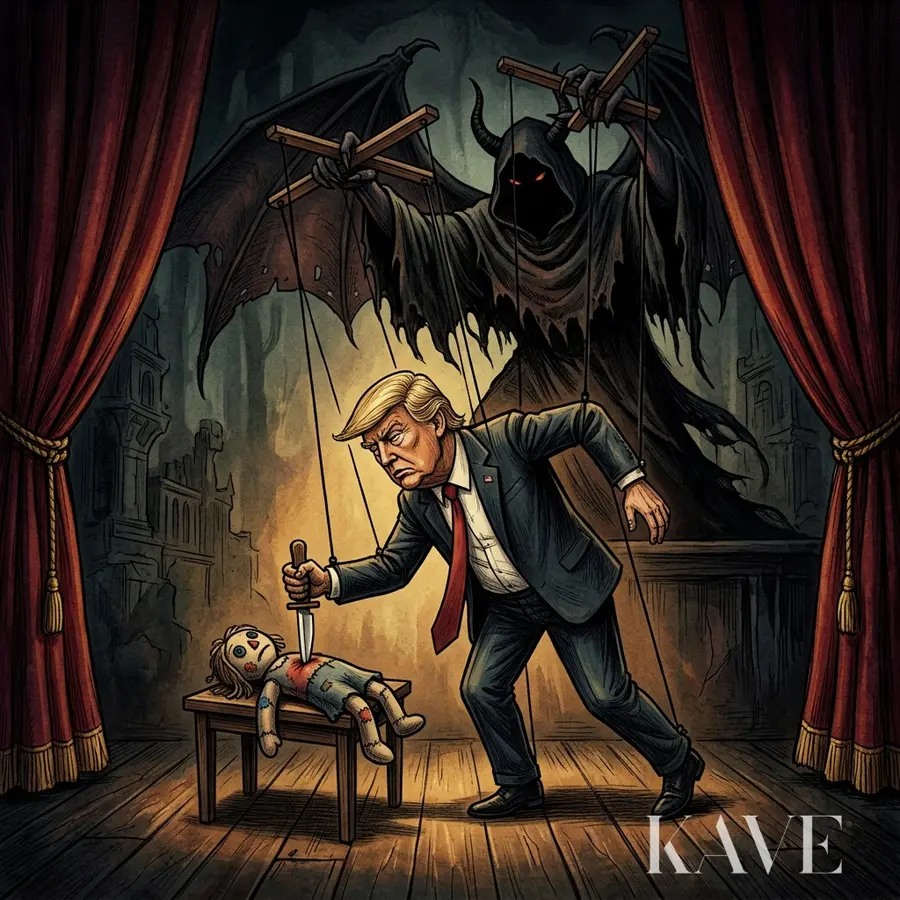
As long as America First lives on, even if Trump is impeached, even if he goes to prison, even if he’s thrown into history’s trash bin, another Trump will emerge. A third Trump will emerge. A puppet with only a different name, hanging on the same line, dancing the same dance.
It was Bush who invaded Iraq in 2003. It was Trump who invaded Iran in 2026. With a 23-year gap, another-named president did the same thing under the same ideology. The justifications differ, but the structure is identical. What changed was that weapons of mass destruction (WMD) were renamed an “imminent threat,” but the script remains the same.
E-International Relations compares the fate of America First to America’s Prohibition era. Prohibition gained massive momentum for a certain period in American society, but ultimately collapsed due to its own contradictions. The author writes: “All those for whom the rest of humanity—meaning everyone automatically relegated to a second-tier priority by ‘America First’—will have to wait until the Trump and Trumpism’s Prohibition-momentum runs out.”
Wait until when? While waiting, who resurrects the children of Minab?
FPIF’s analysis concludes: “The lack of will in Congress and the UN—and the weakening of enforcement capacity—did not prevent the United States and Israel from starting a destructive new war. Their lack of enforcement capacity means that social movements and civil society—inside the United States and across the world—must step up and require their own governments to actually follow the law. Without these popular movements, there is no one to hold the powerful accountable.”
What the world should pay attention to is not Trump’s Twitter account. What the world must crush is not Trump’s political life.
America First is the ideology itself.
This isn’t a problem of domestic affairs in one country. The moment 168 children died, it became a problem for all of humanity. The moment Article 2, Paragraph 4 of the U.N. Charter became a line of printed text, it became a matter of the survival of the international order.
It’s easy to blame Trump. Mock his narcissism, turn his gaffes into memes, and wait for his exit—those are the most comfortable forms of criticism in the world.
But it’s like smashing a puppet doll’s nose on a theater stage. The audience will laugh, but at the next performance, the same doll—or a doll with a different name—will recite the same lines. As long as the hand holding the strings doesn’t change.
American exceptionalism is a virus that’s 200 years old, and America First is the 2020s mutation of that virus. This mutation killed the children of Minab, burned the Strait of Hormuz, and turned international law into scraps of paper.
To borrow Noam Chomsky’s words: “Exceptionalism is a concept held by every great power, and it’s always wrong.” The United States is not an exception either. There’s no exception to the exception of “exceptionalism.”
To borrow Geoffrey Sachs’s words: “This is the most blatant fascism since 1945.”
And the fuel for this fascism isn’t Trump’s brain. It’s the primal certainty of tens of millions of citizens who voluntarily spread it—wearing MAGA hats and shouting “USA! USA!”—the belief that “we’re the best.”
The children of Minab were holding pencils. The United States flew the Tomahawks.
As long as we only look at the hand that threw those Tomahawks, that same hand—under a different name, at different children—will throw Tomahawks again.
We must cut the string. Not the puppet.
America First is the string.
References
Pew Research Center, “Americans Broadly Disapprove of U.S. Military Action in Iran” (2026.3.25)
UNICEF, “Child casualties rise amidst deepening Middle East conflict” (2026.3.11)
Amnesty International via ReliefWeb, “Those Responsible for Deadly and Unlawful US Strike on School” (2026.3.16)
OHCHR, “UN experts denounce aggression on Iran and Lebanon” (2026.3)
CNN, “Iran school strike: Analysis suggests US was responsible” (2026.3.6)
Jeffrey Sachs, Democracy Now! interview (2026.3.13)
FPIF, “The U.S.-Israeli War on Iran Is Illegal” (2026)
E-International Relations, “America First, Humanity Second” (2025.11)
CFR, “Trump’s ‘America First’ Rhetoric Masks a Neo-Imperialist Streak” (2026)
Restad, H.E., “Whither the ‘City Upon a Hill’?” Texas National Security Review (2019)
Nayak & Malone, “American Orientalism and American Exceptionalism” International Studies Review (2009)
Ceaser, J.W., “The Origins and Character of American Exceptionalism” American Political Thought (2012)
Noam Chomsky, via Truthdig, “Exceptionalism Is Always Wrong”
Washington Post, “After Iran, international law no longer fits reality” (2026.3.5)