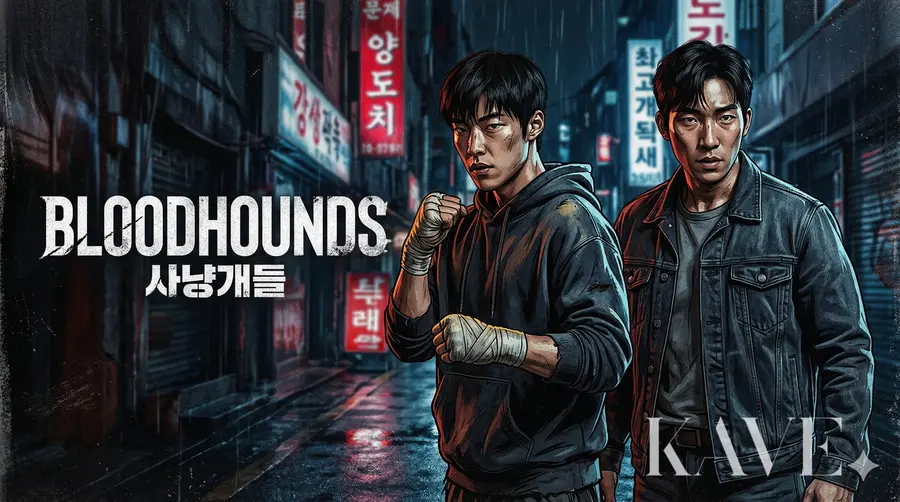
[Magazine Kave=Park Sunam, Reporter] On April 3, 2026, a sharp burst of static crackled across the world’s Netflix screens once again. There are no dazzling superpowers or cutting-edge weapons—just two young fighters with wrapped fists, throwing punches like they crawled straight out of real life’s sweat. Still, viewers everywhere were thrilled all over again by this analog-style brawling. Netflix Original series ‘Bloodhounds’ Season 2 debuted at No. 2 on the Netflix Global TV Shows chart (FlixPatrol 기준) on day one after release, and after just three days it surpassed 5 million views to land in the global Top 10 across 67 countries. Even Rotten Tomatoes’ Audience Score came in strong at 81%, signaling a successful return on both the commercial and critical fronts.
However, that alone can’t fully explain the force of this work with a line like “the action is satisfying.” ‘Bloodhounds’ is, in itself, a massive contradiction—an epic narrative coiled tightly around another. Inside the camera’s frame, it lays bare the violence of capitalism growing out of the COVID-19 pandemic disaster; by the time we reach Season 2, it detonates a bloody war on digital crimes symbolized by the Dark Web and Bitcoin. But the reality outside the camera was even harsher. The lead actor’s exit during Season 1 filming, large-scale script revisions, and the tragic death of a young actress cast an unforgettable shadow over the entire series.
This feature goes beyond the simple reviews covered by existing outlets and instead dissects ‘Bloodhounds’ through sociological, psychological, and global pop-culture lenses. Why did global fans become captivated by Korea’s fist-fighting—and “Marine bromance”—instead of Western gun-fueled action? What philosophical clash lies behind the director’s intended “analog vs. digital”? From the essence of the sociopathic villain created by Jung Ji-hoon (Rain/Bi) to how the tragedy of brutal reality reverberates through the story, we unravel the huge, mesmerizing storyline surrounding ‘Bloodhounds.’
1. The Age of Contagion, Everyday Life on the Edge: The Analog Debt Trap (Season 1’s Legacy)
To understand the massive success of Season 2, you first have to trace it back to the soil of Season 1, where the seeds of this brutal tale were planted. ‘Bloodhounds’ is rooted in a highly specific, realistic time and space: Seoul, South Korea in 2020, where the COVID-19 pandemic tightened its grip on the entire world.
Tears of Small Business Owners and Smiles of Loan Sharks
Director Jason Kim, who helmed ‘Midnight Runners’ and ‘The Divine Fury,’ adapted the similarly titled Naver webtoon into a drama and placed the era’s disaster—pandemic hardship—front and center. In a media interview, Jason Kim revealed, “As a creator living in the same era, I wanted to capture the pain of the pandemic. Everyone was affected by the contagion, and someone out there suffered deep anguish. I wanted to connect their pain and the process of overcoming it with viewers around the world.”
In the drama, boxing prospect Kim Geon-woo (Woo Do-hwan) is a diligent young man. But once sports competitions are canceled due to the pandemic, his dreams are put on hold. Meanwhile, the small café run by his mother Yoon So-yeon (Yoon Yoo-sun) is pushed toward bankruptcy due to business restrictions. In times like this, the ones who laugh the widest are the vicious loan sharks like Kim Myung-gil (Park Seong-woong), who feed on the despair of the weak.
Small business owners who can’t cross the threshold of the bank have to reach for any straw they can, and they look to loan sharks. Kim Myung-gil’s crew then reduces them to slaves with deceptive contracts written in tiny print that are hard even to see through a magnifying glass. As his mother sinks deeper into debt, Geon-woo is forced into a fate where he has to face the loan sharks’ blades—not inside a boxing ring, but on the ruthless asphalt streets.
Crime in this era is extremely “analog.” It’s manipulated paper contracts, stacks of black money, and thugs in back alleys wielding steel pipes and weapons. The instinctive battle structure—fist versus weapon, good individuals versus ruthless, massive capital—sparked a visceral sense of catharsis in viewers worldwide who are living through economic inequality that knows no borders.
2. The Evolution of Capital, a Digital Colosseum: Blood and Bitcoin Combined (Season 2’s World)
In Season 1, it was Geon-woo and Woo-jin (Lee Sang-yi) who brought down Smile Capital and snapped the analog debt chain. But in 2026, three years later, the shape of crime has evolved far faster—and far more cunningly—than the pace of the protagonists’ growth.
The Arrival of the Dark Web and the Iron Knuckle Fighting Championship (IKFC)
In Season 2, director Jason Kim expanded the battlefield into the underworld’s “global fighting league” to maximize the theme of “the conflict between money and humanity.” This world, ruled by the new main villain Im Baek-jeong (Jung Ji-hoon), isn’t just a den of brute physical enforcers. Im Baek-jeong runs the Iron Knuckle Fighting Championship (IKFC) on the Dark Web—an event watched by millions of anonymous users worldwide.
At this point, the paradigm of crime fully shifts from analog to digital. Viewers hide behind their monitors and place massive illegal bets with Bitcoin (Bitcoin). The blood-soaked slaughter taking place on the ring is nothing more than digital content designed to attract traffic and siphon up cryptocurrencies.
Axes of the World | Season 1 (2023): The COVID-19 Pandemic Era | Season 2 (2026): The Global Underground Economy Era |
Forms of Hostile Capital | Illegal loans and usury (Smile Capital) | Global illegal gambling, live Dark Web broadcasts (IKFC) |
Means of Violence | Forged contracts, physical cash, weapons | Bitcoin (cryptocurrency), cyber betting |
Traits of the Main Villain | Kim Myung-gil: A ruthless predator ruling the back alleys | Im Baek-jeong: A sociopath who consumes violence as entertainment for capital |
Protagonists’ Motivations | Reclaiming lost everyday life (settling the mother’s debts) | Surviving on a forced ring—and protecting the ones they love |
Scale of the Threat | Collapse of commercial districts in downtown Seoul | Transnational crime networks via the Dark Web |
Director Jason Kim explained, “If Season 1 was the story of boxers fighting loan sharks in a pandemic situation, Season 2 digs even deeper into the conflict between money and human nature. Global boxing was the perfect vehicle to explore this theme.” As Geon-woo grows into a champion and wins public popularity, Im Baek-jeong sees him as an attractive “product.” Im Baek-jeong offers astronomical sums to lure Geon-woo onto the Dark Web ring, but when Geon-woo refuses, the pressure escalates into terrifying threats and abductions.
In this digital Colosseum, human dignity is converted—completely—into data and cryptocurrency. The madness of faceless crowds hiding behind screens and enjoying betting, and Im Baek-jeong—now living proof of money itself—stitch together the inhumanity of massive digital capitalism with sharp precision.
3. Once a Marine, Always a Marine: K-Bromance and the Symbolism of Home-Cooked Meals
What most differentiates ‘Bloodhounds’ from a lonely John Wick-style revenge tale or Hollywood’s macho action is the deep, unbreakable “bromance” between the two leads—Geon-woo and Woo-jin. Time magazine described the appeal as “a brotherhood that is sometimes comically ridiculous yet always warms your heart injected into a brutal crime drama.”
The K-Marine Spirit: An Icon of Devotion and Bond
Their bromance is tied to more than just friends who click—it’s bound by a uniquely cultural symbol. The setup is that both men are Marines of the Republic of Korea (Korean Marine Corps) by background. In the boxing rookie-of-the-year finals, they meet as opponents and clash fiercely in and out. And after the match ends, at the meal where they exchange confirmation of each other’s Marine corps platoon insignia, they instantly transform into eternal brothers.
While Western military culture often emphasizes individualism and professional rigor strictly centered on performance, the K-Marine spirit depicted in the drama is portrayed as absolute unity—“we share the same bloodline”—and selfless sacrifice. Global fans on Reddit became deeply captivated by this distinctive “senior-junior” culture and the blind loyalty that refuses to abandon each other even at the threshold of death. One critic praised their relationship as “a timeless combination of Ryu and Ken,” calling it extraordinary.
In Season 2, this bromance sinks even deeper into the story’s center. Woo-jin, wounded in the fierce battles of the previous installment and whose life as a pro boxer is over, chooses to step back behind Geon-woo in Season 2 and take on the role of coach—actively nurturing him into a champion. Rather than feeling jealous of his younger brother getting the spotlight, Woo-jin dedicates himself to helping his success like it’s his own, and that devotion is deeply moving. Lee Sang-yi, who plays Woo-jin, said, “Compared to Season 1, you’ll be able to see a Woo-jin who is much more mature and reliable. He fights desperately to protect Geon-woo.” Woo Do-hwan added, “We joke that our feelings for each other have reached the level of a ‘bromance melodrama.’ Because we’ve both experienced the pain of losing someone precious, we want to protect each other so that nobody gets hurt—no matter what.”
The Anchor of a Brutal World: “Home-Cooked Meals from Mother”
In the blood-red web of violence, the powerful symbol that keeps the two young men’s humanity intact is the “home-cooked meals” prepared by Geon-woo’s mother, Yoon So-yeon (Yoon Yoo-sun). If the world’s coldness had left them alone, the two could have lived peacefully—punching a sandbag during the day and sharing their mother’s warm stew and rice at night.
For them, revenge or fighting isn’t about implementing grand justice. It’s a desperate defensive battle to protect an ordinary everyday thing: “the mother’s table.” In Season 2, when Im Baek-jeong attempts the kidnapping of Geon-woo’s mother Yoon So-yeon to threaten Geon-woo, the reason Geon-woo’s eyes suddenly change is simple: their sanctuary is being invaded. A profoundly analog, primal expression of affection—just one warm meal his mother makes—forms a perfect contrast against the crime world steeped in money and greed, strongly persuading viewers of violence’s “reason.”
4. The Mad Dog’s Descent: The Psychology of the Sociopath Created by Jung Ji-hoon (Rain)
The decisive factor that allowed Season 2 to maintain the tension even greater than the previous installment was the arrival of a new antagonist with overwhelming weight. Jung Ji-hoon (Rain), who took on his first villain role in his 28-year career as a singer and actor, achieved a feat of shattering existing clichés through the character “Im Baek-jeong.”
The Birth of Absolute Evil Without a Backstory
In most dramas or movies, villains either have a past story (backstory) explaining why they fell—or gradually reveal madness as the plot unfolds. But director Jason Kim gave Jung Ji-hoon the opposite instruction.
“You didn’t want him to become some obvious villain. Without any roller-coaster tone changes—like pretending to be good at first and then suddenly turning evil—you asked that he stay in an extremely angry state from the moment he first appears. Im Baek-jeong is like a rabid dog who’s been hungry for 10 days, drooling toward his prey (money). We wanted audiences to feel fear every time he shows up: ‘Is he going to kill someone again?’”
To perfectly embody a sociopath with narcissism and poor anger control, Jung Ji-hoon pushed both his body and mind to the limit. For the boxing genius character, equipped with an enormous frame and overwhelming speed, he dedicated six hours a day to weight training and boxing practice. “Boxing is a workout that uses your core and your hips. Even if your stance is slightly off, viewers who know boxing will instantly say, ‘What is that?’ and laugh. I poured my past year fully into this work because I had to do both acting and boxing at the same time,” he said with a grin.
Rage That Invades Everyday Life—and Criticism From His Wife, Kim Tae-hee
Jung Ji-hoon’s acting immersion didn’t easily fade even after the cameras were off. At the press conference and during interviews, he admitted it took a long time to fully come out of character. “Even when I wasn’t acting, I could feel the fire and heat inside me rising. I even got scolded by my wife (actress Kim Tae-hee). It wasn’t that my tone got rougher—it was the look in my eyes that would show up suddenly in daily life. She said, ‘Why is your look like that all the time?’” he said, laughing as he shared the behind-the-scenes story of how completely he had become one with the character.
The man who was synonymous with perfect physique management also showed signs of exhaustion from the extreme self-discipline demanded by this role. “Isn’t it hard to live like all you ever do is work out? I want to stop too, now. If there’s a good project later, I’ll do action again—but roles that obsess only over your body have limits. Next time, I want to try playing a killer in a running shirt in a 100kg American movie where my belly sticks out,” he said, offering a witty reflection. Even so, the “blood-chilling dominance” he exhales in the drama acted as the core engine that pushes Geon-woo and Woo-jin into despair’s pit—exploding the tension across the entire series.
5. Realism That Tears the Skin: The Art of Action Without Compromise
Another true protagonist of ‘Bloodhounds’ is, simply, the action itself. In Hollywood, where guns are common, why does Korean bare-fist action receive such attention? Because it isn’t rooted in superhuman martial arts from fantasy stories—it’s grounded in real street fighting, where sweat and pain are always part of the deal.
Martial Arts Director Heo Myung-haeng and the Art of Rhythm
Martial arts director Heo Myung-haeng, who took the global No. 1 title with the movie ‘Badland Hunters’ and held the megaphone for ‘The Roundup: Punishment,’ which drew ten million viewers, stands at the very top of Korean action direction. He designed the lethal action choreography that runs through Season 1 and 2 of ‘Bloodhounds.’
Director Heo Myung-haeng’s directing philosophy comes from flexibility. “I don’t like dominating the set like a dictator. If there is charisma, actors need room to breathe. My team members like working in that way, and you can’t make a great work in a suppressive environment,” he said. Thanks to this open-set atmosphere, Woo Do-hwan, Lee Sang-yi, and Jung Ji-hoon tapped into instinctive teamwork—like real boxers on an actual ring—pulling out the vivid energy of the action.
Director Jason Kim also stressed that in creating fast-paced action, impact (powerful hits) is the most important. “The action in this series is five times more intense than the previous work ‘Midnight Runners,’” he said confidently.
The Fine Line Between Real Boxing and Cinematic Overstatement
Boxing fans in overseas Reddit communities praised the action sequences of ‘Bloodhounds’ and compared them to famous Western boxing films. One user mentioned Hollywood’s 〈Creed〉 series and said, “In real boxing matches, the jab is essential—but in movies, all you trade are flashy hooks. Real fights are too fast and too monotonous to be captured naturally by film.” He pointed out the limits of cinematic exaggeration.
On the other hand, ‘Bloodhounds’ overcame this dilemma by setting the fights as “street brawls.” There are no rules in a narrow corridor, a deserted building, or on the road where the fight happens—nothing like a ring. The protagonists can’t dodge every attack like heroes. They collide with blade-wielding thugs, get hit in the face countless times, bleed, and limp after hurting their legs. This stubborn directing choice—portraying the protagonists as human beings who hurt just as badly when they get hit, rather than as superhuman—became the driving force that makes viewers hold their breath and fully immerse themselves in each and every action scene.
To achieve this, Woo Do-hwan cooked four meals a day himself and bulked up by 10 kilograms through intense training before and after filming. Lee Sang-yi, who plays the southpaw boxer, endured a brutal diet limited to brown rice, chicken breast, sriracha sauce, and zero-sugar carbonated drinks, recalling, “I’ve never worked this hard at the gym in my life. I felt like I had truly become an athlete.” Their sweat, delivered faithfully beyond the screen, never lied.
6. Reality’s Tragedy Tears the Script Apart: The Kim Sae-ron Case and the Collapse Behind the Story
Behind the perfect narrative that we’re thrilled by on screen lies the cruel tragedy of real life—one that drove the creators to despair and ultimately even took an entertainer’s life. The chain of aftershocks surrounding Kim Sae-ron (playing Cha Hye-joo), who was a lead in Season 1, is an unbearably painful chapter that cannot be left out when analyzing ‘Bloodhounds’ in depth.
A Nightmare of Full-Scale Script Overhauls
In May 2022, with Season 1’s filming racing toward its later stages, lead actress Kim Sae-ron caused a major incident in Gangnam, Seoul: while driving under the influence after getting drunk, she crashed into a transformer and cut electricity to the surrounding business district. In the drama, Cha Hye-joo was a key character who formed a trio with Geon-woo and Woo-jin and was supposed to carry the storyline in the latter half.
Director Jason Kim was trapped in a deep dilemma. The set had already been dismantled, making it impossible—budget- and time-wise—to delete her entire portion and reshoot from the beginning. In the end, the production team chose a severe remedy: they carved out as much as possible from the first six episodes in which she appears, and they had to completely rewrite the scripts for episodes seven and eight within a single month.
“I started with a big dream of making a K-action drama that represents Korea. But after the incident, we had to recreate episodes seven and eight like a completely new narrative structure—like a whole new movie. Editing the script, aligning with the actors in between, and continuing filming was an agonizing time for me, for the actors, and for everyone on the entire staff.”
This heartbreaking patchwork left clear scars on the work. Overseas viewers sharply spotted the collapse in plausibility in the latter half. Users on MyDramaList and Reddit criticized it: “The setup where the core character (Hye-joo) who was burning with revenge mentions a retirement plan and suddenly leaves overseas—before even wiping out his organization—completely contradicts the character’s essence and makes no sense.” They also pointed to another side effect: from the late portion of Season 1 all the way to Season 2, supporting characters belonging to one group were magically depicted as having changed personalities into blind moral saints—an outcome they said was a fatal side effect of the rushed script revisions.
A Witch Hunt That Ended in Death, “Cultural Execution”
After the accident, the reality outside the drama unfolded even more brutally. Under the heavy blanket of public condemnation and media barrage, her self-reflection could never remain quiet. Every detail of her private life was dissected and ridiculed in real time by cyber vigilantes and comment-farmers—from controversies over false explanations about café part-time work, to doubts about the sincerity of financial hardship after being appointed by a major law firm, to eyewitness claims that she was seen entering a Gangnam hold’em pub.
Ultimately, on February 16, 2025, Kim Sae-ron was found dead at her home in Seongdong-gu, Seoul at the age of 24. It was a lonely and tragic ending for a child prodigy who had been elevated to the status of the nation’s “younger sister” after the film ‘Ajumma’ (2010) at age 9.
Overseas media and critics labeled the incident not as a simple scandal but as a “cultural execution.” One critic said, “The internet didn’t even give her a chance to make up for her mistake. She was silenced, mocked, and erased. This shows the brutality of the Korean entertainment system—and cyber violence—that sacrificed so many stars like Sulli and Goo Hara.”
On February 19, 2025, the funeral held at Asan Medical Center in Seoul was attended by fellow entertainers including Won Bin, who had been her partner in ‘Ajumma,’ as well as Han So-hee, Lee Chan-hyuk of AKMU, Lee Soo-hyun, Park Woo-jin of AB6IX, and Kim Bo-ra, among others, who shared their grief. Kwonyongchan, a professor from a well-known celebrity suicide prevention organization, reportedly said at the funeral that Kim Sae-ron’s father testified: “Careless YouTube videos digging into her privacy pushed my daughter into extreme suffering.”
Only after her death did the public and the media finally begin late self-reflection. Fans expressed sorrow in statements: “She tried to acknowledge her past mistakes, reflect, and rebuild her life—but the intensity of the backlash and the cold standards went beyond the limits a human being can endure.” Singer Migyo also voiced anger on Instagram: “Hateful commenters stop only after the person dies. They don’t even realize they’re spreading hatred.” Director Shin Jae-ho of the film ‘Guitar Man,’ which became her final work, also paid a belated tribute, saying, “She was so bright and full of energy, and her acting skills were still excellent.”
Before Season 2 of ‘Bloodhounds’ was released, fans hoped the production might include an opening or ending credit message commemorating her—or at least a flashback scene—yet nothing of the sort was ever included. This bitter paradox, where a drama exposing merciless violence—loan sharks and the Dark Web—ironically lost its lead actress due to the brutality of cyber violence in reality, has remained as a painful scar that expands ‘Bloodhounds’’ world into the real world as a text.
7. The Global Fandom Under a Microscope: A Razor-Thin Line Between Frenzy and Criticism
Despite Season 2’s dazzling box-office performance, the eyes of global core fandom remained sharp and exacting. They cheered for satisfying action while, at the same time, attacking narrative gaps and plausibility holes with ruthless precision.
Reddit’s drama discussion board transformed into a battlefield right after the release of Season 2. The biggest point of attack was the baffling “incompetence” of the righteous characters. One user said, “The ‘kind’ characters have no chemistry, no strategy, and no common sense. Scenes where they only cry instead of moving their mother (Yoon So-yeon) into hiding earlier, or how a police officer who’s a cyber hacker calls the hotel front desk on a normal phone to confirm the location and gets caught—those are completely amateur mistakes,” sharply criticizing the lack of tight plotting.
They also said that many Western viewers who couldn’t perfectly grasp Korea’s public safety reality—where guns aren’t allowed—found it outrageous: “The police survived after being stabbed 400 times with knives last season, and in this season they die after being stabbed 500 times. The sight of a police officer facing armed thugs and not using a gun at all is perfect comedy.” There was also no small fatigue with the flat depiction of the chaebol third-generation heir Hong Min-beom, played by Choi Si-won, and of people from Iil group.
Even so, the reason fans couldn’t let go of the screen until the end is due to the late-series sequences where the “heart” of the two protagonists—strong enough to cover the story’s weaknesses—and the villain’s “rage for survival” collide head-on. In episode 6, it seems Baek-jeong’s right-hand man Yoon Tae-gum (Hwang Chan-seong) betrays him and has Baek-jeong arrested. But the huge-scale operation—mercenaries recruited through Dark Web chat rooms ambushing the police transport car—delivers an extreme level of immersion. Amid this chaos, the brutal killing of the police and Tae-gum amplified viewers’ sense of desperation at confronting absolute evil—along with a craving for catharsis.
8. The Shock of the Cookie Video and the Massive Expansion of the World: Park Seo-joon and the Setup for Season 3
After every fight ends and the ring falls silent, the thing that sent viewers into an excitement frenzy was the “post-credits scene(s)” cleverly arranged around the late episode and either before or after the ending credits. These few minutes openly hinted that the world of ‘Bloodhounds’ would expand far beyond a neighborhood loan shark or an illegal gambling den—into the sphere of national power and intelligence.
The most shocking card was the surprise appearance of global Netflix star Park Seo-joon. Known worldwide for ‘Gyeongseong Creature,’ ‘Itaewon Class,’ and the Marvel Cinematic Universe’s ‘The Marvels,’ he happily accepted the cameo invitation thanks to a connection from director Jason Kim’s previous work ‘Midnight Runners.’
In the drama, Park Seo-joon plays a shadow black-ops agent, “a latest model,” who receives secret instructions from the head of the National Intelligence Service (NIS), Director Choi Kwang-il. He forms a black trio with special hacker Han Seul-ki (Lee Seol) and Dex, and together they hunt down the true mastermind behind the crimes. The latest-model agent designs operations to sneak Im Baek-jeong away from imminent capture—or, conversely, to lure him in. From working behind the scenes in tight plans to ordering Hong Min-beom (Choi Si-won) to lay Geon-woo and Im Baek-jeong’s death-match cards, the operation runs deep in every detail.
The director said, “These are unique characters who must prove their presence using only the charisma and aura that the actor themselves naturally brings—without any specific background explanation.” Western media ScreenRant and fan forums immediately flooded with enthusiastic analysis. “What is the identity of the final morgue scene?” “Is Im Baek-jeong, whom we thought was dead, actually alive for Season 3?” “Is Park Seo-joon (latest model) the true final villain of Season 3—or a new ally helping fight something even greater?”
When asked about this, Jung Ji-hoon said, “I don’t know why people are talking about Season 3, but if it’s planned, I’m willing to bulk up again. Wouldn’t it be fun if I came out as a retired boxer instead of using knives or guns to fight?” leaving a subtle opening that lit a fuse in fans’ expectations. As the story revived even the mercenary fighter Yoo Deu-young (Ryu Su-young), who we thought was dead after Season 1, quitting his secluded life and joining Geon-woo as a dependable comrade, it proved that in this ruthless world that even tricks death, anyone can step back onto the ring again.
9. Conclusion: The Questions Left Behind by Blood-Stained Bandages
‘Bloodhounds’ is the text that most perfectly shows the unique and universal value of Korean content in the global streaming market. It contains gritty but truthful sweat that Hollywood blockbusters can’t provide, and it features a brutal physical spectacle where a fight that could end with a single bullet is turned into a hail of punches that sprays blood dozens of times over.
The narrative began with the confrontation between a debt-ridden aunt during the pandemic era and an illegal loan shark (Season 1), and in only three years it transformed into a war against massive digital fascism hidden behind the Dark Web’s anonymity—trading lives for Bitcoin (Season 2). In the brutal and rhythmic action extravaganza crafted by martial arts director Heo Myung-haeng, what the two young men never gave up on wasn’t a flashy champion belt, but an old mother’s dining table and the sticky K-Marine-style brotherhood. Standing at the peak of capitalism, facing monsters that consume violence with money using the most primal weapon of all—“fists”—this stubborn analog resistance gave viewers across the world overwhelming catharsis.
But behind that glory lies the most brutal bloodstain of all: a lonely, tragic death of a young actress. The public that once roared at the legends of the hounds punishing monsters of capital and power went back to reality, opened their smartphones, and joined another “cyber witch hunt” like anonymous Dark Web spectators—destroying a life. Just as Im Baek-jeong in the drama enjoyed mass murder in exchange for “sports” by leaning on the anonymity of cyberspace, the real-world public also helped “culturally execute” actress Kim Sae-ron through hateful comments and reckless doxxing. This chilling real-and-fiction decalcomania raises a heavy question: are the truly terrifying villains the Im Baek-jeongs who run Dark Web operations inside the screen—or is it the public’s indifference, voyeuristically watching others bleed on the other side of monitors while placing Bitcoin bets?
Now every gaze is turning toward the possibility of Season 3, which flips the world’s structure with Park Seo-joon’s appearance. If the narrative’s looseness pointed out by global fandom can be tightened and the characters’ dimensionality brought to life, ‘Bloodhounds’ will stand as an unforgettable franchise in the history of the Korean action genre. The blood-stained bandages on screen have been loosened for a moment—but the greed in the digital world that analog fists must hit is not over yet. The ring bell is ready to ring again.