
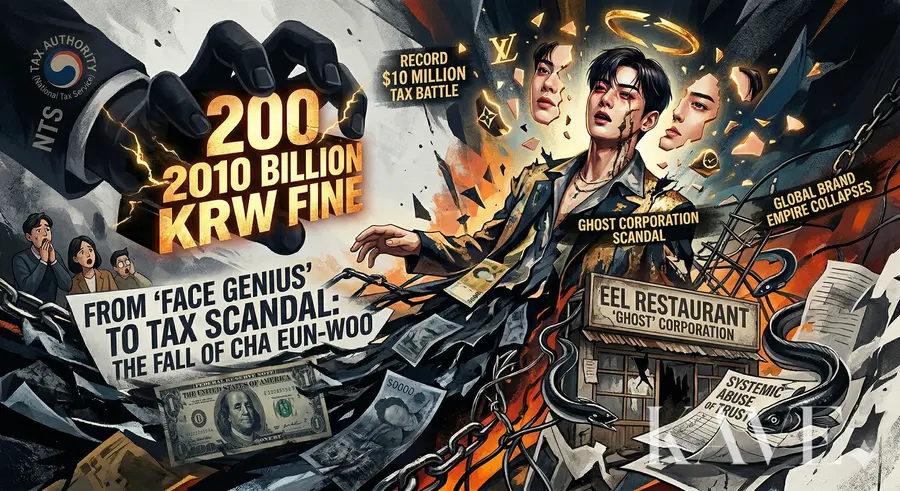
[Magazine Kave=Park Sunam Reporter] As of April 2026, South Korea’s pop culture and arts industry is engulfed in an unprecedented moral and economic crisis after a massive tax-avoidance scandal with no known parallel. The case involving Cha Eun-woo of ASTRO (the group’s member and a top-tier actor who has dominated both at home and abroad), who has been hit with a staggering income tax assessment—an initial notification amount of KRW 20 billion and an estimated final effective payment of about KRW 13 billion—has sent shockwaves throughout the entire industry. This incident is not a mere accounting mistake or ignorance by a single individual. Rather, it is a symbolic revelation of an organized and meticulously planned tax-avoidance mechanism that has surfaced: top stars, essentially “super intellectual property (IP)” engines that generate enormous wealth, the massive agencies that manage them, and the loopholes in the tax system that have been cunningly exploited.
In the past, tax controversies that frequently erupted in show business tended to remain at a one-dimensional level—such as excessive reporting of deductible expenses or simple omission of overseas income. But this matter surpasses earlier cases in both seriousness and malice, because it involved highly sophisticated financial and tax planning: bypassing a services contract structure with the agency through a paper company (Paper Company) under a family member’s name, unlawfully capturing the huge spread between corporate tax and individual income tax rates, and deceitful changes to legal entities to evade additional property acquisition taxes. Moreover, the fact that the Seoul Regional Tax Office’s Investigation Division 4—often called the “Executioner of Corporate World”—was dispatched on an urgent, extraordinary, non-regular special tax investigation confirms that the tax authorities are treating this not as mere evasion, but as an intentional and grave criminal act of tax-avoidance.
The case began in the first half of 2025. Investigation Division 4 of the Seoul Regional Tax Office launched a tough, non-routine special tax investigation targeting Cha Eun-woo and his agency, Fantagio. In South Korea’s tax administration system, the status of Investigation Division 4 is exceptional. Unlike other divisions that handle routine tax audits, Investigation Division 4 is an extraordinary special dedicated team that storms in without prior notice when clear signs are detected—such as the creation of slush funds, evidence of intentional tax avoidance, or fatal accounting fraud by large corporations.
According to tax attorney Bora Moon, a former National Tax Service investigator, the very fact that Investigation Division 4 was deployed directly into an individual entertainer’s tax investigation is a strong judicial signal that the National Tax Service believes the intentional tax evasion case is extremely likely. The initial main target was thought to be Fantagio, the corporate entity itself. However, during an intensive fund-tracing process, the investigation followed a trail of abnormal fund flows involving “Company A,” disguised as being operated by Cha Eun-woo’s mother, Choi M.” From there, the scope of the inquiry expanded fully toward Cha Eun-woo personally and the family’s corporate entities.
After completing meticulous internal reviews and on-site inspections, the National Tax Service notified Fantagio of an additional KRW 8.2 billion assessment, and also delivered an assessment exceeding KRW 20 billion to Cha Eun-woo and Company A. This was recorded as the highest-ever single tax assessment imposed on a South Korean entertainment figure. The reason the tax authorities drew such a heavy “punitive tax” weapon is that they concluded the tax-avoidance rationale attempts by Cha Eun-woo’s side had reached a level that threatened the Act on Aggravated Punishment of Specific Crimes (Special Act)—a very serious matter. Under the Special Act, when the amount of intentional tax avoidance exceeds KRW 1 billion, it can lead to imprisonment with or without hard labor, or a term of imprisonment of five years or more.
Right after the National Tax Service issued the notification of assessment in the KRW 20 billion range, Cha Eun-woo’s side immediately appointed a major law firm and pursued a pre-tax assessment reconsideration (challenge) seeking a review before paying, taking a tight legal response against the authorities’ decision. Fantagio’s initial position was that it would clarify matters according to proper procedures on questions of legal interpretation and application. But once the evidence pointed to clear tax-avoidance indications with little room for dispute, Cha Eun-woo’s side ultimately conceded and, on April 8, 2026, officially announced through his social media (SNS) accounts that he had paid the full assessed amount, fully accepting the tax authority’s decision.
One interesting point is that while the assessment size was initially reported as KRW 20 billion, it was adjusted to around KRW 13 billion during the actual payment process. Some in the media and among the public suspected that the tax authorities granted an unfair reduction benefit. However, this was purely an accounting outcome stemming from the tax administration’s “duplicate taxation refund procedures.”
According to Fantagio’s official position and the explanation from the tax representative, as Cha Eun-woo fully paid the enormous individual income tax imposed by the National Tax Service, a refund procedure was initiated regarding the parts of corporate tax and value-added tax that had already been paid under the past corporate entity “Company A” (a paper company under the mother’s name) but were taxed redundantly. In other words, because the National Tax Service treated Company A’s corporate identity as a nonexistent “ghost company,” denied it entirely, and attributed the income directly to Cha Eun-woo personally—imposing comprehensive income tax at the highest tax rate—the taxes previously paid by that nonexistent entity became legally invalid and were set off (refunded). Only the money that actually came out of the pocket decreased to KRW 13 billion; the National Tax Service’s original tax-avoidance indications amounting to KRW 20 billion and the tax rationale itself were not damaged in any way. The assessment amount still remains a dishonorable record as the largest ever in the entertainment industry.
To understand the essence of Cha Eun-woo’s tax evasion case, you can’t just look at the outcome of having paid “less tax.” You have to closely examine the mechanism of the tax scheme and the detours they designed. Experts point out that this case is a meticulously planned and organized tax crime that takes extreme advantage of the loopholes in the “one-person agency” system that has become entrenched in show business.
South Korea’s current tax system applies very strong progressive tax rates to high-income earners. The top marginal tax rate applied to super-high-income freelancers like Cha Eun-woo or to individual business owners reaches as high as 45%. With the addition of a local income tax of 10%, the effective top rate can rise to 49.5%. In other words, the structure requires paying nearly half of the revenue to the state. Meanwhile, the corporate tax rate applied to corporations such as stock companies varies by taxable income bracket, but is generally in the range of about 9% to 24%, and in practice a notably low rate around 20% is applied.
According to the results of the tax authorities’ investigation, Cha Eun-woo excluded his personal name with precision at the stage of receiving settlement payments, despite being affiliated with a large management agency (Fantagio) that oversees his management work. Instead, he dispersed the income through a distorted method: signing double management services contracts between Fantagio and Company A, established under the name of his mother, Choi M. This allowed settlement payments that should have been attributed to the individual—where income tax as high as 49.5% should have been applied—to be diverted to a family corporation, thereby applying only a corporate tax rate in the 20% range. It was a classic trick of “setting up a shell corporation for the purpose of tax evasion,” aimed at unlawfully capturing an enormous tax gain of 20 percentage points or more.
If Company A had truly been a legitimate company with the proper functions and substance to support Cha Eun-woo’s entertainment activities, then it would have been tolerated as a lawful tax-saving (Tax Saving) action within the boundaries of current law. The single most decisive standard separating tax evasion from tax saving is the “Principle of Substantive Taxation,” one of the core doctrines of the tax law. According to an analysis by Myung-gyu Kim, a business consulting expert who is also a lawyer and accountant, for a corporation to be recognized as legitimate and enjoy tax benefits, it must have “substance” in its business—such as an independent office and human resources that actually carry out management work.
However, the substance of Company A uncovered by the tax authorities was shocking. The company’s registered address for its head office was a building that used to be operated directly by Cha Eun-woo’s parents—a specialized eel restaurant location in Ganghwa-gun, Incheon (currently closed). Bora Moon, a tax lawyer and former National Tax Service investigator, questioned sharply, “How could management services for a top national star like Cha Eun-woo be provided in the space of an eel shop?” She pointed out that the physical mismatch between the nature of the industry and the location went far beyond what would be considered common sense. Since there was no real substance of providing work, or human and physical support, to the affiliated entertainer, the National Tax Service regarded it as a perfect disguised paper company set up solely to capture tax benefits, denied its corporate identity (Piercing the corporate veil), and then issued a tax assessment order combining the income for individual income tax.
A further decisive clue shows that the tax authorities became convinced that this was not mere ignorance or an accounting processing error, but an intentional and meticulous tax-avoidance scheme. Cha Eun-woo’s side secretly changed the legal form of the corporation from a typical stock company to a limited liability company, and during that process they quietly added “real estate leasing business” to its business purpose.
According to Bora Moon’s explanation, this was a rigorously calculated legal detour technique. Under the current Local Tax Act, if a corporation acquires real estate within the Seoul Capital Area’s overconcentration suppression zone, strong additional acquisition tax (acquisition tax surcharge) applies. But if the corporation’s location is moved and its legal identity is exploited as a limited liability company, there are tax blind spots where such additional taxation can be cleverly avoided. The National Tax Service judged that this series of deceptive steps was not a coincidence, but a greedy and malicious cover-up attempt to siphon off national tax revenue by mobilizing the best tax expertise and to indefinitely disadvantage an individual’s assets. Based on this, attorney Myung-gyu Kim estimated that of the total assessed amount of KRW 20 billion, roughly KRW 6 to 10 billion would be punitive “additional taxes” (a “price for lying”) caused by underreporting and delayed payment, aside from the principal amount. This inference underscores the severity of the situation.
In this case, one core party that absolutely must not be overlooked is the role and responsibility of Fantagio (Fantagio), the “original agency” responsible for Cha Eun-woo’s exclusive management. While a large agency continued for years paying huge settlement payments generated by its own signed artists to a third-party ghost corporation, the fact that no internal financial control mechanisms or compliance monitoring network (Compliance) worked properly exposes, in plain view, the chronic and fatal governance weakness common to Korean entertainment companies.
As a result of the investigation division’s intensive tax inquiry, Fantagio was also notified of a massive additional assessment of KRW 8.2 billion under names such as abnormal transactions with Cha Eun-woo’s corporations and deficiencies in fund accounting treatment. This is a question of legal responsibility—beyond simply turning a blind eye to an artist’s tax evasion—as a possible co-conspirator or helper who opened the channel for tax avoidance. As the controversy intensified, Fantagio issued a long apology statement through its official website. They said they failed to sufficiently check the matter in advance and recognized seriously that there were shortcomings in their management process, and that they deeply regret it and reflect on it. They also promised, “We will carry out practical system improvements, including fully reexamining our current internal management structure and decision-making process and strengthening advance verification procedures, including tax and legal review.”
However, industry experts and legal professionals criticize that such post-facto, late apologies and explanations distort the essence of the matter. Fantagio’s internal practice of structural tacit approval of tax evasion is not the first time. Coincidentally, top actor Sun-ho Kim, who was also under the same agency, was caught only a few months earlier, around February 2026, in a very similar tax evasion suspicion using a one-person corporation established by his family. At that time, Kim’s side added a large additional payment of omitted individual income tax on top of the corporate tax already paid, according to the National Tax Service’s findings, and rushed to close that corporation immediately—showing a precursor to the Cha Eun-woo case.
What does it imply that one-person corporation tax evasion by the agency’s leading stars was detected one after another within the same company? It strongly suggests that entertainment agencies, in order to attract top-star artists—who are the company’s core cash cow—and maintain exclusive contracts for long periods, have routinely accepted and tolerated a distorted payment structure in which the artist side demands, as a matter of practice, settlement payments for the purpose of aggressive tax savings or explicit tax evasion (transferring sales to a paper company under a family member’s name). It is hard to believe that the agency’s finance and legal teams were unaware that the “eel shop corporation” was effectively a ghost entity with no real capacity for work or services. In the end, the Fantagio case is a bitter snapshot proving the distorted dynamics and moral hazard in the Korean entertainment industry—where even the minimum internal compliance monitoring network that listed companies should have becomes useless like paper in the face of a “super IP of absolute power” that can make or break a company’s fate.
In today’s mass culture industry, a star’s positive public image and the public’s support function as core intangible assets—so-called “Reputation Capital”—that generate massive profits on their own. Since debut, Cha Eun-woo earned the descriptor “face genius” for his sculpted looks, and with a diligent and courteous attitude, he also solidified a flawless, clean image as a “good young man,” enjoying premium status across all fields: advertisements, broadcasts, and dramas. But once evidence of an organized, intricately planned tax-avoidance scheme surfaced, the enormous reputation capital he had built over more than a decade collapsed overnight. What amplified public anger and betrayal feelings beyond control wasn’t only the sheer amount of evaded money, but also the moral hazard (Moral Hazard) and the public deception that were laid bare across the entire process of how the matter unfolded.
The sharpest criticism on the table was about his enlistment timing. In July 2025, when Investigation Division 4 of the Seoul Regional Tax Office’s intensive tax investigation was tightening its grip, Cha Eun-woo suddenly enlisted in the Army as an active-duty soldier and received an assignment to the military band position under the Defense Ministry’s support unit. When controversy flared, both his agency and Cha Eun-woo argued, “Due to a physical age situation where delaying enlistment any longer wasn’t possible, I had no choice but to enlist without fully completing the tax investigation procedures.”
But this explanation only poured fuel on cold public opinion. In South Korean society, the duty of military service carries sacred value, but it also includes a painful history of being used as a so-called “military run” (a blend of “military” and “run”)—a refuge chosen by celebrities who cause public controversy to temporarily evade relentless public condemnation and imminent legal pressure. Amid the urgent investigation into allegations of a tax crime in the hundreds of billions of won, the suspicion that he forcibly went into hiding through enlistment rather than cooperating earnestly with the investigation sparked deep public anger.
Eventually, on April 9, 2026, the situation escalated even further: an enraged netizen (person A) said through an online community that, “Yesterday, they once again strongly filed an official complaint requesting that Cha Eun-woo’s military band assignment be revoked at the Defense Ministry and reassigned to another position.” This is a symbolic incident in which the public’s severe sense of deprivation and outrage—stemming from the belief that a space meant for performing defense duties faithfully and reflecting shouldn’t be turned into a pardon or a hiding place for a celebrity with moral failings—is expressed through direct action.
Another shocking scene showing how far Cha Eun-woo’s moral indifference had reached was staged in the second half of 2025. On October 31, 2025—while he was already being investigated fiercely for tax evasion allegations in the hundreds of billions of won by Investigation Division 4 of the National Tax Service, and while he was even in active military service—Cha Eun-woo appeared on stage at the “2025 APEC Leaders’ Welcome Gala Dinner,” held grandly at the Lahan Select Hotel in Gyeongju, Gyeongsangbuk-do, and carried out an odd act as though he were observing cultural performances as the host.
The APEC leaders’ summit is the highest-authority international diplomatic event where leaders from the Asia-Pacific region gather. The fact that, as the “face” representing South Korea, the official host who welcomes distinguished guests from around the world at such a sacred stage was actually a suspect in a serious tax crime who had set up a paper company at the address of an eel restaurant to siphon off hundreds of billions of won in taxes owed to the state backstage creates serious cognitive dissonance. It is an act that seriously damages the dignity of national affairs for personal gain, and it became a decisive moment that made the public realize how meticulously calculated—and fabricated—his previously clean image truly was.
It’s also fatal that he didn’t stop at manipulating documents by exploiting legal loopholes; there were indications he thoroughly used mass media as a tool for private benefit. Registered at the location of the tax-avoidance base as the site of the paper corporation, the eel restaurant run by his parents at that address in Ganghwa-gun, Incheon had been cleverly promoted by Cha Eun-woo in the past through broadcast programs and his own social media.
In fact, he appeared on JTBC’s variety show “Mouthful GO” and showed deceptive behavior: bringing cameras along, visiting the restaurant operated by his parents, and actively introducing it to the entire nation as “Cha Eun-woo’s favorite local spot.” By exploiting his overwhelming recognition and the reach of television—a public good—he painted the hidden forward base of tax avoidance (the corporate address) as an ordinary family-run eatery, and even aimed for indirect economic benefits (the effect of a behind-the-scenes advertisement). While he acted the part of a kind, down-to-earth son on the surface, orchestrating a massive tax-avoidance scheme behind the scenes, this horrific double-dealing gave the fandom “Aroha,” which believed and supported him, and the broader public society at large an indelible sense of betrayal and ethical disgust.
Cornered on all sides, Cha Eun-woo—right after news broke that he had fully paid his taxes—posted a second official apology on April 8, 2026, through his social media. He said, “I fully respect the procedures and results of the National Tax Service, and to ensure no further confusion continues, I have paid all relevant assessed taxes in full,” and he bowed. In particular, regarding the controversial establishment of the family corporation, he insisted, “During a period when I experienced many changes and confusion while I was active, I established a corporation as part of a process to carry out my activities more stably. Looking back now, though, there were parts I did not sufficiently examine in that process, and the responsibility is not on my family or the company, but on me, all on me.” He further stated that he would not cowardly avoid the issue by saying, “I didn’t know” or “It was someone else’s judgment,” and took a resolute stance to carry every cross.
He has moved away from the official apology statements of past celebrities, which had been nothing but excuses on the surface, and instead takes a more refined and disciplined form that fully accepts responsibility. However, critics and public opinion are extremely harsh. In this apology statement, specific and truthful explanations about the case’s most essential core—“why on earth he established a ghost company at the address of an eel shop with no real substance,” “why he secretly changed the legal identity to a limited liability company to avoid the additional acquisition tax on real estate,” and “why he tried to process a massive flow of money of hundreds of billions of won through an abnormal and illegal structure”—are thoroughly omitted. Industry consensus is that it is practically impossible to restore the public’s trust, which has already fallen to rock bottom, in the short term with only generic, mechanical explanations wrapped in polished wording while leaving out the heart of the matter.
Ethical failings by people in the arts and entertainment sphere do not end merely with personal loss of honor. The advertising industry, which borrows an entertainer’s image to create brand value, and the global content production industry, where astronomical capital is invested, are the economic ecosystems that respond to reputational risk (Reputational Risk) most immediately and sensitively. The Cha Eun-woo incident became a cold, brutal case study showing how a personal moral lapse within this ecosystem directly turns into massive business disruption and economic loss.
As soon as Cha Eun-woo’s intentional tax-avoidance controversy spread uncontrollably through the media, global luxury brands and major advertisers at home and abroad that had put him front and center as a global ambassador (promotional ambassador) or main model launched a chain reaction of “cut-off” moves. High-end brands such as Christian Dior, which treats an ultra-luxury image as life itself, and Burberry, a British heritage fashion brand, are extremely wary that a serious ethical failing by the individual model could leave a damaging stain and cause harm to the noble heritage the brand has built over decades.
Accordingly, related industries are understood to have immediately stopped exposure for online and offline advertising campaigns featuring Cha Eun-woo and moved quickly to place contracts on hold and proceed with cancellations—taking visible steps to create distance. This effectively means the economic lifespan as an advertising model has received a death sentence. Moreover, depending on the development of the situation, if the “violation of the obligation to maintain dignity” clause in previously signed exclusive model contracts is triggered, Cha Eun-woo’s side could very possibly face lawsuits seeking the return of huge penalty-style liquidated damages amounting to several times the model fees already received. While the advertising world was able to draw a line quickly, the place that fell into the most serious situation of no clear way out was none other than the global mega OTT platform Netflix. Netflix was preparing for the worldwide release of the blockbuster original series “The WONDERfools,” starring Cha Eun-woo and mainstream actress Eun-bin Park as the two leads in the second quarter of 2026.
“The WONDERfools” is a superhero-ish comedic action adventure set against the backdrop of 1999, an era when doomsday/end-of-century beliefs were gaining momentum. It follows neighborhood bumblers who unexpectedly gain superpowers, battling villains threatening the peace of the city. Directed by Yong-sik Yoo, who previously sparked a syndrome with “Strange Lawyer Woo Young-woo,” and written by Dae-jung Heo, who adapted the ten-million-movie “Extreme Job,” it is a tentpole production that carried enormous industry expectations. In the drama, Cha Eun-woo plays the role of Lee Woon-jeong, a special recruitment public official of Haesung City who grows suspicious of a chain of missing-person cases and persistently digs in, while Park Eun-bin plays Eun Chae-ni, a character who unexpectedly gains superpowers, leading the central storyline.
But once lead actor Cha Eun-woo became the center of a tax-avoidance controversy in the KRW 20 billion range, the project hit a major obstacle. Among furious audiences, there was a strong boycott sentiment demanding that people refuse to buy or watch the actor’s works. There were also intense calls for Netflix to completely remove Cha Eun-woo’s scenes from the series, redo and re-edit the entire production, or even postpone the release indefinitely.
Nevertheless, Netflix officially stated, “We have not finalized details such as release date or promotional schedule yet, but there is no change in the fact that the series will be released in the second quarter of this year.” They reaffirmed their intention to push through beginning with the scheduled May 12 production presentation. However, considering the arrows of mounting criticism and the physical constraint of Cha Eun-woo’s military service, they decided to hold that day’s production presentation as a farce where Cha Eun-woo—who was at the center of the controversy—would be completely excluded, and only the rest of the cast and production team, including partner Eun-bin Park, would conduct the event.
Netflix’s forceful decision vividly reveals the bitter “Sunk Cost trap” that modern large-scale content production industries suffer from. When hundreds of billions of won have already been poured into production and filming and post-production are complete, completely removing one lead actor’s scenes effectively collapses the entire narrative structure’s organic flow and means starting over with new reshoots from the beginning. For the platform, that directly translates into an unbearable astronomical cost loss. So even while accepting a certain level of ethical criticism from public opinion, they chose an economically desperate measure: forcing global simultaneous release to recover the invested costs as much as possible and preserve at least minimal revenue.
For a similar logic, the event organizer at a local site in Japan also announced its intention to push ahead with Cha Eun-woo’s large photo exhibition “Afterimage,” scheduled to be held grandly in Tokyo starting April 28, 2026. They stated that it was a project whose legal contract was already fully finalized in August 2024, so it would proceed without changes according to the agreed schedule. The logic of capital has suppressed the ethical justification.
But in real society, the idea that an actor who is morally condemned for attempting intentional tax evasion driven by ruthless greed appears on screen as a heroic special recruitment public official who defeats villains, implements justice, and protects peace is a severe cognitive dissonance for viewers—and fundamentally undermines dramatic immersion. In the long run, this could backfire by fueling global consumers’ strong doubts about the platform’s strict corporate ethics standards and moral sensitivity. As K-content solidifies its integration into the global mainstream market as a major pillar beyond the local scene, producers and major platforms now face a new, harsher regulatory compliance era: casting decisions can no longer rely solely on an actor’s visual recognition or the size of a fan base. Instead, they must thoroughly verify, from the very early planning stages, the financial transparency and ethical eligibility (Background Check) of cast members.
Cha Eun-woo’s tax assessment case in the KRW 13 billion range is a historic milestone in which South Korea’s public authority firmly stepped back and issued a decisive retreat against the “tax-savings omnipotence” and moral indifference that had spread like a fungal infection throughout the entire Korean pop culture and arts industry. The practice of establishing one-person agencies under a family name and creating disguised paper companies—once dismissed within the industry as clever “legal detours for tax savings” aided by sophisticated help from large law firms and accounting firms—has now been clearly redefined as an undeniable “major tax crime.” It is a case that can no longer avoid strict judicial judgment or harsh punishment by the public.
The sharp insights and structural overhaul tasks left by the Cha Eun-woo case across the industry can be summarized into three broad dimensions.
First, the industry must painfully recognize that the tax authorities’ investigative capabilities and fund-tracing techniques have advanced dramatically. Tax authorities no longer fall for polished, perfectly assembled paperwork or plausible corporate formalities created by major law firms. They apply the “Principle of Substantive Taxation” strictly, carry out covert on-site inspections, and relentlessly trace who the final recipient of funds actually is—ultimately enforcing punitive taxation. Cha Eun-woo’s fatal misstep was extreme greed: while he spared no expense to pay for meticulous legal design costs using major law firms and tax accountants, he did not pay for the most basic fundamentals needed for the corporation to be recognized—such as building an actual business space (the eel shop’s closed location) and constructing the human resources capable of performing real management work. Instead, he tried to cynically capture only the benefits of the tax scheme. Starting from this incident, it is obvious that tax authorities will swing their blades of intensive, wide-ranging, and chain investigations against countless top stars’ one-person disguised agencies with similar fund-flow structures.
Second, a comprehensive and fundamental innovation of the internal control systems (Internal Control System) of entertainment agencies (agencies) is urgently needed. As seen in the chain of cases involving Fantagio and Sun-ho Kim, a servile practice where agencies put blind faith in the short-term revenue-generating ability of top stars with massive fandoms and accept the artists’ excessive and illegal settlement demands without even minimal legal verification or braking has ultimately come back as a boomerang—a massive managerial risk that threatens the company’s very survival. For K-entertainment companies to truly take off as global standard companies, they must operate a dedicated external compliance department with independent authority—at an accounting audit level capable of intervening in the process of signing exclusive artist contracts and settling astronomical amounts of money. Institutional supplements must also be supported to name in standardized contracts for arts and entertainment figures clauses that fundamentally block demands for transactions with clearly illegal ghost entities and impose strong penalties upon violations.
Third, a breakthrough improvement in ethical responsibility and civic consciousness on the part of those working in mass culture and entertainment is essential. The immense wealth and noble social reputation enjoyed by top stars are not just personal innate talents; they are social and privileged intangible assets formed entirely upon the public’s blind love and positive attention. However, as South Korean citizens, acts that deliberately and meticulously bypass the duty to pay the proper taxes they naturally owe—and use clever tricks to indefinitely privatize social capital—are no different from antisocial conduct that brutally breaks the implicit social contract of trust with the public. Even if they issue the most refined and polished apologies and hastily pay the assessed lump sum of KRW 13 billion in full afterward, it remains impossible to restore the public’s trust that was shattered and the reputational capital that was damaged to its original state. This case proves that too clearly to ignore.
In the end, Cha Eun-woo’s tax assessment case will be recorded in history as a decisive and painful precedent that warns that if the K-entertainment industry—one that has been repeating breakneck advanced growth fueled by the global K-Pop and K-Drama syndrome—fails to build a transparent and modernized financial foundation commensurate with its dazzling external expansion scale, it could collapse just as brutally as a castle built on sand at any moment due to even a small shock. Going forward, across the entire mass culture and arts industry, the urgent requirement is that transparent and fair settlement models that fully comply with the principles of tax justice be established as the standard, and that industry-wide efforts to cleanse the system—so that firm ethical standards are internalized as the top priority value and an unchangeable rule for every entertainment business—be demanded more urgently than ever. We stand at a turning point where that effort is no longer optional.