


In the middle of the banquet hall, smoke begins to rise from the feast. But no one notices. The mother (Go Doo-shim) is embarrassed because of her unemployed son, the father (Kim In-hwan) is struggling to maintain face, and the siblings are caught up in a scuffle with the wedding staff; everyone's radar is fixed solely on 'family honour' and 'the progress of the feast'. The movie 'Exit' opens with a suffocating family birthday party scene, reminiscent of climbing Everest without an oxygen tank.
The protagonist Yong-nam (Jo Jung-suk) was a rising star in the mountaineering club during his university days. However, in front of the massive wall of society, he repeatedly falls as a long-term unemployed person. At home, he is a burden, and at friend gatherings, he always mumbles, "I’m just... looking into various things." Today, he is reluctantly working as a waiter at the banquet hall due to his mother's insistence, moving around like a transparent person, shoulders hunched.
But then, one person catches his eye in this dreary banquet hall. It’s Ui-joo (Im Yoon-ah), a junior from the same club. Now, she works as a full-time employee in the event team of this building, literally a 'junior who has succeeded in a turnaround'. Yong-nam shows awkward friendliness mixed with joy and inferiority, but Ui-joo maintains a professional distance behind her awkward smile. Between them lies a gap filled with brilliant past memories and a harsh present. The film wraps this subtle air in comedy but brews it with bitterness.
Meanwhile, the city faces a crisis on the verge of explosion from a completely different direction. A mysterious toxic gas begins to erupt in various places in the city. At first, the white smoke rising from afar quickly turns into a deadly gas that knocks people down with just a breath. The street outside becomes a hellscape, and people collapse onto the asphalt without a chance to escape. The banquet hall is no exception. As bizarre smoke seeps in through the window, the moment someone gasps for breath and collapses on the floor, people finally realise they have fallen into the middle of a disaster movie.
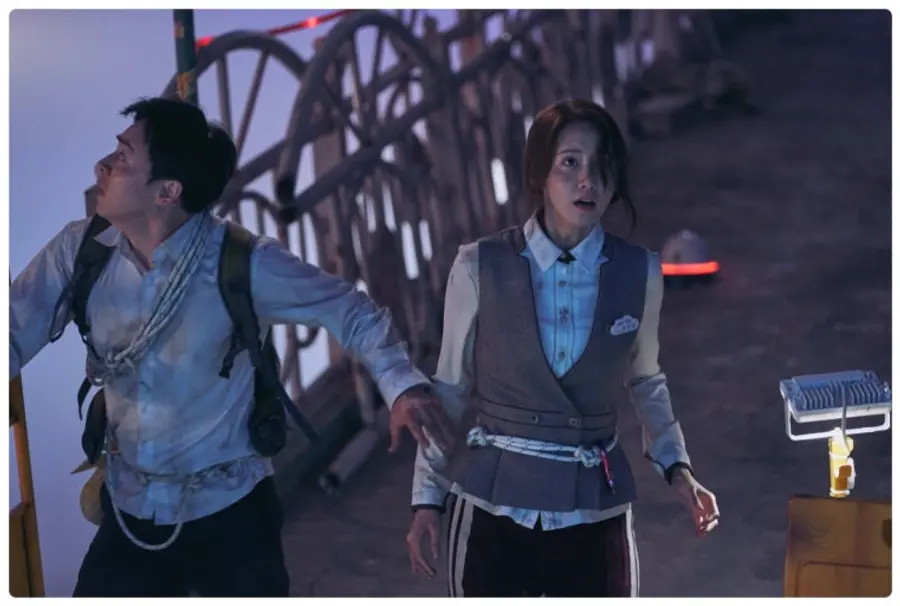
From this point on, the film shifts into high gear. The toxic gas, being lighter, rises and swallows the first, second, and third floors of the building in succession. There is only one choice for survival: "Climb to a higher place." However, this is where Yong-nam's previously 'useless' past suddenly shines. The skills of a young man who was the best climber in the mountaineering club transform into the only unique skill that can save his family and others in an instant. Climbing the railing, scaling the outer wall, and setting up ropes to create rescue routes become Yong-nam's responsibilities. Ui-joo also revives her experiences from the club days, working alongside Yong-nam to explore survival routes inside and outside the building.
Facing disaster comically
As the entire city is engulfed in white toxic gas, the film actively utilises the 'perspective looking down from above'. The camera persistently lowers its gaze to the streets, imprinting on the audience the fact that 'falling down there means the end'. Yong-nam and Ui-joo leap between rooftops, using air conditioning units and signs on the outer wall as stepping stones. The height of the gas continuously rises, and the safe zones they can secure become increasingly narrow. While the scale of the disaster grows, the film tightly focuses on the two people, one family, and one building. I won’t mention here how they send rescue signals and find clues for escape as the conclusion approaches. The last few scenes of 'Exit' are surprisingly exhilarating and humorous for a disaster movie.
Twisting the twisted reality of Korea
'Exit' appears to be a typical disaster escape drama on the surface. It follows the basic formula of the genre like a textbook: a threat element of toxic gas, limited space, a shrinking safe zone over time, and an ordinary character transforming into a hero. However, what makes this film interesting is that it precisely fits that formula into the specific realities of Korean society.
Yong-nam is the most common face of Korean youth in the 2010s. He has decent qualifications but struggles to find a job, often hearing at home, "What on earth are you doing with your life?" He seems like a climber endlessly trying to scale a wall with a rope called a resume, but every time his hands slip, he falls. The shame, awkwardness, and discomfort he feels at family gatherings in the early part of the film press down on the audience more than the disaster itself.
At this point, the setting of climbing operates as a metaphor beyond a simple action device. Hobbies and youthful times that cannot be quantified by studying for exams, qualifications, or certificates are often treated as 'useless things'. However, 'Exit' suggests that those "useless things" can become abilities that determine survival at certain moments. The scene where Yong-nam climbs the building's outer wall appears as if he is pulling up all the times he found difficult to explain to others in his life. The experiences he had not for his family or society but for his own enjoyment ultimately save himself and others. This structure resonated deeply with the audience.

The directorial tone is also exquisite. While maintaining the fear and tension typical of disaster films, it never lets go of the laughter until the end. In the scene where they rush to the rooftop to escape the gas, the club-like banter of "I’ll grab the blue one!" and "There’s a hold over there!" flows like a casual conversation. Even when setting a rope, standard climbing terms and actions appear, making the scene feel like a plausible event rather than an exaggerated 'cartoon'. At the same time, the appearance of humans obsessing over trivial things even in a disaster situation creates a subtle black comedy.
Here, the energy of the actors plays a significant role. Yong-nam, played by Jo Jung-suk, is a character where his unique physical comedy and everyday acting are perfectly combined. When scared, he tends to shout louder, and even though his body is already halfway out, his face is contorted with fear; every detail, including the fact that he pulls out a rice cake covered in crumbs from his pocket during a crisis, stimulates both laughter and tension simultaneously. It feels like not Spider-Man but 'Spider Uncle' is climbing the building. Ui-joo, played by Yoon-ah, is not just a simple 'female lead'. She skillfully organizes the ropes and assesses the situation to devise rescue routes, acting as a practical partner. Between them, there is a strange sense of camaraderie and motivation instead of a clichéd romance. The senior and junior who once sweated together in the club are now pioneering routes against the backdrop of the city.
The mise-en-scène and spatial utilisation cannot be overlooked. Most of 'Exit' takes place in very limited spaces like banquet halls, rooftops, surrounding building exteriors, stairs, and emergency exits. However, the film endlessly splits that narrow space in detail, utilising it in all directions. They hang ladders, tear down banners to make ropes, and use rooftop water tanks, signs, and air conditioning units as stepping stones. By focusing on vertical movement rather than horizontal, it showcases the essence of 'climbing action', which is rare in Korean disaster films. The audience finds themselves gripping their seats tightly, feeling as if they are climbing the outer wall themselves.
From a social context, 'Exit' does not overtly present the dark reality of Korean youth but intricately embeds it in every corner. The scenes where Yong-nam feels humiliation mostly stem from the frame of being the "unemployed child". The family does not come off as entirely bad people. The parents are just flustered between worry and face-saving, and the siblings are busy trying to survive in their own ways. Without making anyone a villain, it accurately touches on the feelings of the youth generation, questioning 'Am I a useless person?'. The structure where such a character finally confirms the value of their abilities in a disaster situation leaves a simple yet profound aftertaste.
Of course, it is difficult to say that this film is perfect. It hardly addresses the causes of the disaster or the subsequent social repercussions, and the setting of toxic gas is somewhat close to fantasy. There is also an impression that the focus is excessively on the protagonist family compared to the extensive scale of damage. However, 'Exit' is primarily a work focused on "an ordinary youth breaking through physically" rather than the politics of disaster or system critique. Within that intent, it performs its task commendably and quite cleverly. The emphasis on physical comedy, ideas, and spatial utilisation instead of emotional excess or unnecessary melodrama is also a strength.

A rescue signal you won't forget after one viewing
For those who want to watch a disaster movie but want to avoid overly bleak and heavy works, 'Exit' fits perfectly. This film certainly deals with a situation where the entire city is in crisis, but it never weighs down the audience's heart until the end. Even in the midst of crisis, it maintains laughter and vitality, and by the time the ending credits roll, one feels strangely refreshed. A strange confidence arises, saying, "Well, my body is still somewhat useful."
Additionally, I would like to recommend it to young people who are belittling themselves due to employment and career issues. 'Exit' is not a film that presents solutions. However, it shows the imagination that abilities, hobbies, and experiences that adults have not acknowledged and that one has deemed trivial can shine from a different angle. The message that "what you are doing now may save you someday" may sound exaggerated, but it comes across as sufficiently persuasive within the medium of film.
Finally, for audiences who want to see how Korean commercial films can mix genres and realities, comedy and action, 'Exit' is an excellent example. After watching this film, one might think, "Even if my life seems on the brink of disaster, should I try moving my body at least once?" Without grand lessons, it has the power to make the audience's bottoms wiggle slightly. That might be the most precious advantage of 'Exit'.