

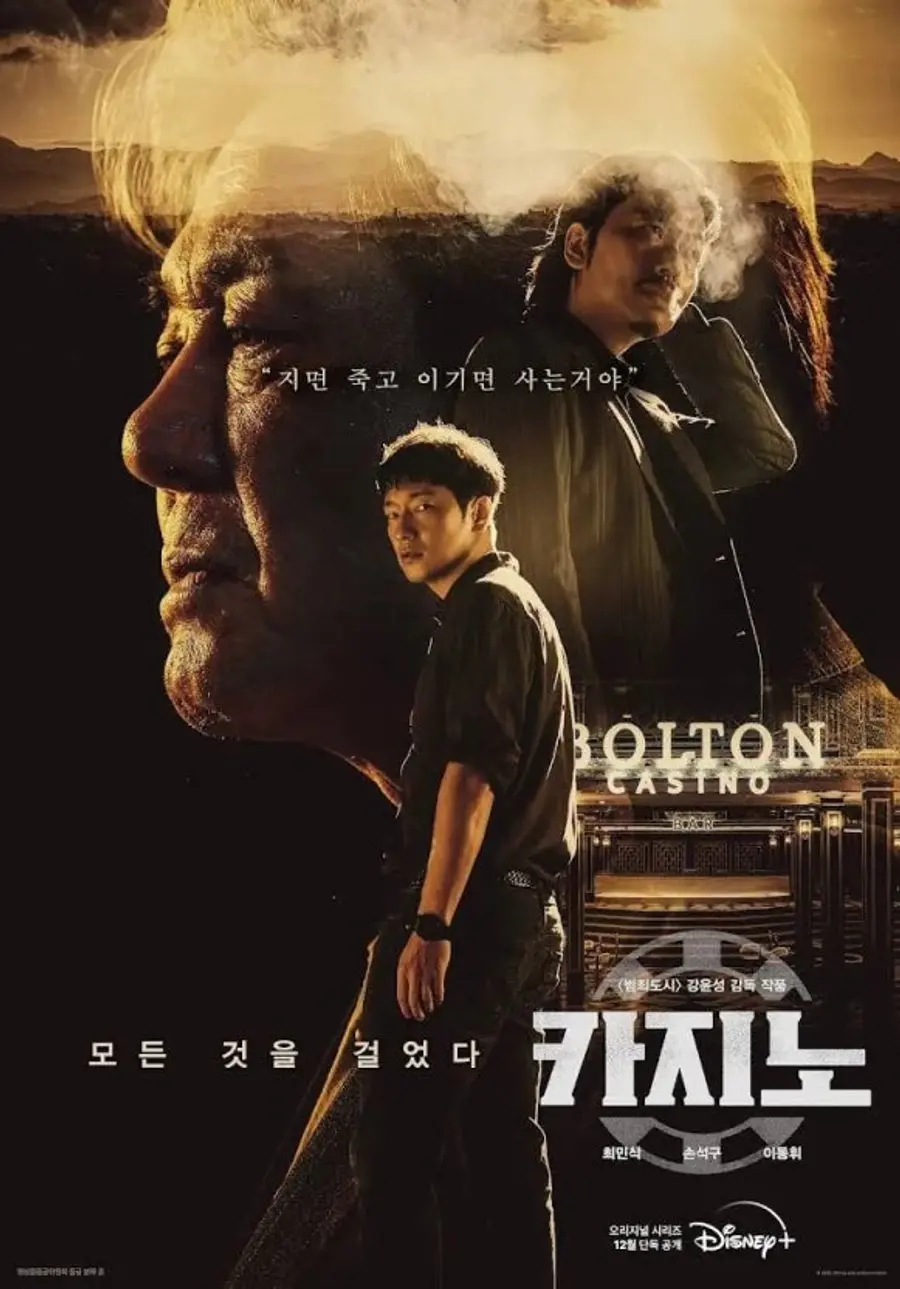
In the heart of a Philippine casino where the lights do not turn off until dawn, the sounds of chips mixed with Korean chatter and cigarette smoke fill the air. It feels like a scene from a mafia movie, but not in Italy, rather in Manila. At the centre stands a man, Cha Mu-sik (Choi Min-sik), a legend in the casino industry and an icon of self-made success. The drama 'Casino' relentlessly follows how this man rose from a penniless student to the king of overseas casinos, only to find himself once again at the centre of a police investigation. Simultaneously, it intertwines the perspective of Korean police officer Oh Seung-hoon (Son Seok-koo), who relentlessly pursues him, and the fear that spreads through the Korean community in the Philippines, creating a 'money-scented' crime epic.
The story traces back to Mu-sik's childhood. Poverty, violence, and a life in a rural area without connections. He chooses money over school, learning the 'language of money' through petty gambling, currency exchange, and loan sharking. It’s as if he is learning business in the back alleys instead of an MBA. As an adult, Mu-sik sets up an English academy, seemingly rising to local prominence, only to taste downfall due to academy corruption and fraud. Despite frequent visits to the police station and enduring tax investigations, he clings to one obsession: "I will get back on the board no matter what." Like a zombie, he rises again and again, a capitalist immortal. This obsession ultimately leads to illegal currency exchange and overseas gambling facilitation, naturally pushing Mu-sik onto the grand stage of Philippine casinos.
When Cha Mu-sik arrives in the Philippines, he is not an 'emperor' from the start. He cautiously gathers Korean customers, watching the local brokers, while slowly planting his own people by managing currency exchange and betting. Like the first move in a chess game, it is slow but meticulous. Beside him is his right-hand man Jeong-pal (Lee Dong-hwi), who has been with him for over a decade. Jeong-pal is a character who shows both desire and anxiety, and if Mu-sik gives the order, he is the type to say, "Hyung-nim, let’s give it a try" and throw himself into action. Together, they navigate the tangled interests of local Philippine forces, Korean gangsters, police, and politicians, growing their casino business. As the stakes rise, so do the commissions, and 'big players' from Korea start seeking Mu-sik. Before long, he becomes a name that anyone who spends money in the Philippines must encounter. Like a drug cartel boss, but instead of dealing with cocaine, he handles gambling addiction and currency exchange fees.
Where Money Gathers, Bodies Also Gather
However, where money gathers, blood also flows. This is an unchanging truth of capitalism. Betrayals and murders erupt surrounding Mu-sik's business. A customer who could not repay his debts is found dead in a Philippine alley, and an organization member who touched the casino's betting money is dealt with brutally. In Korea, news reports state, "Only Koreans are dying in the Philippines," hinting at potential diplomatic issues. The character digging into these incidents is Oh Seung-hoon (Son Seok-koo), a former violent crimes detective now assigned to the Philippine embassy. Oh Seung-hoon investigates the case with the help of local police but soon senses that the murder case is entangled with the Korean government, intelligence agencies, and Philippine power elites. Like peeling an onion, each layer reveals deeper corruption.

Alongside intense scenes of violence, the drama also depicts the lives of the expatriates who have settled in the Philippines. Some become wealthy by using Mu-sik as a stepping stone, while others endure their days by revering him as a 'brother like the heavens'. For them, the casino is both a workplace and their only escape. It’s like the residents of a town where the coal mine has closed, clinging to a newly established factory. However, as the stakes grow, Mu-sik's world is no longer just their league. Public authorities seeking kickbacks, other Korean organizations eyeing casino profits, and local Philippine forces all rush in, causing cracks to appear in his kingdom. Like a sandcastle, it looks grand on the outside but can crumble with a single wave.
From this point on, 'Casino' shows Mu-sik's life as if dissecting it, moving between the past and present. The face of the child actor portraying his younger self overlaps with Choi Min-sik's current face, and scenes alternate between Korea and the Philippines, rural areas and casino halls, police stations and hotel suites. It’s reminiscent of how 'The Godfather Part II' intercuts between Vito Corleone's past and Michael's present. The drama persistently shows how each choice Mu-sik makes twists the lives of many people. On the other hand, Oh Seung-hoon insists on an investigation centred on "people, not money", gradually crossing more precarious lines. The two men, knowing each other yet not, slowly align their collision trajectories on the unfamiliar land of the Philippines. Like Al Pacino and Robert De Niro in 'Heat', they draw closer to each other even when not sharing the same screen. Who survives and what crumbles remains an area for the viewers to discover for themselves.
Crime Action + Capitalism Chronicle = The Evolution of Korean Noir
The most impressive aspect of 'Casino' is that it combines Korean-style crime action with a chronicle of modern capitalism. This work is not simply a myth of a gambling den where "bad deeds lead to ruin". It weaves the era of speculation and gambling that has continued since the Korean IMF crisis into the life of a real person, showing how the desires pushed out of Korea flowed into Southeast Asian casinos, the so-called 'Korea Macau'. The character Cha Mu-sik is a typical villain, yet simultaneously, he is a twisted face of the self-made success myth created by Korean society. He is a character who shows the peak reached after obsessively climbing up, never bending, and pushing forward with the belief that "as long as the results are good, that’s all that matters". Perhaps a dark version of Steve Jobs or Elon Musk, choosing the back alleys of Manila instead of Silicon Valley.
Supporting this world is the overwhelming performances of the actors. Choi Min-sik's Cha Mu-sik has the typical face of a 'brother' who laughs heartily on the outside while constantly calculating on the inside. However, in moments where the gap between laughter and anger, affection and cruelty shifts in mere seconds, the audience feels just how dangerous this character is. Particularly, when he notices the betrayal of a subordinate, the scene where he silently smokes a cigarette while subtly glancing is a textbook example of how fear is created without showing violence. Like a shark slowly approaching in the water, it proves that stillness can be more terrifying than action.

Oh Seung-hoon, played by Son Seok-koo, brings a completely different energy. He is a rough but unyielding detective, striving not to lose his empathy for the victims. Unlike Mu-sik, he does not have dazzling talents or a massive organization behind him. Instead, he is a character who endures with a tone that shouts, "A person has died, and you’re worried about jurisdiction?" Like McNulty from 'The Wire', he is a lonely knight fighting against the system. With Son Seok-koo's unique dry tone and penetrating gaze, Oh Seung-hoon becomes the 'centre of normalcy' that the audience can rely on until the end in this chaotic world. Like a compass, pointing north when everyone else is lost.
Kang Yoon-sung's Rough Realism... The Directorial DNA of 'Crime City'
Director Kang Yoon-sung expands the rough realism and sense of humour shown in the film 'Crime City' to fit the OTT series format. He contrasts the dazzling neon of Philippine casinos with the damp darkness of the back alleys, visually depicting "how small humans become in front of money". Rather than big explosions or car chases, the direction makes the confrontations, threats, and exchanges of glances in a small room feel heavier. It proves that a close-up can be more intense than a shootout.
Narratively, 'Casino' opts for a considerably long breath. Within the structure that moves between the past and present, Korea and the Philippines, Season 1 mainly deals with Mu-sik's growth narrative and business expansion, while Season 2 focuses on the full-blown fall and investigation, leading to a resolution phase. Thanks to this, each episode has the space to relatively calmly show "what waves this choice has caused in one person's life". It’s like reading a long novel, delving into a character's inner self chapter by chapter. However, this long breath can also lead to mixed feelings. The early episodes spend a lot of time explaining the characters' relationships and pasts rather than the events, which may leave some viewers feeling that it is "slow". For audiences accustomed to the Netflix era, it might feel too much like a slow burn.
One of the virtues of this work is that it shows the 'weight' of violence rather than the 'amount'. There are many scenes where someone is beaten, bleeds, and dies, but the direction focuses not on consuming that as thrilling action but on "how the lives of those around change when this one person dies". The death of a minor gangster changes the life of the junior who followed him as a brother, ultimately leading to Cha Mu-sik's own choices and diplomatic issues. Like a butterfly effect, one person's death creates a storm. Through this structure, 'Casino' coldly depicts the causal relationship between violence and money.
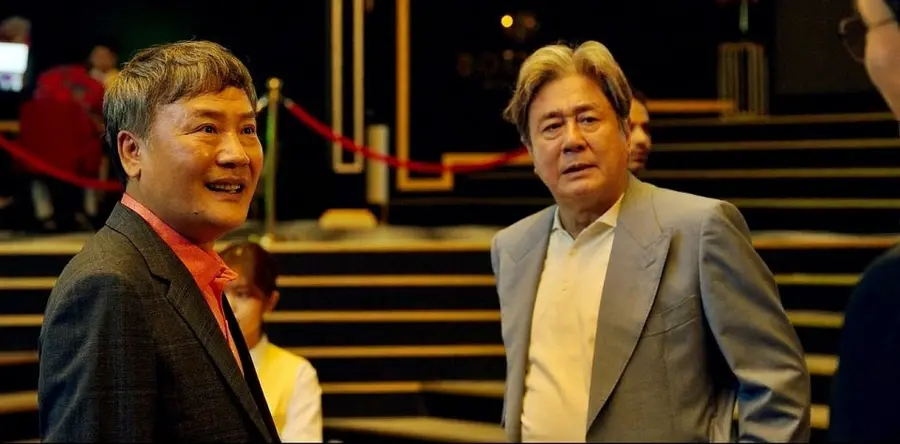
If You Want to Get Lost in K-Story
So, who can 'Casino' be recommended to? Viewers who enjoy slow but dense crime narratives are likely to become deeply engrossed in this drama. Especially if they enjoy the process of building tension through the expressions, dialogues, and cracks in relationships of the characters rather than flashy 'big moments'. It would particularly suit those who liked 'The Wire' or 'The Sopranos'. For those who want to see the names of actors like Choi Min-sik and Son Seok-koo alone, this work provides ample opportunity to witness the acting competition they expected.
Conversely, for viewers expecting fast-paced developments and flashy action from the start, 'Casino' may not be easy. This work shows the full-blown explosion only after sufficiently building the characters' pasts and relationships, requiring a certain level of patience. If you were expecting a 100-meter sprint, you might be disappointed, as it is more like a marathon. Due to the continuous appearance of violence, swearing, and morally grey choices, it may not be comfortable to consume as light entertainment.
Nevertheless, for those who want to feel at least once that "such crime dramas are possible in Korea", I would say not to miss 'Casino'. After watching this work, rather than simply wondering who died and who was injured, you will reflect on what remains at the end of all those choices and betrayals, and what board you are also standing on. Perhaps even after the last episode, the fluorescent lights of the Philippine casino and Cha Mu-sik's heavy breathing will linger in your ears. And that lingering sound will continue to remind us of the dark sides of our society. Like tinnitus, it will not easily fade away.