

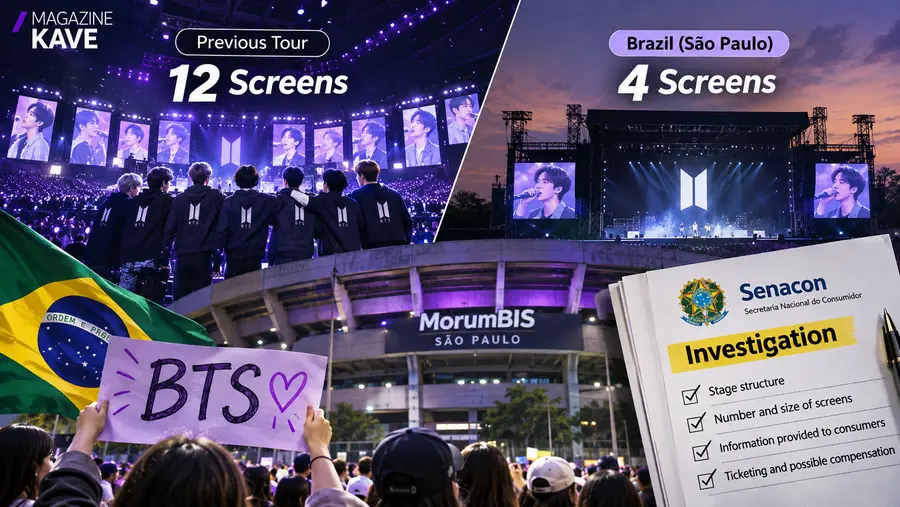
[MAGAZINE KAVE=Reporter Seo In-hye] BTS’s Brazilian tour has become embroiled in controversy over a reduction in the number of large screens, prompting an official investigation by local consumer authorities. The number of screens has been cut from 12 to four, while tickets priced at up to 4,303 reais (VIP) have been sold, putting the question of whether the organisers gave advance notice at the centre of the dispute.
A major concert has two stages: the one the audience actually sees, and the one they pictured when they bought their tickets. The further apart those stages are, the more trust becomes an issue, regardless of the quality of the performance itself.
That gap is now at the heart of the controversy surrounding BTS in Brazil.
BTS will perform on 28, 30 and 31 October at MorumBIS Stadium in São Paulo, Brazil, as part of their ‘ARIRANG’ world tour. But ahead of the opening show, the ARMY fandom’s attention is focused not only on the new setlist or stage outfits, but also on the venue’s large screens.
Twelve LED screens were used on earlier tour dates in South Korea, the US, Europe and Mexico. By contrast, the South American tour is using four screens mounted on a central structure. In terms of numbers alone, that is a third of the previous total.
But seeing this case simply as a comparison of ‘12 versus four’ is only seeing half the picture.
A one-third reduction in the number of screens does not necessarily mean that the value of the concert or the viewing quality has fallen by the same proportion. The actual viewing experience depends on factors including screen area, installation height, viewing angle, resolution and distance from the seats.
The question is what sort of concert fans expected when they bought their tickets, and how accurately the organisers provided the information on which those expectations were based.
518 complaints… fandom’s grievances lead to official government investigation
The controversy over BTS’s Brazilian concerts began in online fan communities, but has now moved into the realm of consumer affairs.
On 22 October, the National Consumer Secretariat (Senacon), part of Brazil’s Ministry of Justice and Public Security, formally requested explanations from concert promoter Live Nation Brazil and ticket seller Ticketmaster Brazil.
The government is not questioning only the number of screens. It wants to establish when the stage layout for the Brazilian concerts was decided and how that information was communicated to ticket buyers.
The documents requested by Senacon include the number, size and location of the screens; the technical and operational reasons for changing the layout; sightline assessments for each seating area; advertising and seating plans used when tickets went on sale; and consumer complaints and any compensation measures.
Procon-SP, the consumer protection agency for the state of São Paulo, has also taken action.
According to local reports, Procon-SP received a total of 518 consumer complaints related to the BTS tour between January and 21 October this year. Of these, 460 concerned the concert layout, accounting for about 88.8% of the total.
These figures do not represent cases in which a defect or breach of the law has been proven. They do, however, show that the venue layout has become a major concern for ticket buyers.
Fans’ concerns are focused particularly on seats far from the stage. In a large stadium, where the distance between the audience and the performers can be considerable, LED screens are not mere decoration. They are an important way of conveying the performers’ expressions and choreography, as well as the camera direction.
The viewing experience can differ within the same venue depending on where the screens are installed.
That is why Brazilian authorities have requested sightline analysis for the entire venue.
Live Nation’s explanation… more important than a ‘smaller stage’ is ‘when fans were told’
In a statement issued on 26 October, Live Nation Brazil acknowledged that the South American tour’s stage layout differs from those used in other regions.
Live Nation said: “The four LED screens are positioned on the central tower and face different directions within the venue, and are designed to provide a 360-degree concert experience.”
It cited logistical and scheduling constraints to explain the regional differences. The implication was that the layout was an operational choice made to enable the tour to visit several cities in South America.
The company also said the Brazilian concert layout was reflected in the official event map published when ticket sales began in April 2026.
The explanation may settle one part of the debate, but it raises a new question.
Did the seating plan available when tickets were on sale give audiences enough information to understand the actual number of screens and the differences in sightlines?
The fact that the ticket-buying page showed the stage position and seating areas is not the same as consumers having been able to understand the visual layout of the concert accurately.
It is difficult to tell from a two-dimensional seating plan alone how many large screens there are, how high they are, or which seats can see them.
Of course, there is no automatic contractual obligation for the stage used at BTS concerts in other countries to be provided unchanged in Brazil. Expectations formed by fans watching footage of overseas concerts must also be distinguished from the conditions of the concert actually sold in Brazil.
So the central legal question does not end with ‘Why were fewer screens used than in other countries?’
Authorities must consider what information was provided at the time of sale and whether it adequately explained matters that were important to buyers’ decisions.
This is where an issue of concert production becomes an issue of consumer rights.
680-reais seats and a 4,303-real VIP ticket… the duty to explain is the same at every price
Ticket prices published by Ticketmaster Brazil varied considerably by seating type.
At the standard price, the Arquibancada, or stands, cost 680 reais; upper-tier reserved seats cost 980 reais; lower-tier reserved seats cost 1,080 reais; and standing-area tickets cost 1,250 reais.
VIP packages, which included benefits such as soundcheck access, were sold for 4,303 reais at the standard price. A separate service fee may apply to online purchases.
The price differences are clear. But the principle that consumers need accurate information about the main conditions of a concert applies regardless of the price of the ticket they buy.
Indeed, this case shows that high-priced VIP packages and standard tickets may involve different kinds of risk.
Buyers in areas close to the stage may be sensitive to their exact position and the routes through the venue. By contrast, those in seats farther away may depend more heavily on the size and positioning of the screens showing the performers on stage.
That is why comparing the value of tickets solely by the number of screens is not enough either.
The actual sightlines from each seating area, the visual information provided by the screens and the conditions communicated at the time of sale must all be considered together.
Article 6, paragraph III, of Brazil’s Consumer Defence Code (CDC) establishes consumers’ right to receive adequate and clear information about the characteristics of goods and services.
How this provision applies specifically to these concerts will depend on the findings of the authorities’ investigation. On the information made public so far, it cannot be concluded that Live Nation or Ticketmaster breached the Consumer Defence Code.
What is clear, however, is that the relationship between the technical specifications of the concert and the information provided to consumers is now the subject of official scrutiny.
Another dispute over a map… why did ‘PIT 1’ and ‘PIT 2’ appear?
Separate from the screens, another issue has been raised in Brazil concerning the seating plan.
The São Paulo Public Prosecutor’s Office (MPSP) has requested an explanation after concerns were raised about differences between the seating plan published when tickets went on sale and technical drawings included in official documents from the city authorities.
The issue concerns the ‘PIT 1’ and ‘PIT 2’ areas shown on the technical drawings.
The concern stems from the fact that these areas did not appear on the seating plan shown to ticket buyers. This prompted fears that, if separate viewing areas were set up close to the stage, they could affect existing buyers’ positions or sightlines.
Live Nation said the PIT areas would not be installed at the actual concerts and that the layout would remain as originally advertised.
The fact that PIT areas appear on technical drawings should therefore not be taken to mean that such areas will actually be set up at the venue.
The prosecutor’s office is seeking to establish how conflicting documents came to exist and which layout will ultimately be used.
The two disputes concern different matters, but they have one thing in common.
They both require verification of whether there is a difference between the concert’s actual layout and the layout described to buyers.
A new standard for K-pop’s globalisation
BTS’s global success has shown that Korean music can build a huge audience across languages and borders.
But securing a place in the global music market is one thing; creating the same production conditions in every part of the world is another.
Venues differ from country to country, as do the time needed to transport and install equipment, safety regulations, staffing and costs. Given these conditions, it is difficult to consider adjustments to a stage layout by a tour promoter inherently abnormal.
That said, operational constraints do not justify omitting information consumers need.
The Brazilian concerts leave the global K-pop industry with three questions.
Who decides when a concert’s layout differs from one region to another? When and how should promoters and ticket sellers explain this to buyers? And what remedies are available if the actual viewing experience differs from what was described in advance?
The specific decision-making and contractual responsibilities of BTS’s agency, HYBE, concert promoter Live Nation and ticket seller Ticketmaster cannot be determined from the information made public. It would also be premature to place the blame solely on the artists or on any one company.
Even so, one fact is clear.
Audiences at major concerts no longer judge only the finished stage. They are beginning to ask how the experience they bought was designed and sold.
The stage plans, sightline assessments and sales information requested by the Brazilian government are documents intended to answer precisely those questions.
When the first concert begins on 28 October, the dispute will enter a new phase. It will then be possible to see how the show looks from the actual seats and how closely the organiser’s account matches the audience’s experience.
Whatever the outcome, this case could set an important benchmark for the global live music industry.
The stages in Seoul and São Paulo do not have to be identical. But the right to know exactly what stage they will see should not depend on which side of a border audiences are on.
If fans’ passion for BTS fills the venue, the industry’s response to that passion should be trust.